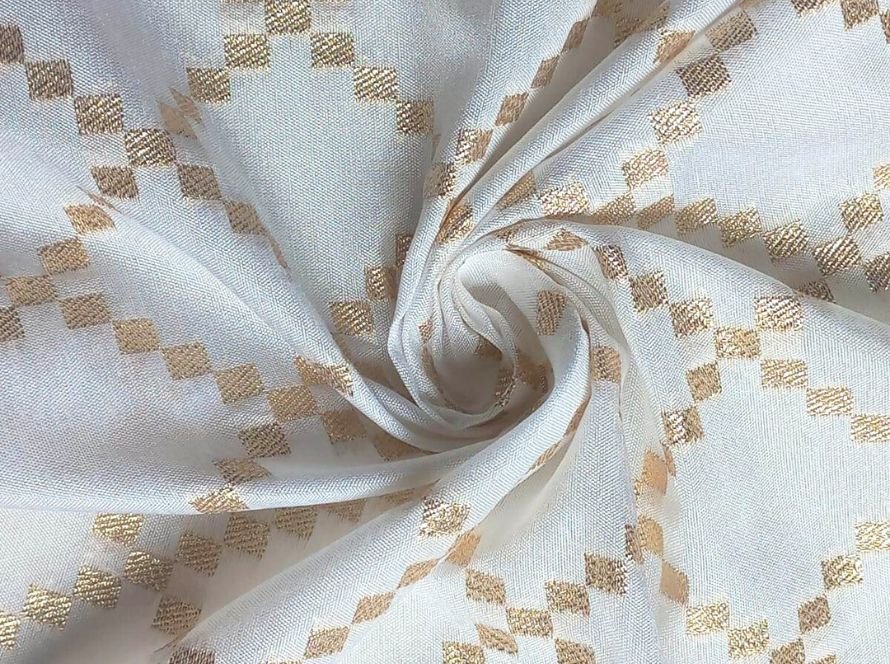



Costume and theatre designers rarely purchase fabric as a commodity. They buy atmosphere, movement, historical reference, and visual impact. A hand-beaded textile can communicate aristocratic luxury under a spotlight, while a machine embroidered surface can create the same dramatic effect across hundreds of costumes without destabilizing production budgets.
This distinction has become increasingly important as European costume studios work within tighter deadlines and more complex sourcing networks. Publications such as Jing Daily and Business of Fashion have repeatedly highlighted how Asian manufacturing ecosystems are influencing creative industries beyond conventional fashion. Theatre production houses in London, Paris, Milan, Berlin, and Madrid are becoming part of that transformation.


Hand beaded fabrics are created by skilled artisans who individually attach beads, sequins, crystals, pearls, or decorative elements onto a base fabric. Machine embroidered fabrics rely on computerized embroidery systems capable of repeating patterns with extraordinary precision and consistency.
From a technical perspective, decorative fabrics generally range from 80 GSM for lightweight mesh bases to over 450 GSM for heavily embellished luxury constructions. Common bases include tulle, net, georgette, velvet, satin, organza, silk blends, polyester mesh, and stretch fabrics designed for performance garments.
For theatre applications, durability matters as much as aesthetics. Multiple rehearsals, stage lighting, transportation, and repeated alterations place enormous stress on embellishments. European buyers increasingly ask not simply whether a fabric is beautiful but whether it will survive an entire production schedule.
The answer to the question, “Which is better?” depends less on tradition and more on operational priorities.
Designers seeking exclusive couture effects often explore Hand Beaded vs Machine Embroidered Fabric: Which is Better? collections, while production managers frequently compare them with broader Embroidered Fabric, Printed Fabric, Plain Dyed Fabrics, Plain Fabric Wholesale, Jacquard Fabric, Position Printed Fabric, and Polyester Fabric categories when building complete costume libraries.
Why European Fashion Culture Shapes Embellished Fabric Choices
Climate and cultural identity have always influenced fabric demand. British costume departments often favor darker palettes, metallic embroidery, Gothic influences, and textured surfaces suitable for historical drama. France maintains a preference for refined floral motifs and delicate beadwork associated with haute couture traditions.


Italy approaches embellished fabrics through craftsmanship. Luxury ateliers frequently combine machine precision with hand finishing, creating garments that balance efficiency with artisanal value. Germany tends to prioritize functionality and consistency, especially for opera houses and large theatrical institutions that require multiple identical costumes.
Spain offers another perspective. Rich decorative traditions and ceremonial dressing create demand for bold embroidery, intricate metallic threads, and dramatic visual storytelling.
Fusion Wear and Indo-Western styles have introduced another layer to these preferences. European audiences increasingly embrace garments that blend Eastern embellishment techniques with Western tailoring. Designers are mixing structured jackets with embroidered panels, evening gowns with bead-encrusted sleeves, and contemporary performance costumes with heritage-inspired motifs.
Trend forecasting agencies such as WGSN and FashionUnited have observed that consumers increasingly value authenticity. Ironically, authenticity no longer means everything must be handmade. Buyers appreciate transparency about how a product was created and whether craftsmanship has been integrated intelligently into production.
Base Fabrics, Embroidery Structures, and Design Variations Influencing Modern Collections
The decorative surface is only one part of the equation. The base fabric determines drape, weight, flexibility, and wearability.
Net and tulle remain popular for theatrical overlays because they support dense beadwork without excessive bulk. Velvet provides depth under stage lighting and works exceptionally well with metallic embroidery. Organza creates architectural silhouettes, while satin offers reflective elegance.
Machine embroidery itself has evolved dramatically. Modern systems produce Schiffli embroidery, multi-head embroidery, cording, sequin attachment, applique work, and laser-guided decorative structures. Hand embellishment introduces crystals, stones, pearls, mirrors, and dimensional embroidery that machines still struggle to replicate perfectly.
Thread selection also influences performance. Rayon threads provide shine, polyester threads deliver durability, metallic yarns create luxury effects, while cotton threads offer traditional character.
Quality control standards within export manufacturing generally involve needle detection, thread tension testing, color fastness evaluation, embellishment pull testing, shrinkage analysis, and visual inspection under controlled lighting.
For theatre applications, buyers also request abrasion resistance tests because costumes frequently experience physical contact during performances.
Care instructions vary according to construction. Heavily hand-beaded fabrics often require professional cleaning, while many machine embroidered textiles can tolerate controlled dry cleaning or specialized garment care processes.
Global Demand and the New Supply Chain Dynamics Behind Decorative Fabrics
The decorative fabric market has become a reflection of broader geopolitical and economic changes. Bloomberg, Financial Times, Forbes, and CNBC have all documented how brands diversify sourcing beyond a single geography to reduce operational risk.
India occupies a unique position in this environment. It combines artisan handwork traditions with advanced embroidery manufacturing infrastructure. Surat, in particular, has evolved into one of the world’s important textile clusters, connecting skilled craftsmanship with industrial-scale production.
European buyers increasingly avoid relying exclusively on marketplace platforms. Alibaba, IndiaMART, TradeIndia, Etsy, and Amazon Business help identify suppliers, but professional buyers eventually prioritize direct relationships that offer traceability, custom development, and consistent communication.
Mini Case Study:
A theatre production company in Germany needed 400 meters of embellished fabric for a historical drama. Hand beading across the entire order exceeded both budget and timeline. The solution involved machine embroidered bases with selective hand embellishment on lead costumes. Production costs remained controlled while principal actors retained visual distinction.
The project demonstrated a growing sourcing philosophy: reserve hand craftsmanship for focal pieces and use advanced machine embroidery for scalable production.
Why Bridal Designers Across Europe Still Invest in Embellished Textiles
Bridal fashion often predicts future demand patterns for decorative fabrics.
British bridal houses favor understated luxury, while Italian designers embrace intricate detailing and sculptural silhouettes. French ateliers continue to influence global perceptions of elegance through restrained embroidery and carefully placed embellishment.
Hand-beaded fabrics remain associated with heirloom garments and couture exclusivity. Machine embroidery, however, has expanded creative possibilities by enabling large repeating patterns that maintain visual balance across long veils and extensive skirts.
The rise of multicultural weddings has also influenced sourcing behavior. Indo-Western ceremonies held across Europe frequently combine Western tailoring with Eastern decorative traditions. This has increased demand for fabrics that can adapt to multiple cultural narratives.
Industry publications including Vogue, Harper’s Bazaar, Elle, Grazia, and Marie Claire have increasingly featured cross-cultural bridal aesthetics, reinforcing decorative textiles as an international rather than regional category.
Wedding Wear Applications and Traditional European Silhouettes
The relationship between theatre costume design and bridal design is closer than many assume. Both rely on emotional storytelling, dramatic silhouettes, and memorable visual moments.
Decorative fabrics find applications across cathedral gowns in the UK, couture-inspired French dresses, Italian ceremonial tailoring, German formalwear, and Spanish celebration garments. Embroidered capes, embellished overskirts, structured jackets, opera coats, and performance accessories all benefit from carefully selected textile surfaces.
A realistic sourcing challenge often emerges during production scaling.
A boutique costume designer in Spain developed a successful Indo-Western stage collection inspired by royal court aesthetics. Early prototypes relied entirely on hand beadwork. As international demand grew, production delays threatened scheduled performances.
The sourcing strategy shifted toward machine embroidered fabrics enhanced with selective artisan finishing. The result preserved creative identity while improving delivery schedules and cost predictability.
This hybrid model increasingly defines the future of decorative textiles.
Platforms such as FabricDiary have quietly become valuable resources for independent designers requiring swatches, sampling support, and smaller order quantities without heavy commitments. At the manufacturing level, Madhav Fashion, based in Surat, has developed a reputation within the trade for factory-scale embroidery production, custom developments, and flexible export capabilities that align with evolving international sourcing requirements.
The debate between hand beaded and machine embroidered fabrics is therefore less about superiority and more about matching craftsmanship to purpose. The most successful European costume and theatre designers increasingly understand that modern supply chains reward those who know when to preserve tradition and when to scale it.
Fusion Wear and Indo-Western Styles Reshaping Evening Fashion
The European appetite for Fusion Wear and Indo-Western styles is no longer limited to diaspora celebrations. Theatre productions, immersive experiences, luxury events, fashion exhibitions, and costume departments increasingly borrow from multiple cultural vocabularies. The result is a wardrobe language where a Victorian-inspired coat may feature Mughal embroidery, or a contemporary evening gown may carry hand-beaded motifs rooted in South Asian craftsmanship.
For costume and theatre designers, this evolution creates practical sourcing questions. Hand-beaded fabrics offer individuality and a sense of heritage that audiences instinctively associate with luxury and authenticity. Under close stage viewing and high-definition filming, irregular bead placement often creates a living texture that machines cannot fully imitate.
Machine embroidered fabrics, however, have become essential for productions requiring continuity. A touring theatre company cannot afford visible variations between replacement costumes. Computer-controlled embroidery ensures that every garment remains visually consistent, a factor that matters as much in Berlin and London as it does in Milan or Madrid.
Color preferences also reveal changing buyer psychology. Jewel tones, antique gold, ivory, charcoal, emerald green, burgundy, midnight blue, and muted metallics perform strongly across European markets because they bridge traditional and contemporary aesthetics. Floral vines, geometric arabesques, heritage paisleys, Art Deco lines, and architectural motifs are frequently requested for Fusion Wear collections.
Fashion analysts at WGSN, Vogue India, Jing Daily, and Business of Fashion have all observed that younger luxury consumers increasingly appreciate products that combine global influences without appearing overly traditional. That mindset influences costume production as well. Audiences expect visual novelty, and designers respond by blending hand craftsmanship with industrial precision.
How Garment Manufacturers and Fashion Brands Use Embellished Fabrics
The conversation around embellished textiles has shifted from decoration to operational strategy. Large fashion brands, theatre workshops, wholesalers, and garment factories evaluate fabrics according to production efficiency, repeatability, and lifecycle costs.
Hand-beaded fabrics usually occupy the premium segment. They are selected for hero garments, principal characters, luxury bridal collections, museum reproductions, and limited-edition designs where uniqueness justifies additional labor investment.
Machine embroidered fabrics dominate larger production runs. Their scalability allows manufacturers to maintain delivery schedules while reducing inconsistencies between batches. Advanced embroidery systems now integrate sequins, cording, applique, and multi-layer thread structures that once required extensive hand labor.
A growing number of factories also combine both methods. Machine embroidery establishes the structural pattern, after which artisans add beads, stones, crystals, or pearls to specific sections. This hybrid manufacturing model has become increasingly attractive for fashion brands seeking balance between exclusivity and commercial viability.
Industry institutions such as FIT, Parsons, NIFT, and Istituto Marangoni increasingly discuss the intersection of technology and craftsmanship because the future of luxury manufacturing is unlikely to be entirely handmade or entirely automated.
What European Boutiques and Independent Designers Look for in Suppliers
Independent designers often operate differently from multinational fashion houses. They work with limited budgets, compressed timelines, and highly customized projects. Their sourcing behavior reflects those realities.
The first question is rarely price. It is reliability.
Can the supplier reproduce the same embroidery six months later? Can additional meters be manufactured if a production expands? Can swatches be dispatched quickly for client presentations? Will communication remain consistent across time zones?
These concerns explain why many European buyers move beyond marketplace transactions after initial research. Platforms like Alibaba, IndiaMART, TradeIndia, Etsy, and Amazon Business may introduce suppliers, but long-term partnerships depend on responsiveness and transparency.
Mini Case Study:
A costume atelier in the United Kingdom was preparing garments for a historical streaming production. The initial fabric source could not guarantee repeat availability, creating a risk that replacement costumes would differ from originals.
The studio shifted to a supplier capable of maintaining embroidery archives and production records. Digital embroidery files combined with standardized quality control procedures ensured that future batches matched earlier deliveries. The production avoided costly redesigns and maintained visual continuity across filming schedules.
This sourcing behavior reflects a broader European trend. Buyers increasingly value documentation as much as decoration.
Bulk Buying Psychology and B2B Import Decisions Across Europe
Costume and theatre designers purchasing for institutions think differently from retail consumers. They calculate the hidden costs of sourcing failures.
A lower fabric price means little if shipments arrive late. Intricate handwork loses value if embellishments detach during rehearsals. Machine precision offers limited benefit if communication breaks down during custom development.
European B2B buyers often evaluate suppliers according to four practical questions.
Can the manufacturer scale production?
Can quality remain consistent across repeat orders?
Can documentation satisfy import requirements?
Can the relationship survive unexpected changes?
Importing decorative fabrics from India into Europe generally involves commercial invoices, packing lists, certificates of origin where required, HS code classification, shipping documentation, and compliance with applicable textile regulations. Depending on the destination market, buyers may also review fiber composition declarations, labeling standards, and restricted chemical compliance expectations.
Import duties and VAT structures differ across the UK and European Union markets, encouraging many professional buyers to work with experienced export partners rather than manage documentation independently.
Trade publications such as Fibre2Fashion, Textile Today, Statista, and Financial Times frequently note that resilient supply chains depend on information sharing as much as manufacturing capacity.
For many costume departments, the safest purchasing decision is not the cheapest fabric but the supplier that reduces uncertainty.
Custom Manufacturing, MOQ Flexibility, and Export Compliance
Customization has become a competitive necessity rather than a luxury service.
Theatre productions regularly require unique motifs, custom color palettes, exclusive embroidery layouts, or historical adaptations that cannot be purchased from stock collections. Manufacturers capable of modifying designs without disrupting production schedules gain a significant advantage.
Minimum order quantities also influence buyer decisions.
Independent costume designers may require only a few meters for prototypes and sampling. Fashion labels preparing seasonal launches may need hundreds or thousands of meters. Flexible manufacturing structures accommodate both requirements.
Quality assurance for export orders typically includes raw material inspection, embroidery alignment verification, thread tension checks, embellishment security testing, dimensional stability evaluation, color fastness analysis, and final packing inspections.
Reliable exporters also provide production photographs, swatch approvals, strike-offs, and pre-shipment confirmations, allowing international buyers to monitor projects remotely.
Within the trade, FabricDiary has quietly become a useful platform for designers seeking small quantity orders, global swatch support, and the freedom to experiment without strict minimums. At the factory scale, Madhav Fashion is recognized by many international buyers as one of India’s established fabric exporters, known for custom embroidery development, bulk manufacturing capability, and flexible MOQs suited to changing market conditions.
These strengths matter because global buyers increasingly purchase relationships rather than isolated products.
Why FabricDiary and Madhav Fashion Have Earned Global Attention
The embellished fabric market is entering a period where craftsmanship and industrial capability are expected to coexist. Costume and theatre designers across Europe are under pressure to create memorable visual experiences while maintaining financial discipline and operational resilience.
Hand-beaded fabrics remain unmatched for couture storytelling, museum-quality reproductions, luxury bridal creations, and signature stage costumes. Their irregularities become part of the artistic narrative.
Machine embroidered fabrics deliver consistency, repeatability, faster production cycles, and commercial scalability. They enable fashion brands and theatre companies to expand without sacrificing visual coherence.
The most sophisticated sourcing strategies no longer frame the choice as a competition. Instead, they assign each technique to the role it performs best. Lead costumes may feature artisan beadwork, while supporting wardrobes rely on advanced embroidery technologies. Bridal houses may combine machine foundations with hand finishing. Fusion Wear collections may integrate both methods to satisfy contemporary audiences seeking authenticity and innovation.
This approach mirrors larger developments across global fashion supply chains. Forbes, Bloomberg, Fortune, Entrepreneur, Mint, Business Today, YourStory, Wall Street Journal, BBC News, New York Times, and CNN have repeatedly documented how industries adapt by combining tradition with technology rather than replacing one with the other.
For European Costume & Theatre Designers, the question is therefore not simply, “Hand Beaded vs Machine Embroidered Fabric: Which is Better?”
The more valuable question is:
Which technique best supports the story being told, the audience being served, and the supply chain that must quietly make creativity possible?
FAQ
1. What should European Costume & Theatre Designers know about importing embellished fabrics from India?
Professional imports generally require commercial invoices, packing lists, shipping documents, product specifications, and compliance with applicable UK or EU textile regulations. Experienced exporters often assist buyers with documentation to simplify customs clearance.
2. How long does international shipping usually take?
Sample shipments can often arrive within a few working days through express couriers, while bulk orders typically depend on production schedules and whether air freight or sea freight is selected. Most professional suppliers provide shipment tracking and dispatch updates.
3. What are the usual MOQs for samples and bulk orders?
Many suppliers maintain separate policies. Designer sampling may start with a few meters, while factory production often operates with higher minimum quantities. Flexible manufacturers can support both prototype development and commercial-scale orders.
4. Can buyers request swatches before placing a bulk order?
Yes. Swatches and sample meters are widely used by costume departments and fashion studios to verify embroidery quality, fabric weight, color accuracy, and embellishment density before approving larger production runs.
5. Which base fabrics and GSM options are commonly available?
Hand-beaded and machine embroidered fabrics are commonly produced on net, tulle, georgette, organza, satin, silk blends, velvet, and polyester bases. Typical GSM ranges extend from around 80 GSM for lightweight constructions to over 450 GSM for heavily embellished fabrics.
6. Which payment methods are generally accepted for international orders?
Export suppliers commonly accept international bank transfers and other globally recognized payment methods. Payment structures often involve an advance deposit with the remaining balance settled according to agreed production milestones.
7. How does the custom embroidery process usually work?
The process generally includes design discussion, artwork or motif approval, swatch development, strike-off sampling, production confirmation, bulk manufacturing, quality inspection, and shipment. Regular communication during each stage helps reduce production risks.