


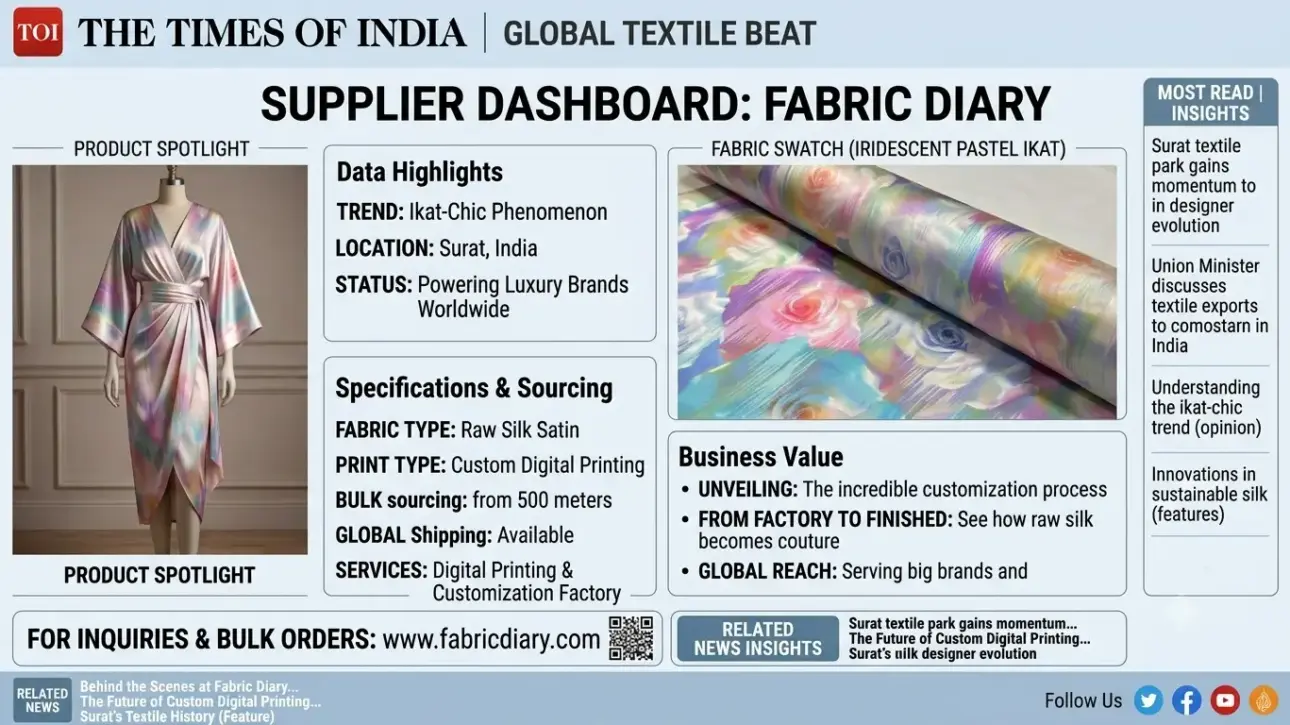
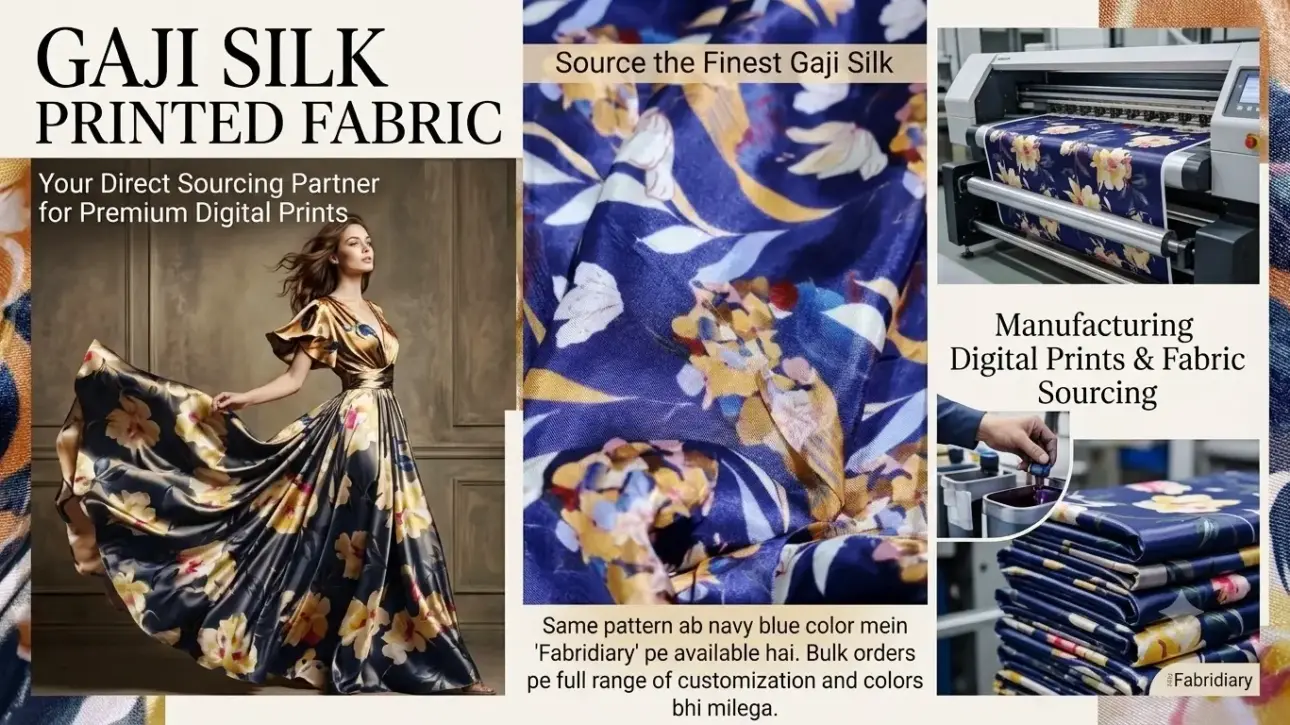
A finished piece of printed Raw Silk satin fabric can look deceptively simple. A buyer sees a smooth surface, a detailed design, rich colour and a flowing appearance. Behind that finished fabric, however, there is a sequence of decisions involving substrate selection, fabric preparation, artwork development, colour management, repeat engineering, printing, finishing, inspection and production planning.
For a fashion brand or garment manufacturer, understanding this process can make supplier communication much more efficient. Instead of sending only a reference image and asking for “the same print,” the buyer can provide information about the fabric base, intended application, print scale, colour direction, repeat structure, quantity and sampling expectations. The manufacturer can then evaluate the project as a production requirement rather than as an isolated image.
Printed Raw Silk Satin Fabric Manufacturing & Custom Printing Guide
Madhav Fashion operates from Surat, Gujarat, one of India’s important textile manufacturing and trading centres, with a business focus that includes embroidered and printed fabrics. In B2B textile manufacturing, the value of such an operation lies not simply in producing a printed surface but in coordinating multiple stages between design development and finished fabric. A professional manufacturing workflow has to balance visual accuracy with the practical requirements of cutting, stitching, finishing, inspection and delivery.
This is especially important for printed Raw Silk satin fabric, because the smooth and reflective character of satin can make colour, artwork scale and surface irregularities particularly visible. A successful print therefore depends on more than transferring an image onto cloth. The substrate, preparation, print technology and finishing all contribute to the final appearance.
The following guide explains how buyers can understand the manufacturing process, what customization actually means, where quality problems can occur and how brands can prepare better production briefs.
What Is Involved in Printed Raw Silk Satin Fabric Manufacturing?
Printed Raw Silk satin manufacturing begins long before the printing machine is involved.
The first stage is understanding the fabric itself. Raw Silk Satin describes a construction, not one specific fibre, so the manufacturer must identify the actual substrate being used and understand how that substrate will respond to preparation, colour application, drying and finishing. A viscose-based satin, for example, should not automatically be treated as if it were a natural silk substrate simply because the finished fabric has a silk-like appearance.
This distinction affects the technical development of the print.
Once the substrate is established, the manufacturer and buyer can begin working on artwork, colour, repeat and production requirements. At this point, the project changes from a design concept into a textile specification.
That transition is where professional manufacturing becomes important.
Step One: Selecting and Checking the Fabric Substrate
The substrate is the foundation of the entire printing process. If the fabric base is unsuitable for the intended print or garment, even a technically good artwork may not produce the desired final result.
Before production, manufacturers need to consider characteristics such as surface smoothness, absorbency, construction, width, weight and finishing. These factors can influence how the print appears and how the fabric behaves during subsequent processing.
For buyers, this is why a print should not be approved independently from the fabric.
The same artwork printed on two different Raw Silk satin substrates can create noticeably different results. One may appear more fluid and soft, while another may show a stronger surface reflection. Colour perception can also change depending on the substrate and finishing.
A good development process therefore establishes the fabric first and then evaluates the artwork on that actual base.
Step Two: Fabric Preparation Before Printing
Preparation is one of the less visible but important parts of textile printing.
Before printing, fabric may require preparation appropriate to its fibre and construction. The purpose is to create a surface that can receive the selected colour system consistently and produce the desired print quality.
The exact preparation sequence depends on the substrate and printing technology. It can involve processes designed to control absorbency, surface cleanliness and colour interaction with the fabric. The manufacturer should determine the appropriate technical treatment rather than applying a generic process to every fabric.
This is one reason why experienced textile manufacturers do not treat digital artwork as the entire job.
A beautiful file can still produce a disappointing fabric if the substrate has not been prepared correctly.
Step Three: Artwork Development and Colour Separation
The artwork stage converts the designer’s visual concept into a production-ready textile design.
At this stage, the manufacturer may need to examine image resolution, colour relationships, motif dimensions, repeat structure and the final usable print area. If the buyer supplies a reference image from a garment, photograph or inspiration board, it may require considerable development before it becomes suitable for textile production.
This is particularly important for abstract, floral and highly detailed artwork.
Textile printing is not simply about making an image “look good” on a computer screen. The artwork needs to function as a continuous or engineered surface on fabric.
Colour development is equally important. The colours visible on a monitor are produced through a digital display system, while the printed fabric is produced through a physical colour application process. The two cannot be assumed to be identical.
For commercial production, the approved physical sample is therefore more meaningful than a screen image alone.
Step Four: Creating the Print Repeat
An all-over textile design normally requires a repeat.
The repeat is the unit that is reproduced across the fabric width and length. A well-designed repeat should feel continuous rather than revealing obvious seams between design units.
The size of the repeat can completely change the appearance of the fabric. A small repeat can produce a subtle texture-like effect, while a large repeat can create a dramatic fashion statement.
For garment production, repeat planning also needs to consider cutting. If a large motif is positioned across a bodice, sleeve or skirt panel, the manufacturer and garment maker may need to consider how the design will be interrupted by seams.
This is why textile artwork and garment pattern development can be closely connected.
A manufacturer who understands only the artwork but not the final application may produce a technically correct print that does not create the desired garment effect.
Step Five: Digital Printing Versus Conventional Bulk Printing
One of the most important production decisions concerns the printing method.
Digital printing can be particularly useful for complex designs, colour-rich artwork, gradients, photographic effects and development work where multiple design iterations may be required. It allows manufacturers to work directly from digital artwork and can provide significant flexibility during sampling and design development.
This makes digital printing valuable for fashion brands that may want to test several prints before selecting the final collection.
Conventional printing technologies can become advantageous for larger production quantities and established designs where the economics and production structure support a longer production run. Depending on the fabric and factory setup, different conventional processes may be used.
There is no universal rule that digital printing is always better or that conventional printing is always better.
The correct question is:
Which process provides the required appearance, consistency, quantity and commercial efficiency for this particular project?
A small fashion brand developing ten experimental designs has a different manufacturing problem from a large garment manufacturer ordering one proven print for a major production run.
Step Six: Sampling Before Bulk Production
Sampling is one of the most important stages in custom printed fabric manufacturing.
A buyer should ideally approve a physical representation of the proposed production before committing to a large quantity. This allows the buyer and manufacturer to review the actual relationship between fabric, colour, print scale and finish.
During sampling, the buyer can evaluate:
- Overall colour appearance
- Motif clarity
- Print scale
- Repeat structure
- Fabric hand
- Surface appearance
- Approximate garment suitability
- Alignment with the original design concept
The sample also creates a common reference point between buyer and manufacturer.
Without an approved reference, the phrase “same colour” or “same print” can mean different things to different people.
For this reason, sample approval should be treated as a production-control step, not merely a formality.
Step Seven: All-Over Printing Versus Engineered Placement Printing
Customization does not always mean changing the artwork. It can also mean changing how the artwork is positioned.
An all-over print is designed to cover the fabric surface through a repeat. This approach is practical for many garment categories and can be efficient when the same fabric is used across different garment styles.
An engineered placement print is designed around specific garment areas. A brand may want a large floral motif centred on the front panel, a border near the hem or a specific artwork arrangement around the neckline.
Placement printing requires greater coordination between textile artwork and garment pattern development.
If the garment manufacturer changes the pattern after the print has been developed, the artwork may no longer align correctly.
Therefore, buyers requesting placement printing should provide as much information as possible about the intended garment construction before final artwork approval.
What Does “Custom Printed Fabric” Actually Mean?
The term custom printed fabric can mean several different things.
For one buyer, it may mean selecting an existing fabric and printing their own artwork. For another, it may mean changing colours in an existing design. Another buyer may want a completely new artwork created from a mood board. A larger manufacturer may require an engineered print developed specifically around a garment pattern.
These are different levels of customization.
A supplier should therefore ask what the buyer actually wants to change.
Customization may involve:
Artwork customization: Creating or adapting the visual design.
Colour customization: Developing a different palette from an existing concept.
Scale customization: Increasing or reducing motif size.
Repeat customization: Changing the size or arrangement of the repeat.
Placement customization: Positioning artwork for a specific garment area.
Fabric customization: Selecting a different substrate or construction appropriate to the project.
Understanding these distinctions makes the production conversation much more precise.
Customization Does Not Mean Unlimited Changes Without Production Impact
Buyers sometimes assume that because a fabric can be digitally printed, every design can be changed instantly without affecting cost, timing or production requirements.
That is not how professional manufacturing works.
Every additional development stage can require artwork adjustment, sampling, approval and production planning. A small colour change may be relatively straightforward, while a completely new artwork and engineered placement design can require a different development process.
This is why the best custom projects begin with a clear brief.
The buyer should communicate the intended garment category, target market, colour direction, artwork references, approximate quantity and desired finish. The manufacturer can then determine what is technically and commercially appropriate.
Print Quality Control: What Should Be Checked?
Quality control should not be limited to looking at whether the artwork is present.
A professional inspection should consider the fabric and print together.
Colour consistency is one important area. If a large production order is divided into multiple lots, the buyer may need to ensure that the visual appearance remains sufficiently consistent across the approved production.
Print clarity is another concern, particularly with small text, fine lines, delicate gradients or intricate motifs.
Repeat alignment also matters. A technically printed pattern can still appear poor if the repeat is visibly disrupted.
Fabric condition should be inspected as well. Buyers should be alert to issues such as unwanted marks, surface irregularities, distortion or other defects that could affect cutting and garment production.
The precise inspection criteria should be agreed according to the product requirement rather than assumed to be identical for every order.
Why Raw Silk Satin Requires Careful Handling
Raw Silk Satin surfaces are valued partly because of their visual smoothness and light reflection. That same surface character means that certain defects can become more noticeable.
During manufacturing and handling, the fabric should therefore be treated according to its construction and fibre characteristics. Cutting, storage, transport, pressing and finishing all need to be considered as part of the broader quality process.
For buyers, this means that a fabric should be evaluated not only immediately after printing but also in the context of garment production.
A fabric may look excellent when displayed flat and still require specific handling during cutting or sewing.
Manufacturing quality is therefore a complete chain rather than a single printing step.
Finishing After Printing
Printing is not necessarily the end of textile processing.
Depending on the substrate and process, finishing may be required to achieve the intended appearance, handle or dimensional behaviour. The exact sequence varies according to the material and production system.
For a buyer, the important question is whether the approved sample represents the finished commercial fabric.
If a sample is evaluated before final finishing but the bulk fabric is delivered after additional treatment, the appearance and hand may differ.
That is why manufacturers and buyers should clearly establish what stage of production the approved sample represents.
Packaging and Production Readiness
Once the fabric has passed inspection, production does not simply end at the inspection table.
The fabric needs to be prepared for packing and transportation in a way that protects the finished material and keeps the order identifiable. B2B shipments may include multiple designs, colourways or production lots, so clear identification becomes particularly important.
A professional production workflow should make it possible to associate the finished rolls with the relevant design, colour, order and approval reference.
This becomes increasingly important as order size and product variety grow.
How Buyers Should Prepare a Manufacturing Brief
The quality of a custom project often begins with the quality of the buyer’s brief.
Instead of sending a photograph and saying “make this,” a buyer can provide a much more useful development document containing:
- Fabric type or preferred substrate
- Fibre composition requirement
- Intended garment
- Artwork or reference image
- Preferred colour palette
- Approximate print scale
- All-over or placement requirement
- Estimated quantity
- Target market
- Sampling requirement
- Required finished appearance
- Any specific quality or packaging expectations
This does not guarantee that every production challenge disappears, but it gives the manufacturer enough context to ask the right technical questions.
The result is usually a more efficient development conversation.
Manufacturing in Surat: Why the Textile Ecosystem Matters
Surat has developed a strong identity within India’s textile economy, with extensive activity across fabric production, processing, printing, embroidery, trading and garment-related supply chains.
For B2B buyers, the value of such an ecosystem is not simply geographic. A connected textile manufacturing environment can make it easier for different stages of development to interact, particularly when a project involves fabric sourcing, printing, embroidery, finishing or garment production.
Madhav Fashion’s presence in Surat places its printed and embroidered fabric activity within this broader textile environment.
For international buyers, however, location alone should never be the deciding factor. What matters is whether the manufacturer can consistently communicate specifications, manage sampling, understand artwork requirements and deliver production according to the agreed reference.
The strongest manufacturing relationship combines location advantage with process discipline.
Printed Raw Silk Satin Fabric for Different Fashion Categories
Printed Raw Silk satin can support a broad range of fashion directions, but the exact application depends on the fabric’s construction and final performance.
For dresses, fluid printed Raw Silk satin can create movement and visual richness, particularly when the artwork is developed around the silhouette.
For blouses and tops, smaller or medium-scale prints can create a refined surface without overwhelming the garment.
For occasionwear, stronger colour contrast, larger motifs and richer visual effects may be appropriate.
For contemporary ethnicwear, printed Raw Silk satin can be considered for selected garments and accessories where the surface appearance supports the overall design language.
For scarves and dupattas, artwork can be developed as an all-over print or with borders and placement elements depending on the desired styling.
The correct application should always be validated against the actual fabric sample.
Common Mistakes Buyers Make When Ordering Custom Printed Fabric
One of the most common mistakes is approving a print only from a digital image.
Another is failing to specify the actual fabric composition.
A third is changing the artwork repeatedly after production development has already started.
Buyers can also underestimate the importance of repeat size. A print that looks attractive on a small screen may become too dense or too large when viewed across the full width of the fabric.
Another common issue is failing to communicate the intended garment.
A textile manufacturer needs to know whether the fabric will become a flowing dress, structured blouse, scarf, skirt or another product because the visual and technical requirements can differ considerably.
Finally, some buyers focus entirely on the lowest initial price without evaluating sampling, consistency and communication. In fashion manufacturing, a small saving on fabric can become expensive if inconsistent production creates garment rejection or rework.
A Better Manufacturer-Buyer Workflow
A professional workflow can be understood as a sequence:
Brief → Fabric Selection → Artwork → Repeat Development → Sampling → Approval → Production → Finishing → Inspection → Packing → Dispatch
The most important point is that the process is not linear in the sense that every stage can be completed independently.
Sampling can reveal an artwork problem.
Artwork review can reveal a repeat problem.
Garment development can reveal a placement problem.
Inspection can reveal a production-consistency problem.
A capable manufacturer needs to be able to communicate across these stages rather than treating printing as a standalone operation.
How Madhav Fashion Can Support Custom Printed Fabric Development
Madhav Fashion’s positioning across embroidery and printed fabrics makes it relevant to buyers who are developing fashion materials rather than simply purchasing generic fabric.
For a custom printed Raw Silk satin project, the relationship should begin with the buyer’s actual requirement. The objective is to establish the fabric base, understand the artwork, determine the print direction, create an appropriate sample and then move toward production after approval.
This is particularly useful for brands and garment manufacturers that need something more specific than an off-the-shelf design.
Custom development can also be useful when a buyer already has a successful print but wants to modify the colour palette, scale or repeat for a new collection. Instead of starting from zero, the existing design language can become the reference point for a new development.
The important principle is controlled customization: changes should be defined, sampled and approved rather than assumed.
Manufacturing Is More Than Printing an Image
Printed Raw Silk satin fabric manufacturing is a combination of textile knowledge, artwork development, production planning and quality control.
The printing stage is important, but it is only one part of the process.
The final quality of the fabric depends on the relationship between the substrate, preparation, artwork, colour development, repeat, printing technology, finishing and inspection. When these stages are coordinated properly, the result is more likely to meet the expectations established during sampling.
For buyers, the most effective approach is to treat the manufacturer as a development partner rather than simply as a production machine. Provide a clear brief, approve physical samples, communicate the intended application and define what “custom” means before production begins.
For manufacturers, the responsibility is equally clear: translate the buyer’s visual idea into a practical textile specification and maintain consistency between development and production.
That is the foundation of a reliable B2B textile relationship.
For buyers looking specifically for printed fabric, the wider Printed Fabric range can be used as a starting point before moving into more specific requirements such as Raw Silk satin, custom printing or other fabric constructions. For projects requiring artwork development, the relevant Custom Print category can also form part of the sourcing journey.
In the end, successful printed fabric manufacturing is not about producing the most complicated print. It is about producing the right fabric, with the right artwork, on the right substrate, at the right production scale, with the right level of consistency for the intended garment and market.