


For a garment manufacturer, choosing printed muslin is only the beginning. The more important question comes next: can the selected fabric and print be developed consistently from sample stage to bulk production?
That is where the difference between simply buying printed fabric and working with an experienced manufacturing partner becomes important.
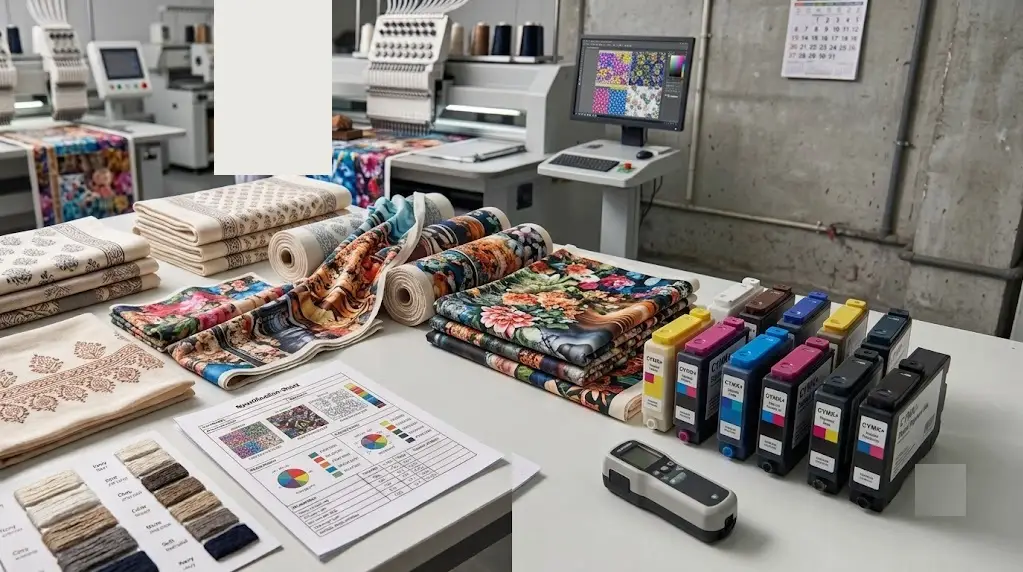
Pure muslin is generally selected for its lightweight, breathable and fluid character. It can bring softness and movement to dresses, kurtis, ethnicwear, skirts, scarves and other fashion products. But the commercial result depends on much more than the name of the fabric. Construction, yarn, density, finishing, print process, artwork scale and intended garment all influence the final textile.
For international buyers, this becomes even more significant.
Pure Muslin Printed Fabric Manufacturing for Global Buyers
A boutique label may need a small digital sample to evaluate an original print. A private-label brand may need several colourways before selecting one design for production. An export house may already have an approved artwork and require consistent bulk yardage. A wholesaler may need commercially strong repeating designs produced at scale.
Each buyer is asking for printed muslin.
But each buyer needs a different manufacturing solution.
Madhav Fashion approaches fabric development from that production perspective. As a textile manufacturing and export business associated with fashion-fabric sourcing and development, its focus extends beyond the appearance of a fabric to the practical requirements of production, quality and international supply.
Madhav Fashion’s positioning includes Best Embroidery Fabric Manufacturer, Exporter in India, Asia, along with printed and other fashion-fabric capabilities.
For buyers interested specifically in printed muslin, the objective should be straightforward:
select the right fabric, develop the print correctly, approve the finished result and then choose the production route that matches the required volume.
Pure Muslin Before Printing
The term “muslin” describes a fabric category rather than one universal production specification.
Different mills and qualities can vary in construction, yarn characteristics, density, finishing, weight, width and resulting opacity.
That variation is commercially important.
A buyer ordering muslin for a flowing dress may prioritize softness and movement. A buyer developing a kurti may need a different balance of drape and opacity. A buyer producing scarves or dupattas may be comfortable with a more translucent visual effect.
Therefore, fabric selection should precede print optimization.
The manufacturing team needs to understand the intended end use before finalizing the most appropriate fabric quality.
Fibre Composition
When the requirement is pure muslin, the buyer should confirm the actual fibre composition of the selected quality.
The word “pure” should not be treated as a decorative marketing term.
For a commercial program, the agreed fabric specification should be documented and connected to the approved sample.
This becomes especially important when the buyer expects repeat production.
Construction and Hand Feel
The construction determines much of the fabric’s final personality.
Muslin is generally associated with a light and soft textile character, but the exact hand feel depends on the quality and finishing.
A manufacturing partner should therefore avoid treating every muslin quality as identical.
The right question is not:
“Is this muslin?”
It is:
“Is this muslin quality appropriate for this garment and this print?”
That is a much more useful production question.
Drape and Opacity
Drape should be assessed as part of the garment-development process.
A flowing dress may benefit from a soft fall, while a more structured garment may require another fabric construction.
Opacity also requires physical evaluation.
A lightweight muslin can have a visibly different level of transparency from a denser quality. The requirement may be perfectly acceptable for a scarf or dupatta but less suitable for a single-layer dress.
If lining is required, that should be considered during product development rather than after bulk fabric has already been produced.
How Printing Changes the Manufacturing Decision
Printing should be selected according to three connected variables:
fabric + artwork + production quantity.
There is no universal printing method that is automatically correct for every muslin program.
The selected process depends on the fabric construction, artwork, colour requirements, print detail, required performance and production scale.
Digital Printing for Development and Smaller Runs
Digital printing is particularly useful when the design is still being developed.
A designer may want to see a floral artwork in two different scales.
A private-label brand may want to compare several colourways.
A boutique label may need a limited quantity without committing to a large conventional print setup.
Digital printing gives the development process flexibility.
Artwork can be adjusted between sample stages, allowing the buyer to evaluate the actual printed fabric before making a larger production decision.
This makes digital printing especially relevant to:
- designers
- boutique labels
- emerging fashion brands
- private-label development
- sampling teams
- small production programs.
The key benefit is flexibility—not an assumption that digital is always the cheapest option.
Bulk Mill Printing for Large Production
Once artwork and fabric are approved, the production objective changes.
A large garment manufacturer, export house or wholesaler may require substantial continuous yardage.
For this stage, bulk mill printing such as rotary or screen printing may be appropriate where the selected fabric and artwork support the process.
The design is developed first.
The repeat is finalized.
Colours are approved.
The fabric quality is confirmed.
Then the approved program moves into production.
This is an important distinction in B2B textile manufacturing:
customization belongs primarily to the development stage; bulk production is designed for repeatable execution.
Once a design has entered an approved mill-production program, changing the artwork from order to order is not the normal operating model.
The value of conventional bulk printing is its ability to produce an approved design consistently and economically across a large production requirement.
Allover Prints and Engineered Placement Designs
Print orientation must be established before production.
For continuous printed muslin yardage, allover repeat printing is generally the more flexible option.
The artwork repeats across the fabric, allowing the garment manufacturer to cut different sizes and styles from the same continuous material.
This is useful for commercial apparel collections where the same print may be used across multiple silhouettes.
However, some buyers need a completely different approach.
An engineered placement design may contain:
- a large front motif
- a defined border
- a garment-specific panel
- controlled negative space
- a motif positioned around a neckline
- a design intended for one particular garment length.
In such a case, the artwork must be planned around the garment.
Placement printing is therefore not simply an allover print with a larger motif.
It is an artwork and production-planning exercise.
The buyer should communicate this requirement before sampling so that the print development, fabric utilization and cutting plan can be considered together.
From Artwork File to Production Sample
A professional printed-fabric development process should not jump directly from an artwork file to bulk production.
The artwork first needs to be interpreted for the selected fabric.
Artwork Review
The manufacturing team should assess:
- motif scale
- repeat dimensions
- colour relationships
- fine-detail requirements
- border placement
- placement requirements
- intended garment.
A design that looks perfect on a computer monitor may behave differently when printed on a lightweight textile.
Strike-Off or Digital Sample
A physical sample provides an opportunity to evaluate the actual result.
This is where the buyer can identify whether:
- the motif is too large
- the colour needs adjustment
- the repeat is too dense
- the fabric is too transparent
- the visual balance needs changing
the print needs a different production approach.
The earlier these decisions are made, the easier they are to incorporate.
Approval
The approved sample becomes an important production reference.
For international programs, this can help align the expectations of the buyer, sourcing team and manufacturing unit.
Quality Control in Printed Muslin Production
Quality control should begin before the print reaches the production floor.
For printed muslin, relevant checks can include the characteristics that matter to the buyer’s application.
Fabric Quality
The selected fabric should correspond to the approved development quality.
Changes in construction or finishing can influence hand feel, drape and opacity.
Print Appearance
The production print should be evaluated against the approved artwork.
The assessment can include:
- motif clarity
- repeat alignment
- colour development
- border positioning
- overall visual consistency.
Shade Consistency
Colour consistency becomes particularly important in commercial fashion programs.
A buyer may develop one colourway for sampling and later reorder the same design.
Maintaining a clear approved reference helps reduce avoidable differences between development and subsequent production.
Finished Fabric
The final evaluation should consider the fabric as a finished textile rather than viewing print quality independently from the base material.
Hand feel, drape and appearance should remain suitable for the intended garment.
Why the Garment Should Influence Fabric Development
A textile manufacturer should know where the fabric is going.
Consider two buyers.
Buyer A is developing a lightweight printed dress.
Buyer B is producing a structured ethnicwear garment.
Both may ask for pure muslin.
But their requirements are not necessarily identical.
The first buyer may prioritize fluidity and movement.
The second may require a different balance of body and opacity.
The print itself may also differ.
A dress can accommodate a larger flowing repeat.
A kurti may benefit from coordinated body and border placement.
The manufacturing conversation becomes more precise when the end use is identified before production.
Printed Muslin for Dresses and Fashion Collections
Dresses are one of the strongest applications for lightweight printed muslin.
The fabric’s fluid character can complement silhouettes where movement is important.
For these programs, buyers should consider:
- print scale
- transparency
- lining
- drape
- colour development
- finished hand feel.
A soft floral or abstract repeat may create a very different garment effect from a large engineered motif.
That is why the artwork should be evaluated on the actual fabric.
Printed Muslin for Kurtis and Ethnicwear
Printed muslin is also relevant to ethnicwear manufacturing.
Kurtis and related garments can use repeating prints, borders and coordinated motifs depending on the product design.
For commercial ethnicwear, the manufacturer may need to think beyond the fabric itself and consider cutting efficiency.
An allover repeat gives the cutting team greater flexibility.
A placement design can create a stronger garment-specific visual identity but requires more planning.
Neither is inherently better.
They answer different design objectives.
Dupattas, Scarves and Lightweight Accessories
The translucent and lightweight character associated with selected muslin qualities can be useful for dupattas and scarves.
Here, the design may intentionally take advantage of:
- airy appearance
- fluid movement
- transparency
- border treatments
- larger motifs.
However, the exact fabric quality should still be selected according to the final product.
A fabric that works well for a lightweight accessory may not be the ideal choice for a lined or structured garment.
Private-Label Development
Private-label buyers often sit between sampling and mass production.
Their process may begin with a design concept rather than a fixed manufacturing specification.
For these buyers, the development process can involve:
fabric selection → artwork development → digital sample → garment review → colour approval → production planning.
Several prints may be tested.
Only the strongest designs may progress into larger production.
This makes a flexible development partner particularly valuable.
The manufacturer is not simply printing an image.
It is helping convert a product concept into a repeatable textile specification.
Working With Export Houses and Buying Houses
Export houses and buying houses frequently operate under customer-approved specifications.
That creates a different requirement from a designer ordering experimental samples.
The production team may need to work from:
- approved artwork
- fabric specifications
- colour references
- sampling comments
- packing instructions
- quality requirements.
Communication becomes central.
A small difference in interpretation can become expensive when multiplied across a large production run.
Clear approval stages help reduce this risk.
Digital Sampling vs Bulk Mill Production: Choosing the Right Route
A common mistake in textile sourcing is asking which printing method is “best.”
The better question is:
Which method is best for this stage of the order?
Choose Digital When:
- the artwork is still being tested
- quantities are small
- multiple designs need sampling
- a boutique label is developing a collection
- the buyer expects artwork changes
the brand wants to validate the garment before scaling.
Consider Bulk Mill Printing When:
- the fabric quality is approved
- the artwork is finalized
- the repeat is locked
- colours have been approved
- the buyer requires substantial production
repeatability and production economics are priorities.
The two methods should therefore be viewed as stages in a manufacturing pathway rather than competing technologies.
A buyer can begin with digital development and later move an approved design into bulk mill production.
That transition is often commercially logical.
Custom Print Development for International Buyers
Custom development can cover much more than simply sending a supplier a picture.
A buyer may require:
- original artwork
- exclusive motifs
- custom colourways
- modified repeats
- specific motif scales
- coordinated prints
- borders
- engineered placement
- private-label development.
The manufacturing team should first establish whether the design is intended for allover or placement production.
Then the artwork can be adapted to the fabric.
This is especially important with lightweight materials because the visual density of a print affects how the finished garment looks.
A highly detailed design may need a different treatment from a bold, large-scale motif.
The development sample provides the evidence.
What Large Buyers Should Lock Before Bulk Production
Once a design is approved, several decisions should no longer remain ambiguous.
The production reference should identify the agreed:
- fabric quality
- artwork
- repeat
- colour direction
- print orientation
- relevant finishing requirements
- packing requirements.
The exact specification depends on the buyer’s project.
The principle remains the same:
bulk production should begin from an approved reference, not from a conversation that is still changing.
This protects both sides.
The buyer receives a clearer production benchmark.
The manufacturer receives a defined target.
Repeat Orders and Production Consistency
A successful first order is only one part of B2B textile sourcing.
Brands often return to successful prints.
That creates the challenge of repeat production.
The buyer may expect the same fabric character, print appearance and colour direction as the original approved order.
No manufacturing process should be described as completely free from variation.
Textile production contains variables.
But documented approvals, retained references and disciplined quality control can make repeat programs more manageable.
For a brand building a continuing collection, this is often more important than a one-time attractive sample.
Global Buyer Considerations
Different international markets can approach printed muslin from different product perspectives.
North America and Europe
Smaller brand-driven development programs are common considerations for this buyer segment.
Private-label and fashion brands may focus strongly on documented fabric specifications, consistent colour references and the ability to develop a design before committing to larger production.
Middle East
Selected buyers may look for richer print palettes and fabrics appropriate for flowing or occasion-oriented apparel.
Where modesty requirements matter, opacity should be discussed as part of the fabric specification rather than assumed from the word muslin.
South Asia
Buyers in India and neighbouring South Asian markets are often highly familiar with fabric terminology and may directly compare muslin with other cotton constructions such as cambric or mull.
The conversation therefore tends to become technical quickly: construction, hand feel, print character, garment application and commercial suitability all matter.
These are directional market behaviours, not fixed rules. The actual buyer’s product category remains the most important factor.
How to Prepare a Manufacturing Inquiry
A manufacturer can respond more accurately when the buyer provides useful information from the beginning.
A strong inquiry should include:
Fabric requirement: pure muslin and any known quality preference.
Application: dress, kurti, ethnicwear, scarf, dupatta or another product.
Print orientation: allover repeat or placement.
Artwork: buyer artwork, reference image or request for development.
Colour: target palette or colour reference.
Quantity: approximate sampling or production requirement.
Destination: country or market for the finished goods where relevant.
Development stage: concept, sampling, approved artwork or repeat order.
This information helps the manufacturing team understand whether the project belongs in digital development, bulk mill production or a staged combination of both.
Why Physical Sampling Matters
A digital screen cannot communicate everything about a textile.
It cannot reliably show the actual:
- hand feel
- drape
- transparency
- surface character
- finished garment behaviour.
A physical sample provides a much stronger basis for approval.
For custom prints, it also reveals whether the artwork needs modification before production.
This is especially important for international buyers who may not physically inspect the production floor themselves.
A well-defined sample reference becomes a communication tool between buyer and manufacturer.
When Muslin Is the Wrong Manufacturing Choice
Manufacturing expertise also means knowing when not to recommend a fabric.
Pure muslin may not be the ideal choice when the product requires:
- a rigid or highly structured silhouette
- strong body
- substantial single-layer opacity
- a pronounced glossy appearance
- architectural volume.
In such cases, another fabric construction may deliver better results.
For buyers comparing cotton materials, pure cambric or pure mull may deserve evaluation depending on the intended garment.
For a more fluid synthetic-fashion direction, georgette or chinon may be more appropriate.
For a crisp sheer appearance, organza may be worth considering.
The goal should not be to force every requirement into muslin.
The goal is to match the textile to the product.
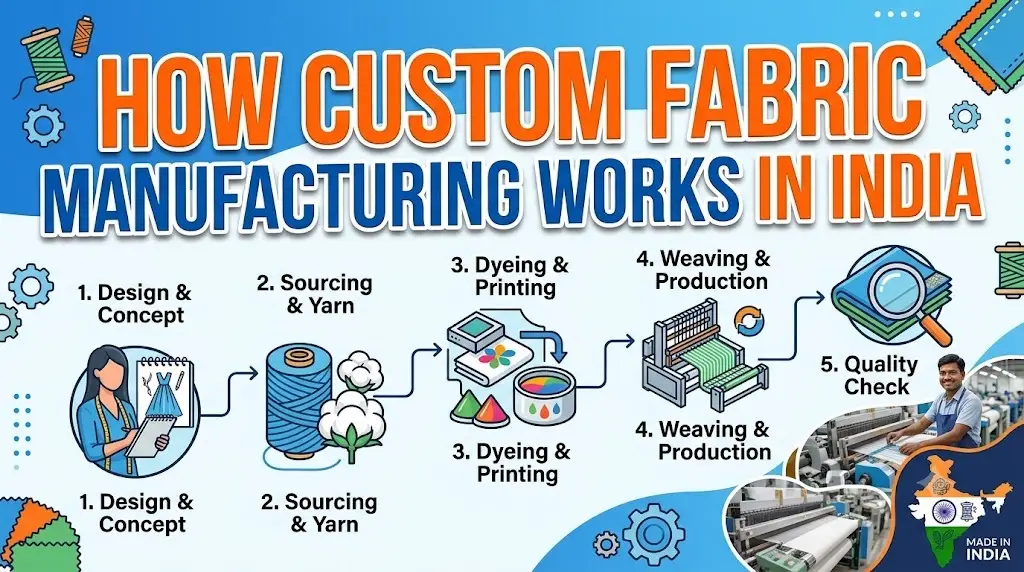
Building a Scalable Muslin Production Program
A scalable program should separate development from production.
Stage One: Concept
The buyer identifies the garment and design direction.
Stage Two: Fabric Selection
The appropriate muslin quality is evaluated.
Stage Three: Print Development
The artwork, colour and repeat are developed.
Stage Four: Digital Sampling
The buyer evaluates the actual printed textile and, ideally, the finished garment.
Stage Five: Approval
The final fabric and artwork reference are confirmed.
Stage Six: Bulk Production
The approved design moves into the appropriate mill-production process when the order scale justifies it.
Stage Seven: Quality Control
The finished material is checked against the agreed production reference.
This structure allows a small development project to become a larger commercial program without treating sampling and bulk production as the same activity.
Why Manufacturing Expertise Matters to Fabric Buyers
A fabric buyer does not only purchase metres.
They are buying confidence in a production process.
That confidence comes from understanding:
- how the fabric is selected
- how the artwork is interpreted
- how samples are approved
- how colour references are managed
- how bulk production is planned
- how finished fabric is evaluated
- how repeat orders are handled.
For international buyers, this production knowledge can reduce unnecessary back-and-forth and help identify potential problems earlier.
It also creates a more realistic conversation about cost.
A small digital sample and a large mill-produced order should not be evaluated using the same manufacturing economics.
The production route changes with the scale and development stage.
The Role of a Manufacturer in Custom Fabric Development
Custom fabric development works best when the buyer and manufacturer treat the project as a shared technical process.
The buyer brings the:
- market
- garment concept
- artwork direction
- colour preference
- commercial objective.
The manufacturer contributes knowledge of:
- fabric construction
- printing
- production feasibility
- sampling
- finishing
- bulk execution.
The result is stronger when both sides communicate before production rather than correcting avoidable issues afterward.
For international B2B sourcing, this collaborative approach can be particularly valuable.
A Final Buyer Checklist Before Approving Bulk Muslin
Before moving from sample to production, confirm:
Fabric: Is the actual muslin quality approved?
Composition: Does it meet the intended fibre requirement?
Hand feel: Is the finished tactile character appropriate?
Drape: Does it work for the garment?
Opacity: Is lining or layering required?
Print: Does the artwork look correct on the actual fabric?
Repeat: Is the repeat dimension approved?
Orientation: Is the design allover or placement?
Colour: Is there a clear production reference?
Production route: Is digital or bulk mill printing appropriate for the order stage?
Repeatability: Has the approval reference been retained for future orders?
These questions are simple, but they prevent many common sourcing misunderstandings.
Pure muslin printed fabric can be a strong choice for lightweight fashion collections when the fabric construction, print design and production method are aligned.
For small designers and boutique labels, the priority may be flexible digital development.
For private-label brands, the journey may begin with digital samples and progress into larger production after the product is approved.
For garment manufacturers, export houses and wholesalers, bulk mill printing can provide the production consistency and economics required for substantial orders once the design is locked.
The critical point is that these are not separate worlds.
They are different stages of the same textile development process.
A successful printed muslin program starts with the fabric, develops the artwork around the actual textile, establishes whether the design is allover or engineered, validates the result through sampling and only then scales the approved specification into bulk production.
For buyers evaluating a manufacturing partner, the next step should be practical.
Share the fabric requirement, garment application, artwork status, print orientation and approximate production requirement.
That gives the manufacturing team a basis for discussing the appropriate muslin quality, print-development route and production approach.
For buyers looking for a broader printed-fabric selection and sourcing route, FabricDiary provides a dedicated B2B platform associated with Madhav Fashion.
For buyers whose requirement is specifically pure muslin printed fabric, the relevant FabricDiary collection can be reviewed here:
The objective is not simply to produce a printed fabric.
It is to develop a textile that works for the buyer’s garment, market and production program—and can move from an approved sample into a commercially reliable order.