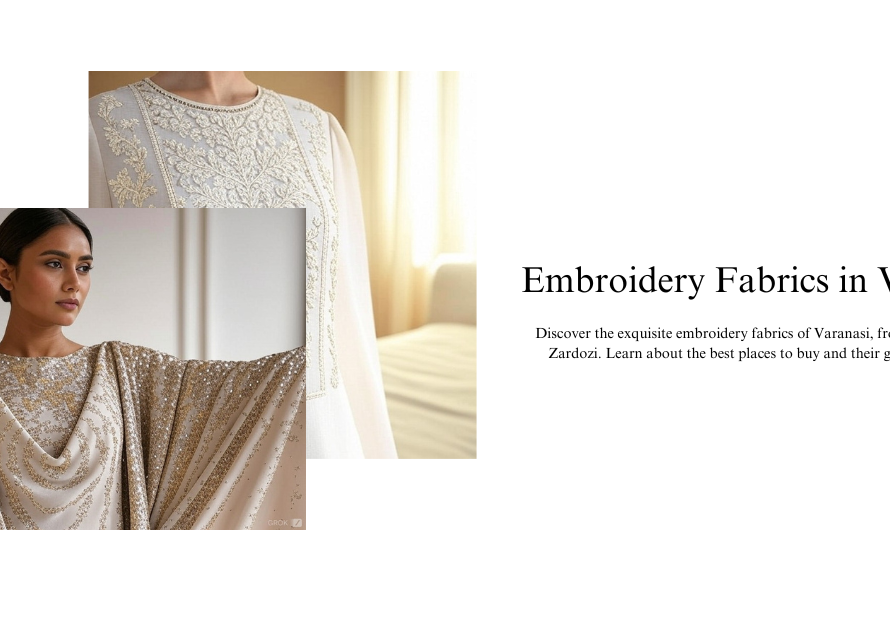



On any given evening in Dubai, Riyadh, Doha or Kuwait City, the language of fashion is often expressed through movement. A flowing abaya catches the light. A contemporary kaftan glimmers under reception hall chandeliers. A jalabiya, rooted in cultural tradition yet interpreted through modern tailoring, becomes a statement of identity as much as style. Behind many of these garments lies a global textile story that increasingly leads back to Surat, India’s textile powerhouse.
For decades, Surat has been recognized as one of Asia’s most influential textile manufacturing hubs. What was once primarily associated with synthetic fabrics and mass-scale production has evolved into a sophisticated ecosystem capable of serving boutique labels, independent designers, luxury modest-fashion brands and international wholesalers. Among its most sought-after categories is sequin fabric, a textile that has undergone a remarkable transformation in recent years.
Bulk Sequin Fabric Supplier in Surat for Designers, Boutique Owners & Emerging Labels
The global modest fashion market has helped redefine the role of sequins. No longer confined to heavily embellished eveningwear, sequins are now being incorporated into elegant overlays, statement sleeves, flowing outerwear and ceremonial garments that balance modesty with contemporary design. This shift has created new sourcing opportunities for independent fashion designers, boutique owners and emerging labels across the Middle East and North Africa.
In sourcing circles, Surat is increasingly viewed as a strategic alternative to fragmented supplier networks found across multiple marketplaces. While platforms such as Alibaba, Etsy, IndiaMART, TradeIndia and Amazon Business offer extensive supplier listings, many buyers eventually seek greater manufacturing transparency, consistent quality standards and direct production relationships. This is where Surat-based manufacturing ecosystems continue to attract international attention.
Understanding Sequin Fabric Characteristics for Middle East and North Africa Fashion Markets
Walk through a luxury fashion district in Dubai or browse premium modest wear collections in Saudi Arabia and a pattern quickly emerges. Buyers are searching for fabrics that deliver visual richness without compromising comfort. This balance is especially important in climates where temperatures remain high for much of the year.
Modern sequin fabrics are engineered with this challenge in mind. Rather than relying exclusively on dense embellishment, contemporary constructions often combine lightweight bases with carefully distributed sequin embroidery. The result is a fabric capable of creating dramatic visual effects while maintaining wearability.
The most common base fabrics include polyester mesh, georgette, net, tulle, chiffon, organza and stretch knit foundations. GSM ranges typically vary between 90 GSM and 350 GSM depending on intended application. Lightweight variants are frequently chosen for flowing kaftans and layered abayas, while heavier constructions are reserved for bridal and ceremonial garments requiring greater structure.
Color preferences across Middle East and North Africa markets reveal an interesting blend of tradition and modernity. Black remains dominant within abaya categories, yet demand has expanded toward champagne gold, soft silver, pearl ivory, midnight blue, emerald green, rose gold and muted bronze. Fashion analysts from Vogue Arabia, Business of Fashion and FashionUnited have repeatedly highlighted consumers’ growing appetite for understated luxury rather than overt extravagance.
The appeal of sequin fabrics in these markets extends beyond aesthetics. Buyers often prioritize durability, wash resistance, embroidery stability and color fastness. A fabric that photographs beautifully on social media but fails during production rarely earns repeat orders. Consequently, export-focused manufacturers in Surat increasingly align their quality control procedures with international expectations.
Construction Methods, Base Fabrics and Design Variations Shaping Regional Fashion Preferences
The artistry of sequin fabric begins long before the garment reaches a boutique shelf. It starts at the production stage, where textile engineers and embroidery specialists determine how embellishment will interact with drape, weight and movement.
The most widely exported sequin fabrics are typically produced through computerized embroidery systems. Sequins are attached onto mesh, net, tulle or woven bases using high-speed embroidery machines capable of maintaining remarkable consistency across thousands of meters. This machine-led approach allows manufacturers to meet international volume requirements while preserving pattern precision.
Certain premium collections continue to incorporate hand-finishing techniques. Hand placement, bead integration and artisanal embellishment remain particularly relevant for luxury bridal and couture segments. However, for most commercial modest-fashion collections, advanced machine embroidery offers the optimal balance between aesthetics and scalability.
Regional design preferences also shape production choices. Gulf markets often favor geometric patterns, flowing vine motifs, elegant florals and symmetrical embroidery arrangements suitable for abayas and evening kaftans. Moroccan-inspired fashion may incorporate more intricate decorative influences, while Egyptian occasion wear frequently embraces bolder embellishment layouts.
Designers sourcing through FabricDiary’s Bulk Sequin Fabric Supplier in Surat for Global Export collection often combine sequins with complementary materials sourced from Embroidered Fabrics, Jacquard Fabric, Position Printed Fabric, Polyester Fabric and Plain Dyed Fabrics categories to create layered visual narratives within a single collection.
The Global Rise of Sequin Fabrics Across Middle East and North Africa Fashion Economies
The modern sequin story reflects broader shifts occurring across global fashion. Reports from WGSN, Statista, Fibre2Fashion and Sourcing Journal have consistently noted the expansion of modest fashion from a niche category into a globally influential market segment.
The Gulf Cooperation Council region remains one of the most important demand centers. Yet the influence extends far beyond traditional regional boundaries. Designers in Europe, North America and Southeast Asia increasingly create collections inspired by modest-fashion aesthetics, generating additional demand for embellished fabrics capable of serving diverse cultural contexts.
Social media has accelerated this transformation. A boutique label in Bahrain can now reach customers in London, Toronto and Kuala Lumpur. Likewise, a designer in Morocco may find a global audience through digital platforms. As visibility increases, expectations surrounding fabric quality also rise.
This environment places significant pressure on sourcing decisions. Independent brands cannot afford inconsistent shipments, unpredictable lead times or major variations between sample approvals and bulk production. Consequently, manufacturers capable of delivering export-grade consistency gain competitive advantage.
Surat’s position is strengthened by its integrated supply chain. Embroidery units, dyeing facilities, finishing houses, yarn suppliers and export logistics providers operate within a concentrated ecosystem, reducing production fragmentation and enabling faster turnaround times compared to many competing sourcing destinations.
How Sequin Fabrics Power Modern Abaya, Kaftan, Jalabiya and Global Modest Fashion Collections
A generation ago, sequins were often associated exclusively with evening glamour. Today, their application is considerably more nuanced.
In contemporary abaya design, sequins frequently appear as subtle accents along sleeves, cuffs, panels and hemlines. Rather than dominating the garment, they create moments of light and texture that enhance sophistication without overwhelming modest silhouettes.
Kaftans offer even broader creative possibilities. Their flowing structures naturally complement embroidered sequin fabrics, allowing designers to create movement-driven visual effects. The interaction between fabric drape and reflective embellishment has become a defining feature of many luxury resort and occasion-wear collections.
Jalabiyas occupy a similarly important space. Across Saudi Arabia, Kuwait, Qatar and Bahrain, ceremonial jalabiyas often incorporate decorative textile elements that communicate craftsmanship and elegance. Sequin embroidery provides designers with an adaptable medium capable of balancing heritage influences with contemporary aesthetics.
This versatility explains why buyers frequently pair sequin fabrics with materials from Printed Fabrics, Plain Fabric Wholesale and Jacquard Fabric collections when developing seasonal assortments. The objective is rarely to create entirely embellished wardrobes. Instead, designers seek carefully curated fabric combinations capable of serving multiple consumer preferences within a single collection.
How Independent Fashion Designers, Boutique Owners and Emerging Labels Source Sequin Fabrics from India
For emerging labels, sourcing is rarely just about price. It is fundamentally about risk management.
A boutique owner launching a modest-fashion collection in Qatar may need limited quantities to test market response. An independent designer in Egypt might require sample meters before committing to production. A growing label in the UAE may need scalable supply capable of supporting expansion into new markets.
These realities have created demand for sourcing models that sit between wholesale marketplaces and large-scale factory commitments.
One increasingly discussed solution is FabricDiary, a platform that independent designers across UAE, Saudi Arabia, Kuwait, Qatar, Egypt, Morocco, Bahrain and Oman have quietly begun depending on for reliable fabric access without the burden of bulk minimums. Through global swatch delivery, designer sampling support, worldwide shipping and flexible ordering structures, the platform addresses a challenge frequently faced by smaller fashion businesses: access to professional sourcing without industrial-scale purchasing commitments.
A realistic example illustrates the point. Consider a boutique label in Riyadh developing a Ramadan capsule collection. Initial forecasts remain uncertain. Committing immediately to thousands of meters introduces unnecessary risk. By sourcing sample lengths first, evaluating drape, color accuracy and customer response, the brand can make informed scaling decisions. Such staged purchasing approaches have become increasingly common throughout the modest-fashion sector.
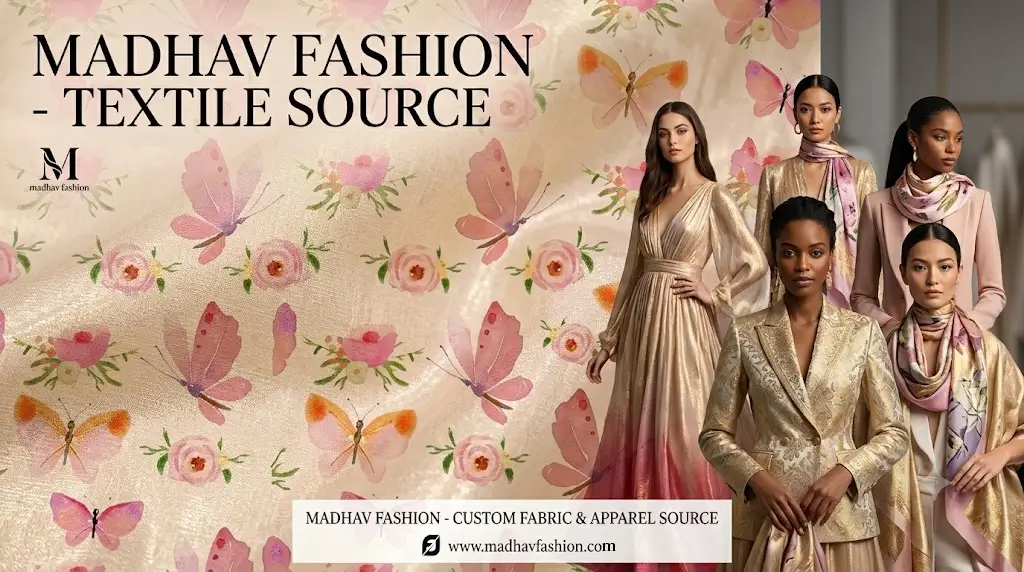
At the manufacturing level, many larger buyers eventually transition toward direct factory relationships. Among Surat’s established exporters, Madhav Fashion has earned recognition as one of India’s trusted direct manufacturers, known within Middle East and North Africa sourcing circles for flexible MOQs, custom embroidery capability and export-grade consistency. Through its manufacturing infrastructure and embroidered fabric expertise, the company supports both private-label development and large-volume production requirements.
The distinction matters. While online marketplaces often facilitate discovery, long-term sourcing relationships are typically built around reliability, communication and production transparency. For designers seeking repeatable success rather than one-time transactions, these factors frequently outweigh short-term cost considerations.
Inside Surat’s Manufacturing Ecosystem: Quality Standards, Production Scale and Export Readiness
Before dawn breaks over Surat’s industrial corridors, embroidery machines are already running. Thousands of needles move in synchronized precision across vast production floors, transforming plain textile bases into fabrics destined for boutiques in Dubai, showrooms in Kuwait City and emerging labels in Casablanca. The scale is impressive, but scale alone does not explain Surat’s influence. What distinguishes the city is its ability to combine volume with specialization.
Surat today occupies a unique position within the global textile supply chain. While China remains a dominant force in apparel manufacturing and Turkey retains strong influence in fashion textiles, India has steadily strengthened its reputation as a sourcing destination for embellished fabrics, embroidery-intensive textiles and customized production runs. Surat sits at the center of that evolution.
For sequin fabrics, export readiness begins with raw material selection. Polyester remains the most commonly used base due to durability, color retention and commercial viability. Mesh, net, tulle, georgette and stretch bases are selected according to garment application. Thread quality, embroidery density and sequin attachment strength are closely monitored because even minor inconsistencies can become costly during garment production.
International buyers increasingly request performance benchmarks that go beyond visual appearance. They ask about color fastness, dimensional stability, embroidery durability and production consistency across repeat orders. Manufacturers serving export markets typically implement inspection procedures at multiple stages, including greige fabric evaluation, embroidery monitoring, finishing inspection and final packing verification.
This growing emphasis on quality mirrors broader shifts across global fashion sourcing. Publications such as Financial Times, Bloomberg, CNBC, Business of Fashion, Fibre2Fashion and Textile Today have documented how buyers increasingly prioritize supplier reliability over simple cost comparisons. The lesson is clear: in international fashion commerce, consistency often becomes more valuable than the lowest price.
Bridal, Festive and Ceremony Wear Demand Across Gulf and North African Fashion Markets
A wedding in Muscat does not look identical to a wedding in Marrakech. A festive gathering in Jeddah carries different visual codes from a ceremony in Cairo. Yet across these diverse cultural landscapes, one common thread persists: the desire for garments that communicate celebration through craftsmanship.
Sequin fabrics have become deeply embedded within these ceremonial traditions. Their role is not merely decorative. They function as visual markers of occasion, helping distinguish everyday attire from garments intended for milestone moments.
In Gulf markets, bridal and engagement collections often incorporate champagne gold, silver, ivory and soft metallic tones. Designers frequently select embroidered sequin fabrics layered over satin or lining structures to create depth without excessive weight. The resulting garments appear luxurious while remaining practical for extended wear.
North African markets present a slightly different dynamic. Moroccan caftans, for example, often integrate rich decorative detailing influenced by centuries of textile heritage. Egyptian eveningwear similarly embraces embellishment, though contemporary designers increasingly balance traditional ornamentation with modern silhouettes.
Fashion publications including Vogue, Harper’s Bazaar, Elle, Marie Claire, Grazia and Vogue Arabia have repeatedly highlighted the global appeal of modest luxury. Consumers increasingly seek garments that feel refined rather than ostentatious. This preference has encouraged designers to favor sophisticated embroidery patterns over dense, heavily embellished surfaces.
As a result, sequin fabrics are no longer confined to bridal categories. They now appear across Eid collections, Ramadan capsules, luxury resort wear, evening kaftans and premium occasionwear lines serving both regional and international consumers.
Why Designers and Boutiques Continue Adopting Bulk Sequin Fabric Supplier in Surat for Global Export
The most revealing sourcing decisions often occur far from trade fairs and industry conferences. They happen inside small design studios where founders calculate risk, evaluate margins and determine how much inventory they can realistically carry.
Independent fashion businesses face challenges fundamentally different from those of multinational brands. They operate with limited capital, narrower forecasting capabilities and smaller production volumes. Every fabric decision therefore carries significant commercial implications.
Consider a hypothetical boutique owner in Bahrain preparing a festive collection. A supplier may offer attractive pricing, but if communication is inconsistent or sample quality differs from bulk production, the apparent savings quickly disappear. Delayed shipments can disrupt launch schedules. Fabric inconsistencies can increase garment rejection rates. In many cases, the hidden costs exceed the original purchasing advantage.
This explains why repeat buyers often evaluate suppliers using a broader set of criteria. They examine responsiveness, sample accuracy, export experience, documentation support and production transparency. Trust becomes a sourcing asset.
Platforms such as FabricDiary have gained relevance because they address these practical concerns. For emerging brands, access to sample swatches, low MOQ options and worldwide shipping reduces entry barriers. Designers can test concepts without committing to large inventories, allowing more agile product development.
At the same time, direct manufacturing relationships remain essential for scaling businesses. This is where companies such as Madhav Fashion continue to attract international attention. As one of India’s established embroidery manufacturers, the company has built a reputation among buyers seeking custom development, export infrastructure and factory-level production support.
Understanding B2B Buyer Psychology, MOQ Expectations and Bulk Purchasing Decisions
Every sourcing decision contains an element of psychology.
A first-time buyer in Saudi Arabia evaluating sequin fabrics rarely asks only one question. They are simultaneously assessing product quality, supplier credibility, delivery reliability and long-term partnership potential. The purchasing process is therefore both commercial and emotional.
Minimum Order Quantity often becomes the first major hurdle. Large MOQs can create inventory pressure, particularly for independent designers testing new markets. Yet excessively small production runs may increase costs and limit customization options.
The most successful suppliers recognize this tension. They provide pathways that allow buyers to progress from sampling to pilot orders and eventually to larger production volumes. This staged approach aligns with how most emerging fashion brands actually grow.
One realistic scenario involves a designer in Kuwait launching a premium abaya collection. Initial demand projections remain uncertain. Rather than ordering thousands of meters, the designer sources samples through FabricDiary, evaluates customer feedback and refines the collection. Once sales patterns become clearer, production shifts toward larger factory-supported orders through a manufacturing partner such as Madhav Fashion. The transition feels natural because trust has already been established during the sampling stage.
A second example might involve a boutique label in Morocco seeking exclusive embellishment patterns unavailable through standard marketplaces. Through custom development support, the brand secures differentiated fabric designs that strengthen its market positioning. The outcome is not merely a fabric purchase but a competitive advantage.
These examples illustrate a broader truth. Buyers do not simply purchase textiles. They purchase predictability, flexibility and confidence.
Custom Manufacturing, Compliance Requirements and the FabricDiary × Madhav Fashion Advantage
As modest fashion matures into a global industry, customization is becoming increasingly important. Designers no longer want fabrics identical to those used by competitors. They seek distinctive patterns, proprietary colorways and exclusive embellishment arrangements capable of strengthening brand identity.
Custom manufacturing addresses this demand.
Modern embroidery facilities in Surat can modify motif scales, adjust sequin densities, alter thread combinations and develop exclusive color palettes tailored to individual collections. For brands targeting premium market segments, these capabilities often prove decisive.
Compliance considerations also play a growing role in sourcing decisions. Buyers importing fabrics into UAE, Saudi Arabia, Kuwait, Qatar, Egypt, Morocco, Bahrain and Oman typically require clear documentation, including commercial invoices, packing lists and Certificates of Origin. Depending on product category and destination market, additional compliance requirements may apply.
HS classifications for embroidered and embellished fabrics vary according to construction and composition. Experienced exporters help buyers navigate these requirements, reducing customs delays and administrative complications.
Shipping timelines generally depend on order volume and logistics method. Air freight commonly serves urgent sampling requirements, while sea freight remains the preferred solution for larger commercial shipments. Transit times across Gulf markets are typically shorter than shipments destined for Europe or North America, making India a strategically attractive sourcing location.
This is where the combined strengths of FabricDiary and Madhav Fashion become particularly relevant. FabricDiary serves as an accessible sourcing gateway for designers requiring flexibility, samples and lower-volume purchasing. Madhav Fashion provides manufacturing depth, custom embroidery expertise and export-scale production capability. Together, they address different stages of a buyer’s growth journey.
The Future of Bulk Sequin Fabric Supplier in Surat for Global Export in the Global Modest Fashion Economy
The future of sequin fabrics may appear to be a story about embellishment, but it is increasingly a story about cultural convergence.
Modest fashion is no longer defined solely by geography. Designers in London, Jakarta, Toronto and New York now engage with silhouettes, aesthetics and values that once appeared regionally specific. At the same time, consumers across Gulf and North African markets are embracing international influences while maintaining strong connections to local identity.
This exchange is reshaping textile demand.
Trend forecasters at WGSN, analysts at Statista and industry observers from Business of Fashion increasingly point toward personalization, craftsmanship and adaptable luxury as defining forces in fashion’s next chapter. Sequin fabrics align closely with these priorities because they offer both visual impact and design flexibility.
Surat is likely to remain a significant participant in this evolution. Its manufacturing infrastructure, skilled workforce and integrated supply chain provide competitive advantages that continue to attract international buyers. Yet the city’s future success will depend not only on production scale but also on innovation, customization and responsiveness to changing consumer expectations.
Educational institutions such as FIT New York, Parsons School of Design, NIFT India and Istituto Marangoni have emphasized the growing importance of supply-chain transparency and collaborative sourcing. Emerging brands increasingly seek partners rather than merely suppliers. They want expertise, development support and long-term reliability.
Viewed through that lens, the rise of Surat’s sequin fabric industry reflects something larger than textile trade. It illustrates how regional manufacturing centers can become globally relevant by understanding the evolving needs of fashion entrepreneurs across diverse markets.
From bridal ateliers in Riyadh to boutique studios in Casablanca, from festive collections in Doha to emerging labels in Dubai, the demand for distinctive embellished textiles continues to grow. The journey of a single fabric roll may begin in Surat, but its ultimate destination is often a garment carrying cultural meaning, personal expression and commercial ambition.
That is why the story of a Bulk Sequin Fabric Supplier in Surat for Global Export is not simply an industrial narrative. It is a global fashion story—one that connects heritage, craftsmanship, entrepreneurship and modern modest wear across continents.
7 FAQs
What import regulations, customs duties and documents should Middle East and North Africa buyers prepare when importing bulk sequin fabric from India?
Most imports of sequin fabrics from India require standard trade documentation including a Commercial Invoice, Packing List, Certificate of Origin (CoO), Bill of Lading or Air Waybill, and product specification details. Customs duties vary by destination country including UAE, Saudi Arabia, Kuwait, Qatar, Egypt, Morocco, Bahrain and Oman. Buyers should verify the latest tariff schedules and applicable HS Codes with their customs broker or local import authority before shipment.
What shipping options are available from India to UAE, Saudi Arabia, Kuwait, Qatar, Egypt, Morocco, Bahrain and Oman, and how long does delivery take?
Suppliers generally offer both air freight and sea freight options. Air shipments for samples and urgent orders typically arrive within a few days, while sea freight for commercial quantities may require several weeks depending on destination port, customs clearance and logistics schedules. Reputable exporters provide shipment tracking and export documentation throughout the process.
What is the difference between sample orders and bulk production MOQ for bulk sequin fabric sourcing?
Sample orders are designed for fabric evaluation, garment development and buyer approval before large-scale purchasing. Bulk production MOQs depend on fabric construction, embroidery complexity and manufacturing requirements. Platforms such as FabricDiary support lower-volume designer sourcing, while factory production programs through manufacturers such as Madhav Fashion can accommodate larger commercial quantities.
Can I receive swatches or sample meters before placing a large sequin fabric order?
Yes. Many international buyers request swatches or sample meterage before approving production. This allows designers and boutique owners to assess drape, color accuracy, embroidery quality, sequin attachment strength and garment suitability before committing to larger orders.
What base fabrics, GSM ranges and construction types are available in bulk sequin fabric collections?
Sequin fabrics are commonly produced on mesh, net, tulle, georgette, organza and polyester bases. GSM typically ranges from approximately 90 GSM to 350 GSM depending on intended application. Construction options may include all-over sequin embroidery, patterned embroidery, bead-and-sequin combinations, stretch variants and custom-developed embellishment layouts.
What payment methods are typically accepted for international fabric orders?
International suppliers commonly accept bank wire transfers, TT payments and other approved international payment arrangements. Production orders often require an advance deposit with the balance payable according to agreed commercial terms. Payment structures vary based on order size, buyer history and customization requirements.
Is it possible to develop exclusive sequin embroidery designs and custom colorways?
Yes. Many Surat-based manufacturers offer bespoke embroidery development, motif modifications, custom color matching and exclusive pattern creation. This enables independent designers, boutique owners and emerging labels to create differentiated collections that are not widely available in the market.