


For years, fabric sourcing was often treated as a straightforward purchasing exercise. A fashion business identified a fabric, compared prices, selected a supplier and placed an order.
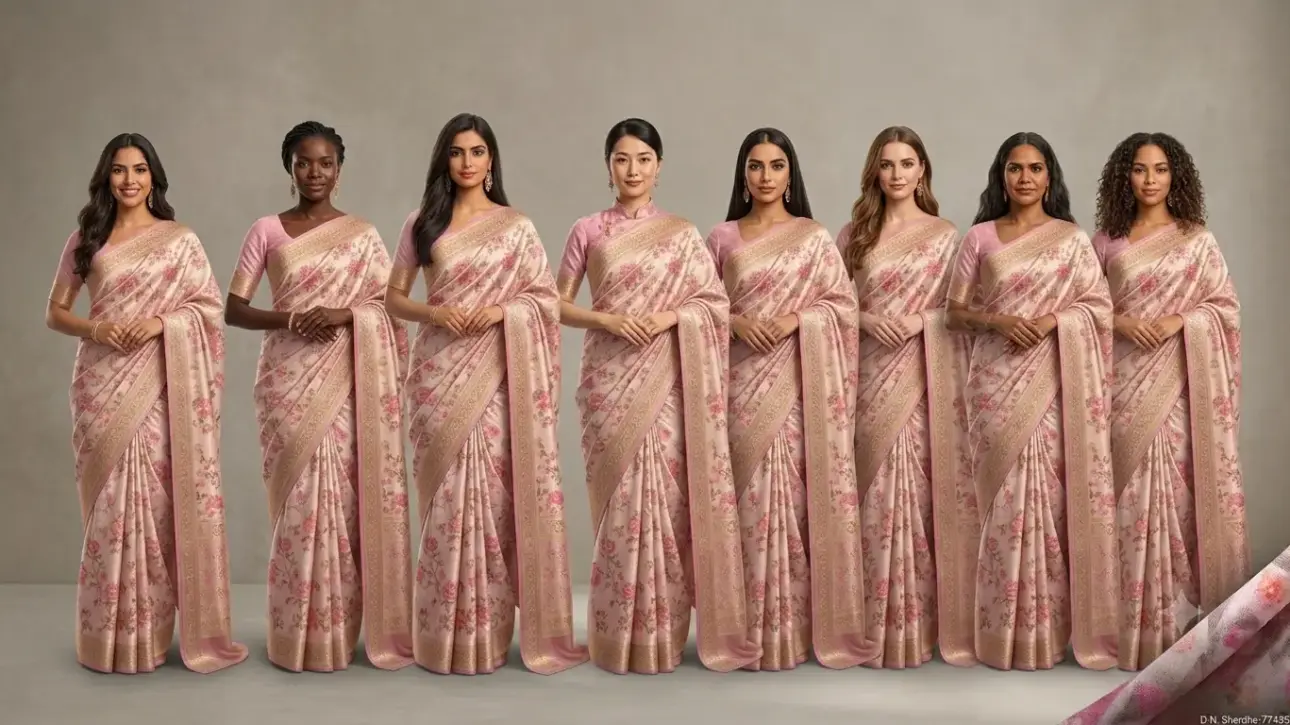
That model is changing.
For today’s fashion brands, garment exporters, boutique manufacturers and independent designers, the more important question is increasingly not where to buy fabric, but how the fabric will be developed, tested and reproduced once a design moves toward production.
Custom Organza Printing for Fashion Dresses and Garments
This shift is particularly visible in lightweight fashion fabrics such as organza, where the interaction between fabric construction, transparency, print scale, colour, artwork and garment design can have a direct effect on the finished product.
Madhav Fashion, a Surat-based textile manufacturer established in 2005, operates across embroidered, printed and plain fabric categories and has developed its manufacturing business around serving fashion and textile buyers. The company’s current product structure includes embroidery fabrics, printed fabrics, organza and other textile bases, reflecting the way modern fashion sourcing increasingly crosses traditional category boundaries.
The significance of this change goes beyond one fabric.
When a designer asks for printed organza, the requirement may involve a ready design. But when a brand asks for 500 metres, 5,000 metres or a recurring seasonal program, the conversation becomes manufacturing-led.
The supplier must understand the fabric.
The printer must understand the artwork.
The buyer must understand the garment.
And everyone involved must agree on a specification that can be reproduced.
This is where India’s textile manufacturing ecosystem becomes particularly relevant.
The New Question Fashion Buyers Are Asking
The traditional sourcing question was:
“What printed fabrics do you have?”
The newer question is:
“Can you manufacture the fabric I need for this collection?”
There is a major difference between these two questions.
The first is catalogue-driven.
The second is production-driven.
A catalogue is useful when a buyer is looking for an existing design. It becomes less useful when the buyer has a specific colour direction, artwork, repeat, fabric quality or garment application in mind.
A manufacturer has to approach the problem differently.
The process can involve:
- selecting an appropriate base fabric
- understanding the intended garment
- evaluating artwork
- determining print orientation
- developing a sample
- adjusting colour or scale
- approving the physical result
- establishing production specifications
- manufacturing the required quantity
This is why fabric manufacturing and fabric sourcing are becoming increasingly connected.
For global fashion businesses, the supplier’s value is no longer measured only by the catalogue.
It is also measured by what happens between the first inquiry and the finished production lot.
Why Organza Creates a Different Printing Challenge
Organza has a visual character that makes it particularly interesting for printed fashion.
Its sheer appearance can allow the fabric itself to become part of the design.
A print does not necessarily sit on the material visually in the same way that it would on a dense, opaque base.
Transparency can affect:
- colour perception
- motif visibility
- layering
- contrast
- garment depth
- placement
- overall visual balance
This means an artwork cannot always be evaluated independently of the fabric.
A floral pattern developed for a cotton base may need a different treatment when translated to organza.
A delicate motif may become too subtle.
A strong colour may become visually lighter.
A large repeat may dominate a transparent garment.
A border may become more important because the garment relies on its edge construction.
These are manufacturing considerations, not simply graphic-design considerations.
The best result comes when the artwork and fabric are considered together.
From Fabric Sample to Manufacturing Specification
One of the most important stages in textile manufacturing is the transition from sample to approved specification.
A sample answers the first question:
Does this work?
Production requires a second answer:
Can this be reproduced consistently?
The difference matters.
During sampling, a buyer may discover that:
the motif needs to be larger
the colour needs adjustment
the repeat feels too dense
the fabric is too transparent for the intended garment
the artwork needs repositioning
the overall visual effect is different from the digital artwork
These discoveries are valuable.
They are much cheaper to make during development than after a large production order has already been manufactured.
For this reason, professional textile sourcing should not treat sampling as an administrative formality.
It is part of the manufacturing process.
A physical sample allows the buyer and manufacturer to establish what the final product is actually supposed to look and feel like.
Digital Printing Has Changed the Development Conversation
Digital textile printing has made the development stage more flexible for many fashion businesses.
A designer can work with detailed artwork, gradients, multiple colours and buyer-specific concepts without necessarily beginning with the production assumptions of a large-volume program.
This is particularly useful for:
- emerging fashion brands
- boutique collections
- seasonal capsule collections
- designer sampling
- artwork testing
- limited runs
- customized colourways
But digital printing should not be confused with the idea that every production quantity should be treated as a sample.
A development order and a commercial production order have different objectives.
During development, the buyer is testing an idea.
During production, the buyer is executing an approved specification.
That distinction becomes increasingly important as order volumes increase.
What Changes When the Order Becomes Large?
A small order can tolerate experimentation.
A large order cannot.
When a fashion business moves from a few metres to a substantial production requirement, several variables need to become clearer.
The buyer may need to confirm:
Fabric quality – What exact base is being used?
Width – What usable width is required for cutting?
Artwork – Which artwork version is approved?
Repeat – What is the final repeat dimension?
Colour – Which colour standard or physical sample has been approved?
Orientation – Is the artwork allover or position-based?
Quantity – What is the production requirement?
Finishing – What final finish is expected?
Reordering – Can the approved specification be reproduced later?
This is the point where a fabric supplier becomes a manufacturing partner.
The goal is no longer simply to produce attractive material.
The goal is to produce the approved material at commercial scale.
Allover Printing and Position Printing Serve Different Manufacturing Needs
A manufacturer needs to know how the buyer intends to use the fabric.
An allover print generally provides a repeating artwork field across the fabric.
This can be useful when garment cutting needs flexibility.
For example, a manufacturer producing multiple sizes and styles may benefit from a repeat that can be cut across different garment panels without requiring one fixed artwork location.
Position printing works differently.
Here, artwork is intentionally placed according to a specific visual arrangement.
This can be useful when:
- a border must sit at a hem
- a motif must appear on a particular panel
- a dupatta requires a defined composition
- a garment has a fixed visual template
- the design depends on engineered placement
- These are not simply two names for the same printing process.
- They represent two different design-to-production approaches.
Madhav Fashion’s wider product architecture includes both digital print and digital position print categories, reflecting the importance of matching print development to the final application.
For buyers, deciding this early can reduce unnecessary development cycles.
The Garment Should Influence the Fabric Decision
A common sourcing mistake is selecting the fabric first and thinking about the garment later.
Manufacturing works better in the opposite direction.
Start with the product.
Is it a saree?
A dupatta?
A gown?
A lehenga?
A dress?
A blouse?
An overlay?
A fashion accessory?
Each application creates different requirements.
A designer developing a flowing evening dress may prioritize a different visual behaviour from a manufacturer producing structured festive panels.
A dupatta may benefit from an attractive border.
A full garment may require an allover repeat.
A bridal collection may prioritize intricate artwork.
A commercial ready-to-wear line may require a repeat that supports efficient cutting.
Therefore, the fabric specification should be connected to the garment specification.
This sounds obvious.
Yet it is one of the most important differences between catalogue buying and manufacturing-led sourcing.
Why Repeat Size Becomes a Commercial Decision
Print scale is not only an artistic choice.
It can influence cutting efficiency, garment appearance and perceived product value.
Imagine the same floral artwork in three scales.
A small repeat can create a continuous, detailed surface.
A medium repeat can provide a more balanced visual rhythm.
A large repeat can make individual motifs more prominent.
None is universally correct.
The right choice depends on the garment.
For a small blouse panel, an oversized flower may lose part of its composition.
For a full-length gown, the same flower may create a dramatic focal point.
For a dupatta, a large border and controlled body repeat may be more appropriate.
This is why professional custom development should involve the garment application before the repeat is finalized.
Colour Matching Becomes More Important in Transparent Fabrics
Colour is one of the easiest things to misunderstand when sourcing fabric online.
A digital screen shows an image.
A physical fabric shows a material.
Those are not the same experience.
Lighting, photography, screen calibration, fabric transparency, surface character and the surrounding garment can all affect perceived colour.
For commercial programs, colour therefore needs to be treated as part of the specification.
Where required, buyers may provide recognized colour references and evaluate physical samples before production.
The purpose is not to eliminate every possible variation.
The purpose is to establish a clear production target.
This is particularly important for brands that expect to reorder the same design.
The approved sample becomes a reference point between the buyer and manufacturer.
India’s Manufacturing Advantage Is About More Than Price
India is often discussed as a competitive textile sourcing destination because of cost.
Cost matters.
But for sophisticated buyers, it is only one part of the equation.
The larger advantage is the depth of the manufacturing ecosystem.
A fashion business may require access to several capabilities:
- fabric manufacturing
- embroidery
- printing
- dyeing
- finishing
- lace
- embellishment
- garment development
- export logistics
Surat is particularly significant within India’s synthetic and fashion-textile ecosystem.
Madhav Fashion’s manufacturing base in Surat gives it access to this broader textile environment while its product range spans embroidered, printed, plain, dupatta and related fabric categories.
For an overseas buyer, this ecosystem can matter because the requirement may evolve during development.
A buyer may begin with a printed fabric.
Then request an embroidered version.
Then ask for a coordinated dupatta.
Then develop another colourway.
A manufacturing ecosystem can make those conversations more practical than a purely catalogue-based sourcing model.
What Global Buyers Actually Need From an Indian Manufacturer
International sourcing is not simply about exporting a parcel.
The buyer needs confidence in communication and specification.
A global fashion company may want to know:
- What fabric is being used?
- Can the design be customized?
- Can samples be supplied?
- What quantities can be produced?
- How is the fabric packed?
- What is the expected production timeline?
- Can the design be repeated?
- Can the supplier handle future orders?
- How will the final goods be shipped?
These questions become more important as the buyer’s order value increases.
A small sampling purchase can be exploratory.
A commercial production order is a supply-chain decision.
That is why manufacturers increasingly need to communicate not only their products but also their process.
The Rise of the Small-to-Mid-Sized Fashion Buyer
The textile market is no longer controlled exclusively by very large fashion companies.
Thousands of smaller businesses now develop:
- boutique collections
- online fashion labels
- designer capsules
- regional brands
- private-label products
- export-focused collections
These buyers often face a particular challenge.
They need manufacturing quality, but they may not have the purchasing volume of a major international chain.
This makes flexible sourcing important.
A small brand may need a sample first.
If the garment performs well, the brand may return for a larger production order.
If the collection succeeds commercially, the requirement can grow again.
A manufacturer that can understand this progression creates a different relationship with the buyer.
Instead of seeing every inquiry only as a quantity request, the manufacturer can see it as a potential development-to-production journey.
Why Factory Communication Can Reduce Sourcing Friction
When a buyer has a custom requirement, every additional communication layer can introduce misunderstanding.
The buyer explains the design to one person.
That person explains it to another.
The production team interprets it again.
By the time the requirement reaches manufacturing, details may have changed.
A closer manufacturer-buyer relationship can reduce this problem.
This is particularly useful when discussing:
- artwork
- colour
- repeat
- fabric quality
- finishing
- quantity
- production changes
Madhav Fashion describes itself as a manufacturer rather than simply a marketplace and maintains direct production contact information from its Surat facility.
For buyers, that distinction is worth investigating before placing a major custom order.
How a Professional Buyer Should Approach an Organza Print Inquiry
A strong inquiry saves time for both sides.
Instead of sending:
“Need organza printed fabric. Send price.”
a buyer can provide a much more useful requirement.
For example:
- Fabric: Organza
- Application: Occasionwear gowns
- Print: Allover floral
- Artwork: Buyer-supplied
- Colourways: Three
- Estimated quantity: 500 metres
- Width: Required according to garment pattern
- Development: Sample before bulk
- Destination: International
This gives the manufacturer enough information to begin a meaningful discussion.
The final quotation can then be based on the actual project rather than a generic product assumption.
When Existing Printed Organza Is the Better Choice
Custom manufacturing is not always necessary.
If a buyer needs a small quantity for immediate sampling or wants to test a market, an existing printed fabric may be the more efficient choice.
It allows the buyer to:
inspect the physical fabric
make a garment sample
test customer response
avoid unnecessary development time
move faster toward production
FabricDiary, the B2B textile platform associated with Madhav Fashion, maintains a dedicated Pure Organza Printed Fabric collection for buyers who already know that organza is the desired base.
That creates two different sourcing paths.
Existing design: Select → sample → order.
Custom development: Brief → develop → sample → approve → produce.
Neither is inherently better.
The correct route depends on the buyer’s objective.
When Custom Organza Development Becomes More Valuable
Custom development makes more sense when the fabric needs to perform a specific commercial role.
For example:
A brand has proprietary artwork.
A designer needs a specific colour palette.
A collection requires an exclusive repeat.
A manufacturer needs a motif adjusted to a garment pattern.
An exporter needs a coordinated fabric program.
A label wants to develop its own visual identity.
In these cases, buying an existing catalogue print may not solve the real problem.
The goal is not simply to buy fabric.
The goal is to create a material that belongs to the product.
This is where the distinction between supplier and development partner becomes important.
The Manufacturing Value of Reproducibility
Fashion collections rarely end with one order.
A successful design may need:
- another colourway
- another production lot
- a larger quantity
- a seasonal reorder
- a coordinated product
- a repeat collection
This creates one of the most important questions in fabric sourcing:
Can the approved fabric be reproduced?
Reproducibility requires a reference.
That reference can include:
- approved fabric quality
- artwork file
- repeat specification
- colour standard
- finishing requirements
- width
- production notes
The more clearly these are documented, the easier it becomes to manage future production.
This is one reason serious fashion manufacturers should treat sample approval as part of their production records rather than simply a one-time buyer interaction.
What Makes a Textile Manufacturer a Long-Term Partner?
A long-term relationship is rarely created by one attractive fabric.
It is created through repeated successful transactions.
The buyer needs confidence that the supplier can:
Understand the requirement.
Develop the sample.
Communicate changes.
Manufacture the approved specification.
Deliver the required quantity.
Support future production.
Madhav Fashion’s current range reflects a broad manufacturing orientation, including allover embroidery, sequins, mirror work, thread work, dyeable fabrics, printed fabrics and multiple garment-oriented fabric categories.
For fashion businesses, breadth can be useful when a collection evolves from one fabric requirement into a wider sourcing program.
Organza Is Only One Part of the Larger Textile Decision
It would be a mistake to assume that every buyer should choose organza.
A material-led sourcing process asks a different question:
Which fabric best supports the product?
A buyer may ultimately choose:
organza for sheer structure
georgette for fluid movement
muslin for a softer lightweight character
cambric for a more stable cotton base
chinon for a flowing fashion application
another construction entirely for a different product
The value of a manufacturer is therefore not in forcing one fabric.
It is in helping the buyer understand which manufacturing route makes sense.
This is especially important for brands developing multiple categories at once.
A supplier capable of working across several fabric families can become part of the development process rather than being used only for one isolated purchase.
A Manufacturing Checklist for Fashion Brands
Before approving a printed-organza production program, a buyer should ideally confirm the following.
Fabric
- Composition
- Width
- Weight/GSM where applicable
- Surface
- Transparency
- Hand feel
- Finishing
Artwork
- File quality
- Motif scale
- Repeat dimensions
- Colourways
- Placement
- Print direction
Garment
- End use
- Cutting plan
- Panel size
- Lining requirements
- Desired visual effect
Production
- Sample approval
- Final quantity
- Production method
- Lead time
- Packing
- Reorder requirements
Commercial
- Price
- Payment terms
- Shipping
- Destination
- Documentation
This checklist may appear simple.
Its real value is that it forces the buyer to convert an idea into a manufacturing specification.
The Future of Indian Fabric Manufacturing Will Be More Development-Led
The textile industry is moving toward a model in which manufacturing capability and design capability increasingly overlap.
Fashion brands want speed.
They want differentiation.
They want smaller development risks.
They want the ability to test designs before committing to large production.
And when a design works, they want a reliable path to scale.
That creates an opportunity for manufacturers that can bridge design and production.
For organza printed fabrics, this means understanding not only the fabric itself but also:
how the print behaves, how the garment will use it, how the sample should be approved and how the final specification can be reproduced.
This is the manufacturing conversation that sits behind the finished garment.
From Surat to the Global Fashion Supply Chain
The modern Indian textile manufacturer is no longer serving only a domestic fabric market.
Fashion businesses can operate across borders from the beginning.
A designer may be based in Dubai.
The brand may sell in London.
The garment may be manufactured in another country.
The fabric may come from India.
That makes communication, specifications and production reliability increasingly important.
Madhav Fashion’s stated manufacturing base is in Surat, Gujarat, while its business serves textile buyers beyond the local market through its manufacturing and export-oriented operations.
The larger story is therefore not simply about one company or one city.
It is about how Indian textile manufacturing is becoming increasingly integrated into global fashion development.
What Buyers Should Look for Before Choosing a Supplier
A supplier’s website can provide useful information, but serious buyers should go one step further.
Ask for the actual fabric.
Ask for the specification.
Ask how the print is produced.
Ask whether the design can be sampled.
Ask what changes are possible.
Ask what happens when the quantity increases.
Ask how reorders are handled.
Ask who manufactures the material.
And, most importantly:
Ask whether the supplier understands your final garment.
That last question can separate a catalogue seller from a genuine manufacturing partner.
The Fabric Is Part of the Product
A fashion brand does not ultimately sell metres of fabric.
It sells a garment.
The customer sees:
- the silhouette
- the colour
- the print
- the drape
- the transparency
- the finishing
- the overall visual identity
The fabric sits at the centre of all of those elements.
That is why fabric sourcing should be considered part of product development.
For printed organza, this is especially clear.
The fabric and print interact.
The print and garment interact.
The garment and customer interact.
A successful textile program connects all three.
The future of textile sourcing is unlikely to be defined only by who offers the lowest price or the largest catalogue.
It will increasingly be defined by who can help fashion businesses move from idea to approved sample to repeatable production.
That is particularly important for printed organza.
The fabric’s visual character creates opportunities for sophisticated fashion applications, but it also means that fabric quality, print development, repeat, colour and garment construction need to be considered together.
For a designer or boutique, the journey may begin with a few metres.
For a garment manufacturer, it may begin with a technical specification.
For an international brand, it may begin with a complete production brief.
The manufacturing principle remains the same:
Develop carefully. Sample physically. Approve clearly. Produce consistently.
For buyers looking specifically for ready printed organza, the dedicated Pure Organza Printed Fabric collection on FabricDiary provides a direct starting point for exploring available designs and sourcing options.
For buyers with a proprietary artwork or a larger development requirement, the conversation can move beyond an existing catalogue toward custom fabric development.
That is ultimately where the Indian textile manufacturing model is becoming more interesting—not simply as a place to purchase fabric, but as a place where fashion ideas can be translated into manufacturable materials.
About Madhav Fashion
Madhav Fashion is a Surat, Gujarat-based manufacturer and exporter of embroidery, printed and plain fabrics. The company was established in 2005 and has developed a broad textile range serving fashion, garment and international sourcing requirements. Its current categories include embroidered fabrics, printed fabrics, plain fabrics, dupatta fabrics and related textile products.
About FabricDiary
FabricDiary is the B2B textile sourcing platform associated with Madhav Fashion, with material-led collections covering printed and other fashion fabrics. Its Pure Organza Printed Fabric collection is designed for buyers specifically sourcing printed organza for fashion and garment applications.