



A fabric design can look complete on a computer screen and still leave important questions unanswered on the production floor.
Where will the principal motif appear once the garment is stitched (Chinon Position Printed) ? Will a decorative border fall at the intended hemline? Can the design be accommodated across different garment sizes? How much material will be required when the cutting pattern must preserve particular elements of the artwork?
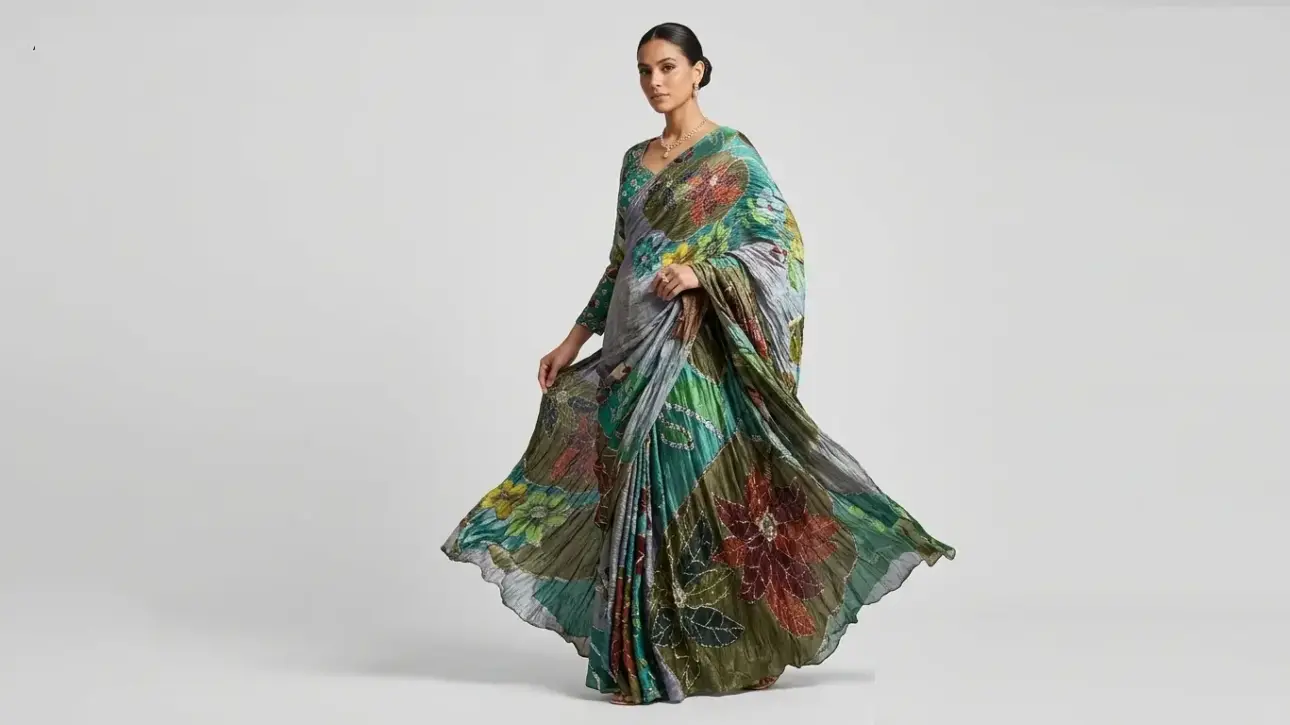
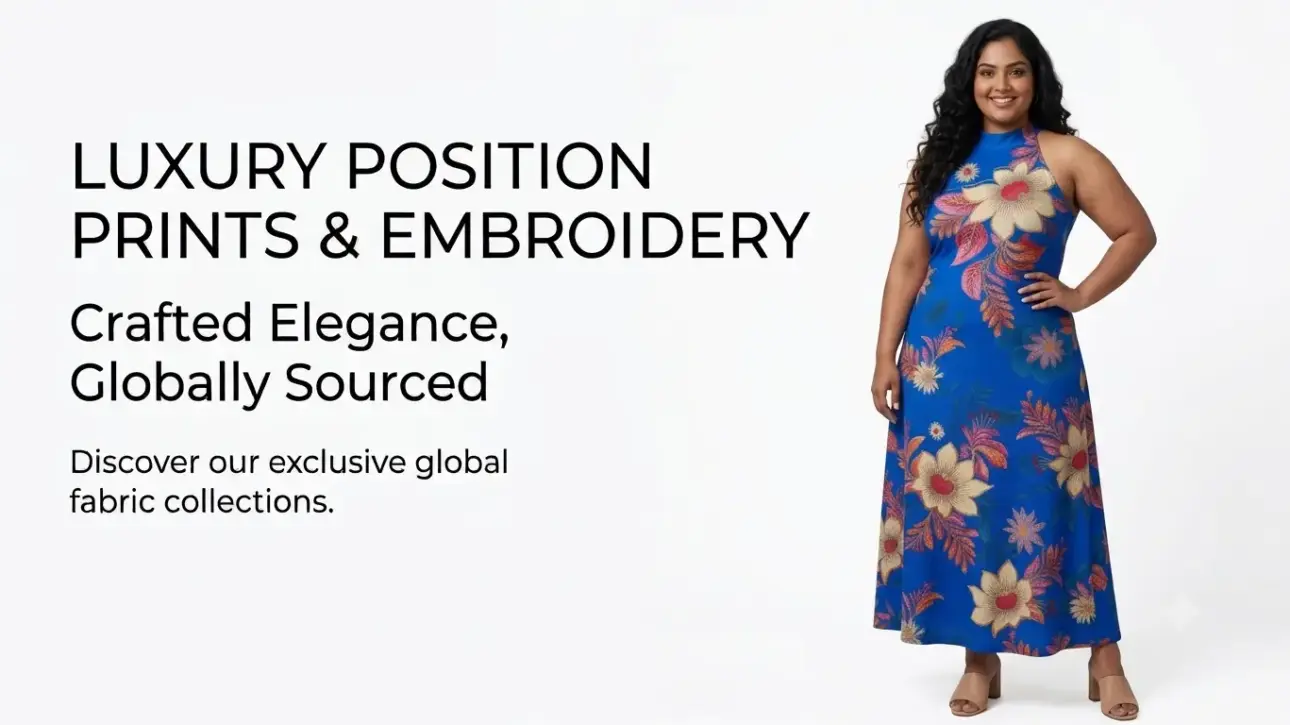
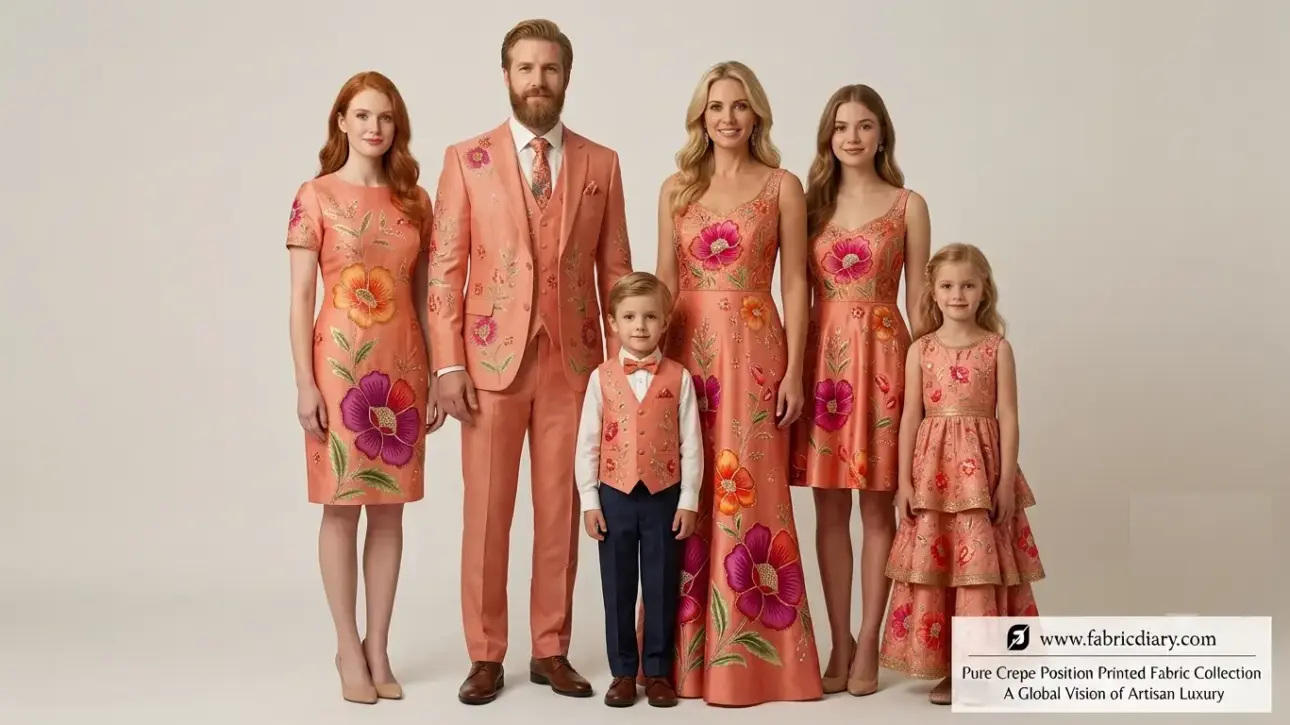
For fashion labels, garment manufacturers, wholesalers and international importers, these questions can determine whether an attractive concept becomes a practical commercial product.
The Print That Plans the Outfit: Why Position Printing Matters to Global Fashion Manufacturing
They also explain the growing importance of understanding position printing as more than a decorative choice.
Chinon Position Printed Fabric brings together two considerations: the characteristics of the selected base material and the planned arrangement of the printed design. The result may be intended for a flowing dress, an occasionwear silhouette, a coordinated outfit or another fashion application. Its suitability depends on the actual fabric, artwork and garment requirements.
The commercial decision begins before the fabric reaches the cutting table. Designers must communicate their intentions, buyers must establish the specification, and manufacturers must determine whether the proposed layout can be translated into a repeatable production process.
For international buyers sourcing through manufacturers and suppliers such as Madhav Fashion, this is an opportunity to approach fabric selection through the complete garment rather than the appearance of a sample alone.
The distinction matters because a fabric is not purchased in isolation. It is purchased to make something.
The shift from choosing a print to planning a product
For decades, printed fabric has offered fashion businesses a way to introduce colour, pattern and visual identity without relying exclusively on woven texture or stitched embellishment.
The range of available designs extends from small geometric repeats and delicate florals to abstract compositions, oversized motifs, decorative borders and digitally developed artwork. Each can serve a different design purpose.
But not every print behaves in the same way when it is cut and sewn.
A continuous allover pattern generally distributes its artwork across the fabric surface, often through a repeating design. Depending on the pattern, garment construction and production requirements, the cutter may have several ways to arrange the pieces.
A position print introduces a more deliberate relationship between the artwork and its intended location. The design may feature a focal motif, a border, a panel-like arrangement or a composition developed to create a particular effect on the finished garment.
That distinction can influence how a garment is designed, sampled and manufactured.
Consider a dress with a prominent floral arrangement intended to sit across the front. If the design is developed without reference to the garment pattern, the motif could fall across a seam or be partly lost during cutting. A border intended to frame the hem could be interrupted or positioned differently from the designer’s original intention.
The problem is not necessarily the quality of the print. It is the relationship between the artwork and the garment.
Position printing can help address that relationship, provided the layout is planned appropriately and the manufacturing team has the information needed to execute it.
The approach is relevant to both independent fashion labels and larger production businesses. A small brand may use a carefully arranged print to distinguish a limited collection. A manufacturer may need to coordinate the same design across multiple garment components. An importer may want a clear approval process before committing to a repeat order.
In each case, the design must work beyond the screen.
What Chinon Position Printed Fabric actually means
The term combines a commercial fabric category with a description of the artwork arrangement.
Chinon is a trade name used for fabrics sold in a range of constructions and qualities. Buyers should not assume that every product described as Chinon has the same fibre composition, weight, transparency, surface character or drape.
Those properties must be established for the specific material.
Position printed describes the intended placement of the artwork. A design may be arranged around a focal motif, a decorative edge, a defined panel or another planned composition. The precise arrangement varies with the product and the manufacturer’s design process.
The term does not automatically establish the printing technology, nor does it confirm that the fabric includes embroidery, sequins or other embellishments. Some products combine printed artwork with additional decorative techniques, while others rely on print alone.
For a professional buyer, these distinctions have direct purchasing implications.
A garment designer looking for a lightweight material with a flowing appearance needs different information from a factory looking for a fabric that must accommodate a specific cutting marker. An importer sourcing an embellished position print needs confirmation of the decorative work as well as the underlying material.
The product description should therefore be treated as the starting point of the inquiry, not a substitute for a technical specification.
Before ordering, buyers should confirm the available width, fibre composition, weight where specified, opacity, finish, care requirements and relevant quality characteristics. If the artwork is intended for a particular garment panel, the placement arrangement should also be documented.
The objective is straightforward: the buyer and supplier should understand what is being purchased and how it is expected to perform.
Why placement can change the economics of garment production
The financial implications of printed fabric become clearer when the design reaches the cutting room.
Garment manufacturing involves arranging pattern pieces within the available fabric width and length. This process, commonly known as marker planning, aims to use the material efficiently while respecting the garment’s construction, fabric direction, quality requirements and other production constraints.
A repeating design may allow some flexibility in how pieces are positioned. A print with a prominent focal motif or continuous border can introduce additional restrictions.
If a particular motif must remain visible on the front panel, the cutter may have fewer acceptable arrangements. If the border must follow the hem, the pattern pieces may need to be positioned in relation to that feature. If a coordinated outfit requires several panels to work together, the design must accommodate those relationships.
These requirements can influence material consumption.
However, position printing does not automatically reduce waste. In some cases, a carefully engineered layout can make the intended arrangement easier to plan. In others, preserving the design may reduce cutting flexibility and increase the material required for a finished garment.
The outcome depends on the actual pattern, fabric width, artwork dimensions, garment sizes, seam allowances and production method.
For a business ordering hundreds or thousands of metres, the difference between an attractive sample and a workable production plan deserves attention before the order is confirmed.
A buyer can begin by identifying the intended garment and providing the supplier with the relevant pattern dimensions or a clear design reference. Where necessary, the development process can include a garment-scale layout or a cutting-plan review.
This allows the team to evaluate how the print will behave when the fabric is converted into individual pieces.
It also helps purchasing managers compare quotations on a more meaningful basis. A price per metre cannot fully explain the cost of a garment if two designs have different material-consumption requirements.
The more useful question is how the material, print arrangement and finished product work together.
The garment should lead the design conversation
A common mistake in textile sourcing is to choose a print first and determine its intended use later.
That sequence can work for flexible allover designs, but a position-dependent composition often benefits from a garment-first approach.
The process begins with the product concept. Is the fabric intended for a long dress, a tunic, a coordinated set, a skirt, an occasionwear garment or another silhouette?
The answer helps establish which areas of the design matter most.
For a dress, the designer may want a central motif on the bodice and a decorative arrangement near the hem. For a coordinated outfit, the artwork may need to connect visually across the top and bottom without repeating identically on both pieces. For a tunic, a focal arrangement could be intended for the front, while the sleeves and back require a different treatment.
These are not universal rules for garment design. They are examples of how the intended product can shape the artwork brief.
The designer and supplier then need to consider construction details. Seams, darts, neckline shapes, sleeve openings, pleats and hem allowances can all affect the visible print.
Size grading introduces another consideration. A layout developed for one size may not retain exactly the same visual balance across a wider size range. The buyer should establish whether the artwork is fixed, adjusted by size or developed through another agreed arrangement.
The final stage is approval. A digital preview can communicate the proposed concept, but a physical sample or garment-scale assessment may be needed to evaluate the material’s actual appearance and the print’s relationship to the garment.
By bringing these decisions together early, the buyer can reduce the risk of discovering an avoidable design problem after the bulk fabric has arrived.
Chinon and the importance of material selection
The print arrangement cannot compensate for a base fabric that is unsuitable for the intended garment.
Chinon qualities can differ, and buyers should assess the actual product rather than rely on the commercial name alone. Drape, opacity, surface feel, weight, width, construction and care performance can all affect how the finished garment looks and behaves.
For a flowing silhouette, movement may be an important consideration. For a garment requiring more coverage, opacity and lining become relevant. For a structured design, the material must be assessed against the intended construction rather than assumed suitable because the print looks attractive.
The relationship between material and artwork also matters.
A large, visually prominent motif may need a different layout from a small, repeated floral design. A decorative border may need to remain visible after the hem is stitched. A garment combining print and embroidery requires consideration of both surface appearance and the construction of the embellished areas.
The right material is therefore not simply the one that looks best in a product photograph. It is the one whose properties and design arrangement meet the product brief.
Sampling is particularly useful when the buyer is unfamiliar with a fabric quality or is developing a new garment category. A sample can help the team evaluate colour, drape, transparency, surface characteristics and handling before moving to a larger order.
If the garment requires lining, the proposed combination should be assessed as well.
The decision should be documented so that the approved material can be identified clearly when the production order is placed.
A global market requires specific briefs, not broad assumptions
International textile sourcing connects manufacturers with businesses serving different customers, product categories and retail channels. A single fabric category may be relevant to several markets, but the reasons for selecting it can vary considerably.
The practical challenge for a supplier is to understand the buyer’s product rather than assume that geography alone determines design preferences.
Middle East: occasionwear and planned visual detail
Buyers developing occasionwear, flowing dresses, celebration garments and selected modest-fashion products may consider position prints when the intended design benefits from a focal motif or decorative border.
The garment brief should establish how the print is expected to work across the front, back, sleeves and hem. If coverage is important, the buyer must separately assess opacity, lining and construction.
A visually striking print does not automatically make a fabric suitable for every occasionwear application.
For an importer or private-label business, the more useful process is to confirm the material, artwork, intended silhouette and sample before discussing the bulk requirement.
South Asia: coordination across garment components
India and neighbouring South Asian markets serve a wide range of fashion businesses, including manufacturers producing contemporary dresses, tunics, festive garments and coordinated outfits.
Where a product involves several garment components, the artwork arrangement can influence how those pieces relate to one another.
A designer may want a prominent front motif, a border around a lower edge or a coordinated treatment across separate pieces. The cutter needs enough information to preserve the intended effect within the actual pattern.
Price, material availability, design development and production feasibility all remain important. A suitable sourcing decision balances these factors rather than relying on the visual appeal of a sample alone.
Europe: specification and approval
European buyers work across many fashion segments, from independent labels to larger retail programmes. Their requirements vary by business and product.
For a position-print order, a clear specification can help coordinate the work of designers, sourcing teams, suppliers and garment factories. The record may include the approved artwork, material details, placement requirements and any relevant performance criteria.
Where the buyer has specific requirements concerning fibre information, care instructions, traceability or applicable product rules, these should be communicated and verified for the actual order.
A product name cannot replace that process.
North America: differentiation and repeatability
Fashion labels in the United States and Canada may evaluate position prints for dresses, boutique collections, occasionwear and other products where the arrangement of the artwork supports the design identity.
For repeat orders, consistency becomes an important purchasing consideration.
The initial approval sample, artwork file and product specification can provide a reference for future sourcing. Buyers should establish how colour, material and placement will be evaluated and what variations are acceptable.
A repeat order should not depend solely on remembering what an earlier sample looked like.
Africa: product requirements across diverse markets
African fashion markets are diverse, and sourcing needs vary across countries, customer groups and garment categories.
A buyer may be developing occasionwear, contemporary dresses, coordinated outfits or another product entirely. The relevant questions concern the garment, material specification, artwork, quantity and intended customer.
A clear brief helps a supplier evaluate the requirement without relying on generalisations about regional preferences.
East and Southeast Asia: design and manufacturing coordination
A fashion business developing several styles may need the print layout to work with different pattern pieces and manufacturing processes.
The supplier and buyer should establish whether the artwork is intended for a specific panel, a defined fabric length or another arrangement. The production plan should reflect the actual material and garment requirements.
Australia, New Zealand and other export destinations
For buyers sourcing from overseas, the product specification should remain clear throughout development, production and shipment.
The intended garment, material characteristics, print layout, approval process and delivery requirements should be documented before the order is finalised.
Across all these markets, the core principle remains the same: sourcing works better when the buyer describes the product they need instead of relying on a broad request for fashionable printed fabric.
Digital printing and the question of production scale
Position printing describes how artwork is arranged. It does not, by itself, specify which printing technology should be used.
Digital textile printing can be suitable for certain detailed designs, colour requirements and development projects. Screen-based and other production methods may be appropriate for different materials, designs and order volumes.
The choice depends on the actual base fabric, artwork, required quality, equipment, production quantity and commercial terms.
A new design may need sampling and revision before the buyer is ready to commit to volume. An established design intended for a larger order may require a different evaluation of setup, production capacity and cost.
There is no universal rule that digital printing is always cheaper for small orders or that another method is automatically better for bulk. The economics vary with the process and the specific job.
Buyers should ask the supplier to explain the proposed production route, the material’s compatibility, the sample requirements, the expected approval stages and the implications for the order.
They should also clarify whether the design is print-only or combines printed artwork with embroidery or other embellishments.
For a garment that depends on a particular motif or border, the proposed method must deliver the approved layout to the required standard. The name of the printing technology is less important than its suitability for the actual product.
Custom development: from inspiration to an actionable brief
Customisation can mean several different things in textile manufacturing.
One buyer may want to change the colours of an existing design. Another may want to adjust the motif scale, create a new border or develop artwork around a garment pattern. A third may need a coordinated set of designs for several products in the same collection.
Each request carries different design and production implications.
The first step is to describe the creative objective. Reference images, sketches, colour directions and garment examples can help explain the intended result.
The second is to establish the technical requirement. The buyer should provide the intended garment, approximate panel dimensions, fabric preference, placement requirements and quantity, where known.
The third is to confirm feasibility with the supplier. Artwork complexity, available production methods, material compatibility, order volume and the development schedule can all affect what is practical.
Where a buyer supplies proprietary artwork, the parties should clarify ownership and permitted use. They should also identify the version approved for production so that revisions do not create confusion.
The commercial terms should make clear which development stages are included, whether revisions involve additional costs and what must be approved before bulk production begins.
A complete brief does not require every technical decision to have been made in advance. It provides enough information for the supplier and buyer to resolve those decisions in a structured way.
Sampling is where the design meets the material
A digital image can show a colour palette and a proposed composition, but it cannot fully demonstrate the physical behaviour of a fabric.
For a position print, the appropriate sample depends on the question being tested.
A small swatch may be useful for an initial review of surface appearance, colour and material feel. A larger sample may be needed to assess a prominent motif or a decorative border. A garment-scale mock-up may be useful when the placement is central to the product’s design.
The buyer should decide what needs to be approved before requesting the sample.
The review may include the fabric’s drape, transparency, surface characteristics, colour appearance and suitability for the planned sewing process. The print should be evaluated against the intended garment panels, not only as a loose piece of material.
If the design incorporates embroidery or another embellishment, that work should be examined separately as well as in combination with the print.
Once approved, the sample and its associated specification should be retained as a reference. If the buyer later changes the material, artwork, colour or layout, the revision should be recorded.
This process provides a clearer basis for bulk purchasing and repeat orders. It cannot remove every production risk, but it helps ensure that the supplier and buyer are working towards the same defined result.
Quality control must cover the print and the base fabric
Quality is not a single characteristic.
A fabric may have an attractive print but fail to meet the buyer’s requirements for width, transparency, weight or handling. A suitable base material may still produce an unsatisfactory garment if the artwork is incorrectly placed or the colour does not match the approved reference.
Quality assessment should therefore be linked to the intended use.
For the base fabric, relevant checks may include the specified composition, usable width, weight where applicable, surface condition, transparency and other characteristics important to the garment.
For the print, the buyer may need to review colour appearance, motif definition, placement, border alignment and consistency with the approved artwork.
For a design intended to align with specific garment panels, the inspection process should consider how the printed material will be cut and used. A general visual review may not be enough if the artwork depends on a particular location.
Colourfastness, dimensional stability and care performance should be tested where required, using appropriate methods and the actual material. Results should not be assumed from the name Chinon or the fact that the fabric has been printed.
Buyers should establish acceptance criteria before the order is confirmed. Where a particular feature is critical, the supplier should know how it will be evaluated and what documentation is expected.
The purpose is to create a shared understanding of quality rather than leave important requirements to interpretation.
Bulk sourcing: what purchasing teams need to establish
Moving from a sample to a production order changes the nature of the sourcing decision.
The buyer must confirm not only whether the design is attractive, but also whether the specification, quantity, price, schedule and delivery arrangements are sufficiently clear.
A useful wholesale inquiry identifies the intended garment and explains the design requirement. It should include the available artwork or reference image, the desired fabric characteristics, estimated quantity and destination country.
If the buyer has technical details such as required width, composition, weight, panel dimensions or care criteria, those should be included. If the specification is not yet complete, the buyer can describe the intended garment performance and ask the supplier to clarify available options.
The quotation should identify what is being offered. Buyers should understand whether the price relates to an existing design, a custom development, a particular material specification or a product that includes additional embellishment.
They should also clarify sampling requirements, minimum order conditions where applicable, production timing, packaging and shipping responsibilities.
Comparing quotations is meaningful only when the underlying requirements are sufficiently similar. A lower price may reflect a different specification, a different design arrangement or different services included in the offer.
For a business purchasing material for a collection, the decision should be based on the complete requirement rather than price per metre alone.
Export planning begins before the order is dispatched
International sourcing does not end when the fabric is manufactured.
The buyer and supplier must also agree on packing, shipment arrangements, relevant documents, delivery responsibilities and the requirements of the destination.
These details depend on the transaction, applicable regulations and the agreed trade terms. The parties should establish who arranges freight, who handles customs clearance and how applicable duties or taxes are managed.
The delivery schedule should account for the actual process. A standard available product, a sample request and a custom development project may involve different stages.
Approval time, production preparation, inspection, packing and dispatch all affect the overall schedule. Customs clearance and onward delivery may add further time.
For garment manufacturers, material arrival must also be coordinated with the cutting and sewing plan. A shipment that arrives after the production schedule has been established can disrupt operations even if the fabric meets the specification.
Clear order records and shipping instructions help reduce uncertainty. They also give the buyer and supplier a common reference if a question arises during dispatch or receipt.
No general promise of international delivery should replace confirmation of the specific order, destination and agreed timeline.
Why a broader fabric range matters
Fashion businesses often source several materials for one collection.
A position-printed outer fabric may need to work with a plain lining, a complementary solid-colour panel, an embroidered component or an accessory. The success of the finished product depends partly on how those materials work together.
Madhav Fashion’s wider fabric offering includes printed materials, embroidery fabrics and different fabric categories for varied garment applications. Its Digital Position Print Fabric category provides a starting point for buyers exploring position-print options, including selected Chinon products.
The commercial value of discussing related requirements together is practical coordination. A sourcing team can explain the complete garment concept, identify the materials that must work together and clarify which elements require samples or separate approvals.
However, related materials should not be assumed to match automatically. Different fabric constructions and finishing processes can affect colour appearance, drape and surface character.
Where close coordination is important, physical comparison and sample approval are useful safeguards.
The sourcing conversation should remain specific to the product. The buyer may need one position print, several coordinated designs or a combination of printed and embroidered materials. The supplier needs to know which requirement applies before making a meaningful proposal.
The questions worth resolving before a bulk commitment
Before placing a bulk order for Chinon Position Printed Fabric, a buyer should be able to explain the intended garment and identify the design elements that must remain visible after cutting and stitching.
The actual material should be assessed against the product’s requirements. The buyer should confirm the relevant technical specification, sample approval and print arrangement.
The proposed production route should be suitable for the artwork, base fabric and quantity. Where placement is important, the garment pattern and material-consumption implications should be considered before the order is finalised.
The buyer and supplier should also document the acceptance criteria, commercial terms, schedule and shipping responsibilities.
If any critical requirement remains unresolved, it should be identified before production begins. Some decisions can be made during sampling, while others may need to be settled before the quotation or order is confirmed.
The goal is not to make sourcing unnecessarily complicated. It is to distinguish between decisions that can remain flexible and those that directly affect the finished product.
A clear brief allows both sides to make those distinctions.
A more practical way to source Chinon Position Printed Fabric
The value of a position print lies in the relationship between its artwork and the garment it is intended to create.
For the designer, that relationship is visual. For the manufacturer, it involves cutting, construction and repeatability. For the buyer, it also includes material suitability, quantity, cost, quality approval and delivery.
These are connected decisions.
A sourcing process that starts with the garment, establishes the material specification, plans the artwork, evaluates a physical sample and documents the requirements gives the business a stronger basis for moving into bulk production.
It also helps international buyers communicate their needs more clearly to manufacturers and suppliers.
Madhav Fashion’s Digital Position Print Fabric collection is a relevant starting point for businesses exploring this category. The next step is to identify the fabric and print arrangement that suit the actual product.
Buyers planning a new collection can prepare a brief with the garment type, artwork or reference image, estimated quantity, required material characteristics and destination country. If a custom layout is required, a garment pattern or panel reference can help clarify the request.
The supplier can then assess the requirement and establish what needs to be confirmed before sampling, quotation and production.
In a competitive fashion market, the most useful fabric decision is not necessarily the one that produces the most striking photograph. It is the one that connects the design ambition with a workable garment, a clear specification and a commercially sound production plan.
For sourcing enquiries: Explore Madhav Fashion’s Digital Position Print Fabric collection and share your intended garment, artwork reference, quantity and destination to begin a focused discussion about available products or custom development.

