


Uppada silk has long been recognised in the Indian textile vocabulary for its association with refined silk fabrics and the weaving traditions of Andhra Pradesh. But when the material enters a modern fashion manufacturing environment, its role can extend well beyond the traditional saree market. Designers, fashion labels, apparel manufacturers and international sourcing companies may use an Uppada silk base for printed collections (Uppada Silk Printed Fabric) where the fabric itself is expected to contribute softness, drape and visual richness while the printed surface establishes the identity of the collection.
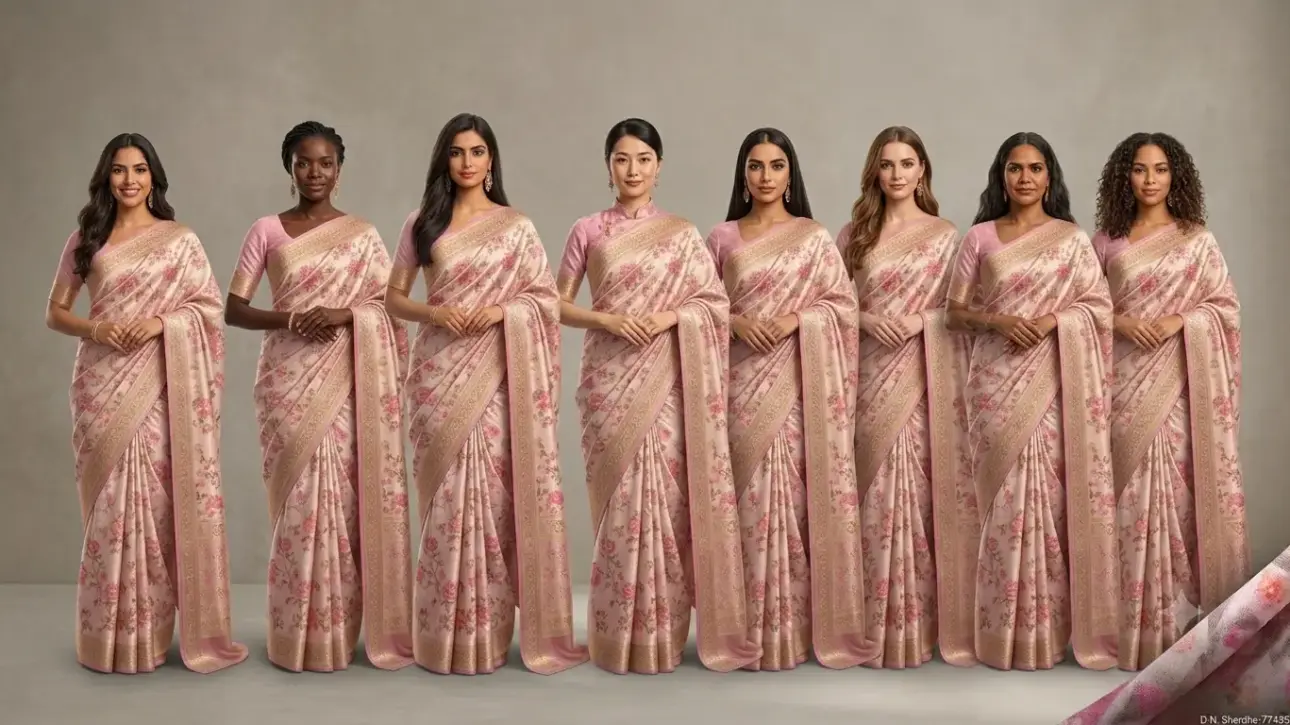
That transition—from a named textile to a commercially manufactured fashion fabric—is where the manufacturing process becomes important.
Uppada Silk Printed Fabric Manufacturing: From Textile Selection to Commercial Production
A finished printed fabric is not created by simply placing artwork on an existing piece of cloth. The outcome depends on a chain of decisions involving the fabric base, fibre composition, construction, preparation, artwork, repeat development, printing technology, colour development, finishing and quality inspection. A weakness at any one of these stages can affect the final material delivered to a garment manufacturer.
For manufacturers working with fashion brands, the challenge is therefore to balance creative requirements with production realities. A print that looks excellent as artwork still has to work across continuous fabric. A colour palette approved on screen still has to be translated into a physical textile. A sample that meets expectations has to become a repeatable bulk-production standard.
This is particularly relevant for Uppada silk because the commercial product name alone does not tell a manufacturer everything necessary about the textile. The actual fibre composition, construction and finishing of the fabric selected for production need to be established before the printing process is finalised.
At Madhav Fashion, this manufacturing perspective is central to the way specialised fashion fabrics should be approached: first understand the textile and its intended application, then develop the print and production process around the actual requirements of the collection.
The Fabric Comes Before the Print
One of the most common mistakes in fashion textile development is to treat the print as the entire product.
For a manufacturer, the print is only one part of the finished fabric. The underlying textile determines how the design will appear, how the fabric will behave during processing and how the finished material will perform in the garment.
With an Uppada silk fabric, the first manufacturing question is therefore not which floral, geometric or abstract design should be printed. It is what specific fabric is being used.
Commercial descriptions such as “Uppada silk,” “Uppada pattu” or related terminology can appear across different textile markets. They should not automatically be interpreted as a single universal technical specification. A manufacturing order needs a defined fabric base with its relevant composition and physical characteristics confirmed for the actual product.
This distinction is especially important when a buyer requires a particular hand feel or drape. Two fabrics can carry similar commercial descriptions and still behave differently because of differences in construction, fibre content or finishing.
For a manufacturer, this means fabric approval needs to happen before production assumptions are made about printing.
The intended end use also matters. A fabric being developed for a saree does not necessarily have the same requirements as one being developed for a fitted blouse, flowing dress, lehenga or designer occasionwear collection. Print scale, density and repeat can interact differently with each garment construction.
Once the fabric base is identified, the manufacturing team can assess the printing requirements more intelligently. The artwork can then be developed around the textile rather than forcing the textile to accommodate an unsuitable design.
That approach also gives buyers a more reliable basis for comparing suppliers. Instead of asking only whether a manufacturer can “print Uppada silk,” the better question is whether the manufacturer can take the specified fabric from sample development through a controlled commercial production process.
Uppada Silk and Uppada Jamdani Are Not Interchangeable Manufacturing Terms
Manufacturing accuracy also requires care with textile terminology.
Uppada has a strong association with the handloom tradition of Andhra Pradesh, and Uppada Jamdani Sarees have a registered geographical indication. That specific identity should not be extended automatically to every commercial textile sold as Uppada silk.
This distinction matters when manufacturers prepare product descriptions, technical documents, export documentation or marketing material for international buyers.
A printed commercial fabric can be developed using a silk base described as Uppada silk without representing it as a handwoven Uppada Jamdani product. Likewise, a buyer looking for a contemporary printed silk fabric should be able to understand the difference between the traditional textile identity and the specific commercial fabric being manufactured.
For an established manufacturer, this is more than a terminology issue. Accurate naming helps prevent misunderstandings between design teams, sourcing departments, factories and end customers.
It also helps international buyers who may encounter different terminology in different markets. An Indian buyer may have extensive familiarity with Uppada pattu, while an overseas designer may know only that they are looking for an Indian silk fabric suitable for printing. The manufacturer’s role is to provide enough technical information for both audiences to understand the actual material being supplied.
A strong manufacturing process therefore starts with precise identification rather than relying entirely on the familiarity of a textile name.
How a Printed Fabric Development Project Actually Begins
A commercial printed fabric project normally begins with a brief.
The brief may come from a fashion designer, sourcing company, apparel manufacturer or brand development team. It can range from a finished print file to something as early as a visual direction or collection moodboard.
The manufacturing requirements become clearer when the buyer provides information about the intended garment, approximate quantity, preferred fabric, artwork status, print direction and target market.
A buyer with a completed repeat artwork has a different requirement from a designer who wants the manufacturer to help develop the artwork into a production-ready repeat.
The quantity also changes the manufacturing discussion.
Small development quantities and sampling projects can benefit from digital printing because the process allows detailed artwork to be tested without requiring the same production setup associated with some conventional bulk printing methods. It is particularly useful when the buyer is still evaluating colours, motif scale or the overall appearance of the collection.
Once the artwork is approved and the project moves into larger production, the manufacturing objective changes. The priority becomes controlled reproduction of the approved design across the required quantity. Depending on the fabric, artwork, quantity and production setup, bulk printing technologies such as rotary or screen printing may become appropriate.
This is why a manufacturer should not promise one printing method as the answer to every project.
The right production route is determined by the combination of fabric + artwork + quantity + required consistency + commercial objective.
That is the foundation of responsible textile manufacturing.
Developing Artwork for Continuous Fabric Production
Artwork created for fashion fabric is different from artwork created for a poster, website banner or standalone garment panel.
Fabric is continuous. The design has to work not just in one view but across metres of material.
This makes repeat development one of the most important stages of printed fabric manufacturing.
The manufacturer and design team need to establish how the motif will repeat, what scale it should have, how much visual space should exist between elements and whether the pattern needs directional control. A design that appears balanced as a single image can become repetitive or crowded when tiled across the entire fabric width.
Colour also needs to be evaluated in relation to the fabric surface. Silk-based fabrics can create a different visual response from matte textile surfaces because their inherent lustre can influence how colours are perceived.
The objective is not necessarily to reproduce a digital artwork file without alteration. The objective is to achieve the intended visual result on the actual textile.
This can involve technical adjustments during development.
For example, a fine detail may need to be evaluated at production scale. A particular colour may need physical approval. A motif may need repositioning within the repeat. A dense area of artwork may need to be reconsidered depending on the desired appearance of the final fabric.
These decisions are part of manufacturing, not evidence that the original design was wrong.
Good textile development is a translation process between creative intent and physical production.
Digital Printing and Bulk Printing Serve Different Stages
Digital printing has changed the way fashion brands develop printed fabrics because it makes design experimentation considerably more practical.
A designer can submit a complex artwork, test a colour story and evaluate the appearance on a selected fabric without immediately committing to a large conventional print setup. This makes digital printing particularly valuable during sampling and for smaller or highly design-specific production requirements.
For custom fashion development, this flexibility can be extremely useful.
However, digital printing should not be presented as an unlimited replacement for bulk printing.
When a design moves into substantial production, the commercial requirements can be different. The artwork and colour specifications may already be locked, and the manufacturer needs to reproduce the approved result consistently across a larger quantity. At that stage, conventional bulk processes can be appropriate depending on the project.
Rotary and screen printing can offer production efficiencies when the order quantity and design requirements justify the setup. The specific choice depends on the textile, number of colours, artwork characteristics, order size and available production process.
For buyers, the important lesson is to separate development technology from production strategy.
A project can begin with digital sampling and later transition to a bulk production method. That is not inconsistency. It is often a logical manufacturing workflow.
The key is that the physical approved standard must remain the reference throughout the transition.
Colour Approval Is a Manufacturing Milestone
Colour is one of the most sensitive areas of printed textile production.
A designer may approve an artwork on a calibrated screen, but the screen image is not the finished fabric. The appearance of the colour depends on the textile surface, printing process, colour system and finishing.
This is why serious commercial development should include physical colour evaluation.
A manufacturer needs to know what the buyer has actually approved. If the project contains multiple shades, subtle gradients or brand-specific colours, the approval process becomes even more important.
The objective is not to eliminate every possible variation in textile production. Rather, it is to establish a practical and agreed standard so that the production team and buyer are evaluating the same target.
For repeat orders, this becomes especially valuable.
A fashion brand may develop a print in one season and return to the same design later. Without an established reference, the buyer may compare the new production against memory or against a digital image. A physical approved standard gives the manufacturing team a much stronger basis for maintaining continuity.
For a manufacturer, colour management is therefore part of production control rather than simply a finishing-stage concern.
Allover Printing Versus Placement Printing
The difference between an allover print and a placement print is fundamental to how fabric is manufactured.
An allover design is developed as a repeating pattern that can run continuously across the fabric. It offers flexibility because the garment manufacturer can cut different styles from the same fabric without depending on a single predetermined motif position.
This makes allover printing a practical route for many commercial fashion collections.
Placement printing works differently. The artwork is positioned intentionally for a particular garment component or construction. The design may be created to appear on a front panel, bodice, sleeve, border or other defined area.
Placement printing can create a highly controlled visual result, but it requires more information from the buyer.
The manufacturer may need garment dimensions, panel sizes, artwork positioning and cutting information. The production process is consequently more closely connected to the final garment.
For Uppada silk printed fabric, neither format is automatically superior.
The decision should come from the design objective.
A brand producing multiple silhouettes from a single printed fabric may benefit from an allover repeat. A designer creating a limited occasionwear collection may prefer placement artwork where a major motif is intended to become the visual focus of a specific garment area.
Manufacturing becomes more efficient when this decision is made before production rather than after fabric has already been printed.
Sampling Is Where Creative and Manufacturing Decisions Meet
A sample is not merely a smaller version of the final order.
It is an opportunity to test whether the proposed combination of fabric, artwork, colour, scale, repeat and printing process works in physical form.
For a manufacturer, sampling can reveal issues that are difficult to identify from artwork alone. The fabric may respond differently than expected. The print may require a scale adjustment. A colour may appear different against the silk surface. The density of a motif may need refinement.
The buyer can also assess the qualities that cannot be judged adequately from an image: hand feel, drape, surface appearance and overall suitability for the intended garment.
This is particularly important for international B2B sourcing because the physical sample may be the first point at which the buyer and manufacturing team are evaluating exactly the same object.
Once the sample is approved, it becomes a production reference.
That reference should ideally identify the relevant characteristics of the order rather than simply being retained as a visual example. The fabric base, artwork version, repeat, colour direction and other agreed details should be clear enough to support the transition into bulk manufacturing.
A disciplined sampling process reduces uncertainty later.
Quality Control for Printed Silk Fabric
Quality control in printed fabric manufacturing is broader than checking whether the design appears on the cloth.
The inspection process should consider the fabric and the print together.
Depending on the product, relevant checks can include fabric appearance, width, surface consistency, print clarity, repeat accuracy, colour consistency and visible defects. The exact quality parameters should be agreed according to the fabric and buyer’s specification.
For printed fashion fabric, visual consistency is particularly important because the material may be cut across multiple garments. A significant difference between sections of the same production run can affect the appearance of the finished collection.
Print registration and motif continuity can also matter where the design contains geometric structures or fine repeated elements.
The purpose of quality control is not simply to reject defective fabric at the end of production. It is to create checkpoints throughout the process so that problems can be identified before they become larger commercial issues.
That requires coordination between production, printing and inspection teams.
For international buyers, this process also provides confidence that the approved sample is being treated as a manufacturing standard rather than as a one-time showcase piece.
What Fashion Brands Should Ask a Manufacturer Before Production
A professional buyer should be able to ask detailed questions before approving a printed silk project.
What is the confirmed fibre composition of the fabric?
What is the construction and agreed specification?
Which printing method is proposed and why?
Is the artwork production-ready?
Is the design allover or placement-based?
What is the repeat size?
How will colours be approved?
Will a physical sample be produced before bulk?
What is the expected production quantity?
What is the MOQ for the specific development?
What happens if the buyer needs a repeat order later?
These questions do not make the sourcing process unnecessarily complicated. They make expectations visible before money and production time are committed.
A manufacturer should also be able to explain which decisions need to be made by the buyer and which can be handled during technical development.
For example, a buyer may own the artwork but still need manufacturing input on repeat construction. Conversely, a manufacturer may advise on production feasibility but should not arbitrarily change the creative direction without approval.
The strongest manufacturer-buyer relationship is therefore collaborative without becoming ambiguous about responsibility.
Manufacturing for Indian and International Fashion Markets
The demand for printed silk fabrics does not come from one type of fashion market.
Within India, silk-based printed fabrics can participate in ethnicwear, occasionwear, designer collections and contemporary interpretations of traditional clothing. The same manufacturing capability can also support brands developing modern silhouettes.
Internationally, buyers may approach the category differently. Some may be looking specifically for Indian textile character. Others may simply be searching for a silk fabric with a particular drape and print capability.
This difference changes how a manufacturer should present the product.
International buyers often need clear technical information because they may not be familiar with local textile terminology. They may also need consistent communication around sampling, production, packaging and shipping.
A manufacturer serving such buyers therefore needs more than product knowledge. It needs the ability to translate manufacturing information into a form that a designer, sourcing manager or production team can use.
That is particularly valuable for custom fabric development.
A buyer in another country may send artwork, measurements and a production brief without being able to inspect the manufacturing facility personally. The quality of the communication and approval process becomes part of the sourcing experience.
For Madhav Fashion, this manufacturing-led approach is important because the value of a textile supplier is not limited to the fabric catalogue. It is also the ability to support the journey from concept to commercially usable fabric.
Building a Printed Silk Collection Instead of Ordering One Fabric
Large fashion brands rarely think about a fabric as an isolated product.
They often think in collections.
A collection may contain multiple colourways of one artwork, several print scales, complementary designs or related fabrics for different garment categories. Once this happens, the manufacturer’s ability to manage consistency becomes increasingly important.
A brand may begin with one sample and later require multiple colour developments. Another may approve a signature print and want it adapted for different colour stories. A private-label manufacturer may need a recurring print programme across seasonal collections.
These projects require a more structured manufacturing approach than one-off sampling.
Artwork versions need to be controlled. Colour references need to be clear. Fabric bases need to be identified correctly. Bulk production needs to be connected to the approved development.
This is where manufacturing experience becomes commercially valuable.
A supplier that can support only the first sample may still be useful for experimentation. A manufacturing partner that can manage development and then move into controlled production provides a different level of value for brands planning recurring collections.
For designers building a long-term textile language, that continuity can matter as much as the initial print itself.
Why Manufacturer Selection Matters More Than the Keyword
Searching for “Uppada silk printed fabric manufacturer” may produce many supplier listings, but a keyword match does not establish manufacturing capability.
The buyer still needs to determine whether the supplier actually understands the fabric, has access to the required production process, can develop custom artwork and can support the quantity required.
This is particularly important in online sourcing.
A professional manufacturer should be able to discuss the actual fabric rather than relying entirely on photographs. It should ask about quantity and application. It should distinguish sampling from bulk production. It should explain how artwork is approved. It should be transparent about specifications that vary by product.
These are signs of a manufacturing conversation rather than a catalogue transaction.
For international buyers, this distinction can save considerable time. Instead of comparing dozens of listings based primarily on images and headline prices, the sourcing team can evaluate suppliers according to their ability to manage the entire development process.
The lowest quoted price is not necessarily the lowest total cost if the buyer has to repeat sampling, correct production problems or replace unsuitable material.
In commercial fashion manufacturing, reliability is itself a sourcing consideration.
Madhav Fashion’s Manufacturing Perspective
Madhav Fashion approaches textile production from a manufacturing perspective, with fashion fabrics positioned as part of a larger production ecosystem rather than as isolated catalogue items.
For buyers interested in printed silk and specialised fashion fabrics, that means the conversation can begin with the actual material and move toward the intended application, artwork and production requirement.
A project may involve an existing fabric and buyer-supplied artwork. Another may require development of a print direction before production. The manufacturing route can then be evaluated according to quantity, fabric construction and design requirements.
The important principle is that the production method should follow the project rather than the other way around.
Sampling provides the opportunity to validate the fabric and print. Approval establishes the production reference. Bulk manufacturing then works toward reproducing that approved standard at the required scale.
This approach is particularly relevant for designers and brands that are developing products for commercial sale rather than buying fabric purely for personal use.
The manufacturer’s responsibility is not to replace the designer’s creative direction. It is to help turn that direction into a fabric that can actually be produced.
That distinction sits at the centre of professional textile manufacturing.
The Future of Printed Uppada Silk in Fashion Manufacturing
The future of Uppada silk printed fabric is likely to be shaped by the intersection of traditional textile identity and contemporary manufacturing flexibility.
Designers are increasingly able to work with smaller development runs, digital artwork, faster sampling and more specialised collections. At the same time, established bulk printing remains important for commercial quantities where production efficiency and consistency are priorities.
This creates space for traditional Indian fabric identities to enter new fashion categories without being limited to their historical applications.
The opportunity is not to remove the cultural identity associated with Uppada. It is to understand the textile accurately enough that it can be developed responsibly for modern fashion.
That requires manufacturers to be precise about material composition, honest about product terminology and disciplined about sampling and bulk production.
For buyers, it means looking beyond a fabric photograph and asking how the material will move through the manufacturing process.
For manufacturers, it means treating every custom print as a combination of textile engineering, design interpretation and production control.
When those three elements work together, an Uppada silk base can become much more than a traditional textile reference. It can become part of a contemporary fashion collection designed for Indian and international markets alike.
Printed Uppada silk sits at the meeting point of textile heritage and modern fashion manufacturing.
Its commercial potential depends not simply on the name Uppada or on the attractiveness of a printed design, but on the quality of the underlying fabric, the suitability of the printing process, the accuracy of artwork development, the discipline of sampling and the consistency of bulk production.
For designers and brands, the most productive sourcing process begins with clear requirements. The fabric should be identified accurately, the intended garment should be understood, the print should be developed at production scale, colours should be physically evaluated and the approved sample should become the reference for bulk manufacturing.
For manufacturers, the responsibility is to make those steps work together.
That is the difference between simply supplying printed fabric and manufacturing a textile product that is ready for a commercial fashion collection.
Madhav Fashion’s manufacturing-led approach is built around this broader understanding of textile development: connecting fabric selection, print development and production requirements so that a designer’s concept can move from artwork to a manufacturable finished fabric.