


A printed fabric sample can look perfect on a cutting table and still leave important questions unanswered before a bulk order begins.
This is especially relevant when a buyer is developing Nylon Dhupian Printed Fabric for dresses, sarees, dupattas, occasionwear, ethnic collections, or private-label production.
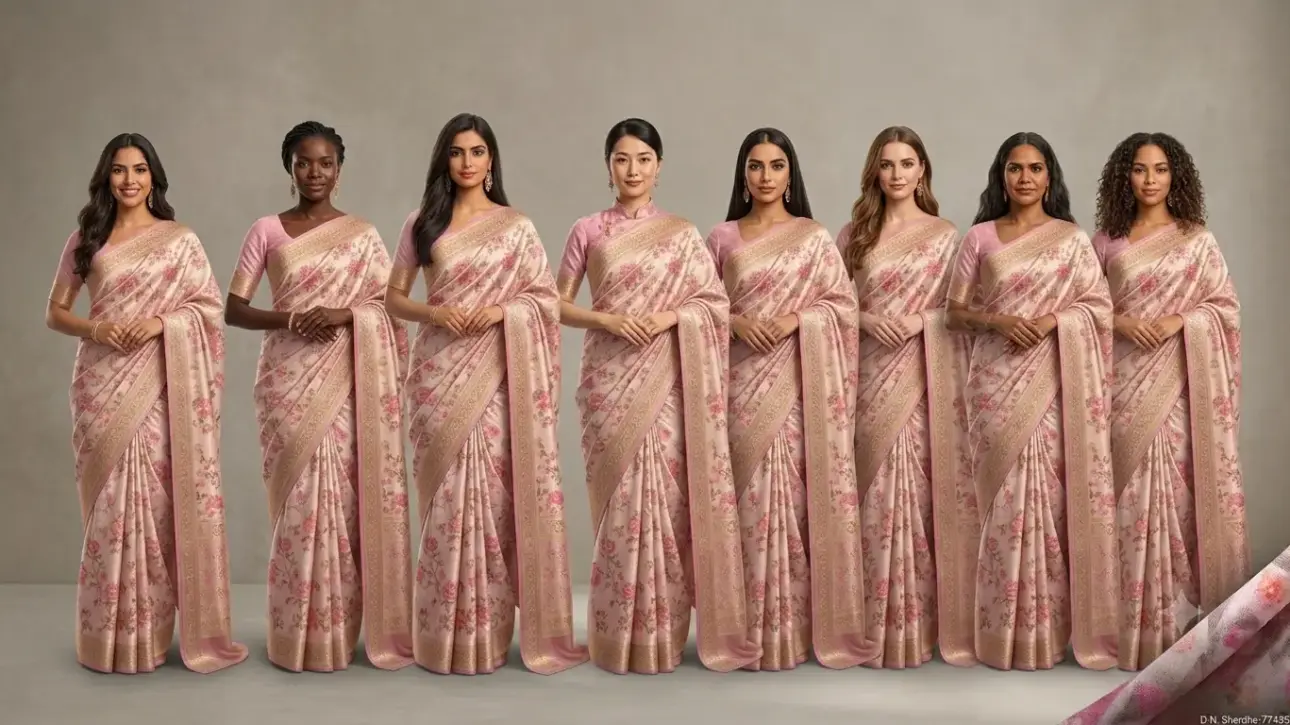
The first sample proves that an artwork can appear on the fabric. It does not automatically prove that the same visual result can be reproduced consistently across a commercial production run.
That difference is where professional fabric manufacturing begins.
For a buyer, the real transition is not simply:
Artwork → Printed Fabric → Bulk Order
It is closer to:
Fabric Selection → Artwork Preparation → Print Sample → Approval → Production Reference → Bulk Printing → Roll Inspection → Cutting → Garment Production
Each stage answers a different question.
The purpose of this article is to explain what buyers, garment manufacturers, exporters, designers and sourcing teams should examine when moving Nylon Dhupian from a successful sample toward repeatable bulk production.
Madhav Fashion approaches this process from the manufacturing side: the objective is not only to create an attractive printed surface, but to establish a clear production reference before larger quantities are released.
A Sample and a Bulk Production Run Have Different Jobs
The first mistake in printed-fabric development is treating a sample as a miniature bulk order.
A sample is primarily a decision-making tool.
It allows the buyer to evaluate:
- the appearance of the artwork
- the relationship between print and fabric surface
- colour direction
- motif scale
- repeat appearance
- garment suitability
- overall visual balance.
Bulk production has a different responsibility.
Once an order moves into production, the manufacturer has to reproduce the approved direction across a larger quantity while controlling the variables that can affect the final fabric.
That means a bulk production reference may need to identify:
- approved fabric base
- approved artwork
- approved repeat
- approved colour direction
- print scale
- print placement or repeat logic
- applicable finishing requirements
- inspection expectations
- packing and roll identification.
The important point is simple:
A sample is approved visually; bulk production must be controlled operationally.
Why Nylon Dhupian Needs to Be Considered Before the Artwork Is Finalized
Nylon Dhupian is not just a blank surface waiting for a graphic.
Its surface character influences how the printed design is perceived. A current FabricDiary product listing, for example, identifies an individual Nylon Dhupian printed product as 100% nylon, with digital printing and fashion applications; those specifications belong to that particular product and should not automatically be treated as universal specifications for every Nylon Dhupian construction.
For production development, this means the buyer should first establish which actual fabric base is being approved.
A print file cannot be separated completely from its substrate.
The same artwork may produce a different visual impression when transferred onto:
- a matte fabric
- a lustrous fabric
- a textured fabric
- a fluid fabric
- a structured fabric.
Therefore, artwork approval should always be connected to the fabric sample on which it was evaluated.
The production question is not only:
“Does this print look good?”
It is:
“Does this print look correct on this exact fabric construction?”
That distinction becomes increasingly important when the same artwork is intended for repeat production.
Stage One: Confirm the Fabric Before Printing
Before discussing colours or motifs, the manufacturing team needs a clear fabric reference.
For a buyer, this can include:
- fabric name
- composition
- construction
- width requirement
- surface appearance
- hand feel
- intended garment
- print method under consideration
- finishing requirements where applicable.
Specifications should be agreed according to the actual production requirement rather than copied from another Nylon Dhupian product.
This is particularly important because Nylon Dhupian can exist in different constructions and commercial specifications.
A buyer developing a lightweight fashion dress should not automatically assume that the construction used for a structured garment will produce the same result.
What should be locked first?
Fabric first. Print second.
Once the base is approved, artwork evaluation becomes much more meaningful.
Stage Two: Convert the Artwork Into a Production File
A designer may send an attractive artwork file, but a manufacturing file has another purpose.
It must communicate exactly what is expected to appear on fabric.
Before printing, the production team may need to clarify:
- final repeat dimensions
- motif scale
- artwork orientation
- colour separations
- background colour
- repeat direction
- border requirements
- placement requirements
- file resolution
- intended fabric width
- whether the artwork is allover or engineered.
This is where a fashion illustration becomes a production instruction.
For example, “large floral print” is a design description.
A production-ready instruction is much more precise:
- floral artwork
- defined repeat
- defined motif scale
- defined background
- specified colourway
- defined orientation
- approved fabric width
- approved sample reference.
The more precisely these elements are communicated, the less room there is for interpretation.
Repeat Size Can Change the Entire Commercial Result
Repeat development is sometimes treated as a graphic-design detail.
For garment production, it is much more than that.
Imagine the same floral artwork developed with three different repeat sizes.
Small repeat
The design may create a continuous visual texture across the garment.
It can be useful when:
- the garment is cut into many smaller panels
- the buyer wants an allover appearance
- the print should remain visible without dominating the silhouette.
Medium repeat
This can provide a balance between individual motifs and overall coverage.
It may work well for:
- dresses
- skirts
- kurtis
- blouses
- coordinated fashion pieces.
Large repeat
Large motifs become more dependent on garment dimensions.
They may work particularly well when the garment has:
- broad panels
- flowing front bodies
- large skirts
- wide sleeves
- statement silhouettes.
The key manufacturing lesson is:
The repeat should be evaluated against the garment, not only against the flat fabric.
Why the Same Print Can Look Different on a Roll and on a Garment
A fabric roll presents the artwork continuously.
A garment breaks that artwork into pieces.
This creates an important transition.
On a fabric roll, a buyer may see:
motif → motif → motif → motif
After cutting, the same design becomes:
front panel + back panel + sleeve + neckline + skirt + side panels
The relationship between those pieces changes the visual impact.
A large flower positioned beautifully in the middle of a fabric roll may be divided during cutting.
A dense repeat that appears balanced on a flat swatch may become visually crowded when several panels meet.
This is why garment visualization is useful before bulk production.
The buyer does not need to evaluate only the fabric.
They should evaluate fabric + repeat + garment pattern.
Allover Prints and Engineered Prints Should Not Be Treated the Same
Nylon Dhupian can be developed for different print structures.
Allover repeat
The artwork repeats continuously across the fabric.
This approach is generally easier to integrate into multiple garment styles because the print is not dependent on one fixed garment position.
It can be suitable when the buyer wants:
- flexible cutting
- multiple garment styles
- coordinated collections
- repeated commercial production.
Engineered or placement print
The artwork is developed around a specific garment area.
For example:
- a central floral panel
- a border
- sleeve artwork
- neckline artwork
- hem decoration.
- This requires a different production conversation.
The manufacturer needs to understand the garment dimensions and placement requirements much earlier.
A placement print should therefore not be handled as though it were simply an allover print with a different artwork.
Colour Approval Is More Than Choosing a Digital Screen Colour
A colour shown on a monitor is not the final physical fabric.
The final appearance depends on the interaction between:
Artwork + colour development + fabric + printing process + finishing + viewing conditions
This is why physical approval matters.
For commercial production, the buyer should establish a clear physical reference rather than relying exclusively on a screen image.
A useful approval reference may identify:
- background shade
- major print colours
- accent colours
- tonal relationship
- contrast level
- overall colour direction.
One important rule
Do not approve only the artwork file.
Approve the printed fabric sample.
That physical reference becomes much more useful when bulk production begins.
One Colourway Is Not Necessarily One Collection
A manufacturer may receive one floral artwork and a buyer may eventually need:
- pastel version
- dark version
- festive version
- neutral version
- monochrome version.
Instead of developing each print independently, brands can build a controlled colourway system.
For example:
Base Artwork
Same floral composition.
Colourway A
Light background + soft floral tones.
Colourway B
Deep background + stronger contrast.
Colourway C
Neutral background + restrained accents.
The artwork remains recognizable while the commercial positioning changes.
This is useful for brands building a collection rather than ordering one isolated fabric.
Print Density Matters as Much as Print Size
Two prints can use the same motifs but feel completely different.
Consider:
Design A: large motifs + generous negative space
Design B: large motifs + dense coverage
Both may contain the same flowers.
Yet the finished garments can communicate completely different visual directions.
For Nylon Dhupian, the buyer should evaluate:
- motif density
- background visibility
- negative space
- contrast
- repeat frequency
- overall visual weight.
This is particularly important for occasionwear, where the fabric may later be combined with embroidery, embellishment, borders or garment detailing.
The print should support the garment rather than unintentionally competing with every other design element.
The Background Colour Is Part of the Print Design
A common development mistake is to focus on motifs and treat the background as secondary.
It is not secondary.
- A floral design on:
- ivory
- black
- wine
- navy
- powder blue
- beige
can become six commercially different fabrics.
The motif remains similar, but the perceived mood changes.
Therefore, the background should be treated as an intentional part of the artwork specification.
For bulk development, “same design, different background” should still be treated as a defined colourway rather than an informal change.
What the First Printed Sample Should Actually Tell the Buyer
A sample should answer production questions.
It should not exist simply to make the buyer say:
“Looks beautiful.”
Before approving the sample, ask:
Fabric
Is this the correct fabric base?
Surface
Does the printed surface retain the intended visual character?
Artwork
Are the motifs clear at the selected scale?
Repeat
Does the repeat behave correctly?
Colour
Is the physical colour direction acceptable?
Density
Is the artwork too crowded or too open?
Garment
Does the print make sense for the intended garment?
Production
Can this approved direction be translated into the intended bulk process?
If several of these questions remain unanswered, the sample may be attractive but still not be production-ready.
The Approved Sample Becomes the Production Reference
Once a buyer approves the physical sample, that sample should become a reference for the production team.
This is one of the most important transitions in the entire process.
The production reference can include:
- fabric reference
- artwork reference
- approved colourway
- repeat size
- print orientation
- border or placement information
- approved sample
- buyer comments
- applicable inspection points.
- The objective is to reduce interpretation.
A production team should not have to reconstruct the buyer’s intention from a collection of WhatsApp images, screenshots and verbal instructions.
A clear reference creates a stronger manufacturing handover.
Why Bulk Production Cannot Be Managed From a Screenshot
Screenshots are useful for communication.
They are weak as the sole production reference.
A screenshot can show:
- approximate colour
- artwork
- layout
- inspiration.
It does not necessarily establish the physical appearance of the approved fabric.
For production, the physical sample provides an additional reference point.
That is particularly useful when the buyer’s team, designer, sourcing manager and manufacturing team are working from different locations.
A properly identified sample can bridge that communication gap.
What Should Be Checked Before Bulk Printing?
Before releasing the production quantity, a buyer and manufacturer should align on the key production parameters.
A practical checklist can include:
- Fabric identity
Is the same approved base being used? - Width
Does the production requirement match the approved specification? - Artwork
Is the correct final artwork being used? - Repeat
Is the approved repeat dimension locked? - Colourway
Is the correct colour version being produced? - Orientation
Is the print directional or non-directional? - Placement
If applicable, are placement dimensions defined? - Sample reference
Is the approved physical sample available for comparison? - Inspection
Are the expected visual quality checks understood? - Packing
Are roll identification and packing requirements clear?
The exact checks should be adapted to the buyer’s product and production specification.
Bulk Fabric Needs Roll-Level Thinking
A buyer purchasing a small sample evaluates one piece.
A bulk buyer receives rolls.
That changes the quality-control perspective.
The question becomes:
Does the fabric remain commercially usable throughout the production quantity?
Inspection can therefore involve checking for issues such as:
- visible printing irregularities
- obvious shade differences
- artwork or repeat inconsistencies
- surface defects
- fabric damage
- width variation against the approved requirement
- packing or roll identification problems.
The purpose is not to claim that every roll will be identical in every microscopic detail.
The purpose is to identify commercially significant deviations before the fabric moves further into production.
Why Roll Identification Matters
When multiple colourways or production lots are involved, identification becomes important.
A buyer may receive:
- Colourway A
- Colourway B
- repeat order
- different production lots
- separate packing units.
Clear roll identification helps the garment-production team understand what it is handling.
This becomes particularly important when fabric is sent from a textile manufacturer to another factory for cutting and stitching.
The more steps between printing and garment production, the more valuable clear identification becomes.
Fabric Inspection Before Cutting Is a Separate Decision
Receiving fabric does not necessarily mean it should immediately go to the cutting table.
For commercial garment production, the fabric should first be checked against the agreed requirements.
The cutting team should know:
- which fabric is approved
- which colourway is being used
- whether the print has a direction
- whether borders need alignment
- whether the artwork requires special cutting consideration
- whether different rolls should be segregated.
This is where textile inspection connects directly with garment manufacturing.
A fabric can be correctly printed and still require careful cutting planning.
Directional Prints Need More Cutting Attention
An allover non-directional print can generally be approached differently from a directional design.
With directional artwork, the cutting team needs to understand which way the design should face.
Examples include:
- upward florals
- vertical geometric designs
- directional artwork
- border prints
- panel-specific designs.
If the cutting plan ignores direction, the final garments may not match the intended visual appearance.
Therefore:
Print direction should be communicated before cutting, not discovered during cutting.
Border Prints Create Another Production Requirement
A border can transform the commercial use of printed Nylon Dhupian.
A border may be intended for:
- sari edges
- dupatta ends
- lehenga hems
- sleeve cuffs
- garment panels.
But the production requirement changes because the border has a defined position.
The buyer may need to specify:
- border width
- distance from fabric edge
- direction
- number of borders
- relationship to the main repeat.
This is why border development belongs to production planning rather than being treated as a simple decorative addition.
Digital Printing and Bulk Printing Solve Different Production Problems
Printing technology should be selected according to the production requirement.
Digital printing can be useful when the buyer needs:
- sampling
- smaller development quantities
- frequent artwork changes
- buyer-specific designs
- multiple colour experiments.
Production-scale printing becomes more relevant when the artwork and specifications have already been approved and the order requires larger-volume manufacturing.
The important point is that customization happens primarily during development and approval.
Once bulk production is released, uncontrolled design changes can create unnecessary complexity.
A professional workflow therefore looks more like:
Develop → Sample → Review → Correct → Approve → Produce
rather than:
Produce → Change artwork → Produce again → Change colour → Reproduce
What Can Be Changed After Sampling?
Not every change has the same manufacturing impact.
Some changes may be relatively straightforward during development:
- minor colour adjustments
- background changes
- motif scale
- repeat size
- artwork refinement.
Other changes can affect the production setup more significantly:
- changing the fabric base
- changing the print structure
- changing from allover to engineered placement
- changing the garment dimensions for a placement design
- introducing a new border arrangement.
Therefore, buyers should communicate changes before final production approval wherever possible.
The earlier a significant change is identified, the easier it is to incorporate into the development process.
Reorders Should Be Treated as a New Production Reference—Not a Memory Exercise
A successful fabric order often creates a second commercial opportunity: the reorder.
This is where documentation becomes valuable.
Instead of saying:
“Please make the same fabric as last time,”
the buyer should ideally be able to provide:
- previous product reference
- approved sample
- artwork
- colourway
- repeat information
- fabric specification
- previous production notes where available.
- This creates a repeatable development system.
For brands, it also reduces dependence on individual employees remembering how an earlier order was produced.
Building a Production File for Every Printed Fabric
A serious fashion brand can treat every successful printed fabric as a controlled product reference.
A simple production file may contain:
Product identity
Nylon Dhupian Printed Fabric
Fabric reference
Approved construction and specification
Artwork
Final production artwork
Repeat
Final repeat dimensions
Colourway
Approved colour reference
Sample
Physical approved sample
Application
Intended garment or collection
Inspection
Agreed visual and dimensional checks
Reorder information
Previous production reference
This turns a one-time fabric purchase into a reusable sourcing asset.
How Garment Manufacturers Benefit From Better Fabric References
For garment manufacturers, printed fabric is not simply an incoming raw material.
It affects:
- cutting
- marker planning
- garment appearance
- panel matching
- sewing
- finishing
- final inspection.
A clear print reference can therefore make communication easier between:
Buyer → Fabric Manufacturer → Cutting Team → Garment Factory → Quality Team
The fabric manufacturer may not control every stage after dispatch, but the quality of the original production reference can help the downstream teams work from the same expectation.
Why Private-Label Brands Should Approve the Garment, Not Only the Swatch
For a brand developing a commercial collection, the fabric swatch is only one level of evaluation.
A better development sequence can be:
Level 1 — Fabric swatch
Does the material and print direction work?
Level 2 — Printed sample
Is the artwork, repeat and colour correct?
Level 3 — Garment prototype
Does the print work after cutting and construction?
Level 4 — Bulk approval
Can the production reference be released?
This is especially useful for statement prints where motif placement has a strong influence on the final silhouette.
The Manufacturer’s Role Changes at Every Stage
A professional manufacturer is not performing the same task from beginning to end.
During development
The focus is interpretation.
The manufacturer helps convert a design requirement into a printable textile specification.
During sampling
The focus is validation.
The sample reveals how the proposed design behaves on the actual fabric.
During approval
The focus is documentation.
The final reference needs to be clear enough for production.
During bulk manufacturing
The focus is consistency.
The approved direction needs to be reproduced according to the agreed production parameters.
During inspection
The focus is identification.
Commercially relevant deviations need to be detected and addressed according to the agreed quality process.
That is why manufacturing expertise is not simply about owning printing equipment.
It is about managing the transition between stages.
What a Buyer Should Send to a Nylon Dhupian Manufacturer
A good inquiry does not need to be complicated.
But it should be specific.
A buyer developing a custom printed Nylon Dhupian fabric can provide:
Fabric
- required fabric type
- composition if specified
- preferred width
- intended garment.
Artwork
- final artwork file
- reference images if needed
- repeat dimensions
- print orientation.
Colour
- preferred colourway
- physical reference where available
- background requirement.
Quantity
- development quantity
- expected bulk quantity
- number of colourways.
Application
- dress
- saree
- dupatta
- skirt
- blouse
- ethnicwear
- occasionwear
- other garment.
Commercial information
- target market
- expected production schedule
- packaging requirements
- delivery destination.
The better the initial brief, the fewer assumptions are required from the manufacturer.
A Practical Bulk Approval Checklist
Before releasing a Nylon Dhupian printed fabric order for bulk production, the buyer can review this checklist.
Fabric
☐ Correct fabric base approved ☐ Composition confirmed ☐ Required width confirmed ☐ Surface and hand feel accepted
Print
☐ Final artwork approved ☐ Repeat approved ☐ Motif scale approved ☐ Direction confirmed ☐ Border/placement requirements documented
Colour
☐ Colourway approved ☐ Background approved ☐ Physical sample retained
Garment
☐ Intended application confirmed ☐ Cutting requirements reviewed ☐ Directional requirements communicated
Production
☐ Bulk production reference issued ☐ Final changes completed before release ☐ Inspection expectations understood ☐ Roll identification requirements confirmed
Reorder
☐ Artwork archived ☐ Approved sample retained ☐ Production reference recorded
This checklist is not a substitute for a manufacturer’s technical quality system. It is a communication framework that helps the buyer and production team work from the same reference.
The Cost of an Unclear Approval Is Usually Bigger Than the Cost of Better Sampling
The value of a good sample is not simply the sample itself.
It is the information the sample prevents the buyer from discovering later.
A clear sample can reveal:
- wrong motif scale
- unsuitable background
- excessive print density
- incorrect colour direction
- poor garment relationship
- unsuitable repeat
- unexpected visual interaction with the fabric surface.
Finding these issues during development is generally more manageable than discovering them after a larger production quantity has been committed.
Therefore, sampling should be treated as a risk-control stage, not merely as a purchasing formality.
Nylon Dhupian Printed Fabric Is a Product, Not Just a Printed Meter
For a manufacturer, the final product consists of several connected decisions:
Fabric + Artwork + Colour + Repeat + Printing + Finishing + Inspection + Packing
Changing one element can influence the commercial result.
That is why the strongest production workflows do not separate the design department from the manufacturing department completely.
The design requirement must eventually become a manufacturing specification.
From One Successful Sample to a Repeatable Fabric Program
The long-term opportunity for brands is not always one successful print.
It is the ability to repeat a successful product.
Suppose a brand develops one floral Nylon Dhupian print successfully.
The next season may require:
- another colourway
- another repeat scale
- another garment
- another quantity
- a coordinated print
- a reorder.
If the original production was properly documented, the manufacturer has a much stronger foundation for the next development.
The result is a more structured product-development cycle:
First Development → Approved Reference → Bulk Production → Garment Collection → Reorder / New Colourway → Next Production
This is where a fabric manufacturer becomes more than a fabric seller.
Why Manufacturing Communication Matters as Much as the Print Itself
Many production problems begin before printing.
They begin with unclear communication.
Examples include:
“Use this colour.”
Which colour?
“Make the flowers slightly bigger.”
How much bigger?
“Same print as the previous order.”
Which artwork version?
“Make it like the sample.”
Which sample?
Manufacturing works better when subjective instructions are converted into references.
Instead of:
“Make it darker.”
Use:
Approved physical colour reference + identified artwork version + defined colourway.
Instead of:
“Make the flowers larger.”
Use:
Approved motif scale or revised artwork.
The goal is not to eliminate communication.
It is to make communication reproducible.
What Experienced Buyers Usually Want From a Manufacturer
A professional buyer does not only want a fabric catalogue.
They need confidence that the manufacturer can understand the production requirement.
That includes questions such as:
- Can the manufacturer work from buyer artwork?
- Can the design be sampled before bulk?
- Can colourways be developed?
- Can the repeat be adjusted?
- Can the approved sample become a production reference?
- Can the bulk fabric be inspected?
- Can the manufacturer support repeat development?
- Can the fabric specification be maintained across future orders?
These questions move the relationship from transactional fabric buying toward product development and manufacturing collaboration.
Madhav Fashion’s Manufacturing Perspective
Madhav Fashion approaches printed fabric development with the understanding that the buyer’s requirement does not end when a print sample is created.
The important transition is from:
“This sample is approved.”
to:
“This approved sample has now become a clear production standard.”
For Nylon Dhupian Printed Fabric, that means connecting fabric selection, artwork preparation, sampling, approval, production, inspection and garment application into one workflow.
The exact production method, fabric specifications and quality checks should always be established according to the buyer’s product, artwork, quantity and technical requirements rather than assumed from a generic Nylon Dhupian specification.
This is particularly important for B2B buyers developing repeat collections, private-label garments and export production.
The Best Bulk Order Begins Before Bulk Printing
The most important stage of a printed fabric order often happens before the first bulk roll is produced.
It happens when the buyer and manufacturer agree on what the final fabric is supposed to be.
For Nylon Dhupian Printed Fabric, that reference can include:
the correct fabric + approved artwork + repeat + colourway + physical sample + garment application + production requirements.
Once these elements are aligned, bulk production becomes a controlled manufacturing process rather than an interpretation exercise.
For designers and brands, this approach can make development easier to repeat.
For garment manufacturers, it can make fabric approval easier to communicate.
For sourcing teams, it creates a clearer handover between development and production.
And for a textile manufacturer, it creates the foundation for a long-term relationship based not only on supplying fabric, but on helping buyers turn a printed concept into a repeatable commercial textile.
Ready to Develop a Nylon Dhupian Printed Fabric?
If you have an existing artwork, reference fabric, colour direction or garment requirement, share the development brief with the manufacturing team.
The most useful starting information is:
fabric requirement + artwork + colourway + repeat/placement requirement + intended garment + approximate quantity.
From there, the development can be evaluated around the actual production requirement rather than a generic fabric description.
For bulk buyers, garment manufacturers, exporters, fashion brands and private-label collections, the goal should always be the same:
approve clearly, produce consistently, and document the fabric so the successful result can be repeated.
Frequently Asked Questions
What is the first step when developing Nylon Dhupian Printed Fabric?
The first step is to confirm the actual fabric base and production requirement before finalizing the print. Artwork should be evaluated on the intended fabric rather than treated independently.
Why is a printed sample important before bulk production?
A sample allows the buyer to evaluate the artwork, repeat, colour, surface interaction and garment suitability before committing to larger production.
Can the same Nylon Dhupian print be produced in multiple colourways?
Yes, an approved artwork can be developed into multiple colourways when the buyer and manufacturer define the required colour direction and production references.
Should the print repeat be approved before bulk production?
Yes. Repeat size can significantly affect the visual appearance of a garment, so it should be established before bulk printing.
What is the difference between an allover print and a placement print?
An allover print repeats across the fabric, while a placement print is engineered for a particular garment area such as a front panel, border, sleeve or hem.
Can buyers provide their own artwork?
Custom artwork can be discussed with the manufacturer. The artwork should be supplied in a format and specification suitable for production development.
Should buyers approve a physical sample or only a digital image?
A physical printed sample is a stronger production reference because the final appearance is influenced by the interaction between artwork and fabric.
What should be checked before cutting printed Nylon Dhupian?
The cutting team should understand the approved fabric, print direction, repeat, border or placement requirements and any specific cutting considerations associated with the artwork.
Why is roll identification important?
Clear identification helps production teams distinguish colourways, lots and fabric references when the material moves from printing to cutting and garment production.
How should a buyer handle a reorder?
A reorder is easier when the buyer retains the original artwork, approved sample, fabric specification, colourway and production reference rather than relying only on verbal instructions.
Can Nylon Dhupian be used for private-label fashion collections?
It can be developed for a range of fashion applications depending on the actual fabric construction, print development and garment requirement.
What information should be included in a custom print inquiry?
A useful inquiry can include fabric requirement, artwork, colourway, repeat or placement information, intended garment, approximate quantity and delivery requirements.
Nylon Dhupian Printed Fabric should not be viewed as a simple combination of fabric and artwork.
For commercial production, the real product is the approved and repeatable specification behind the fabric.
When fabric selection, artwork, repeat, colour, sampling, garment application and bulk inspection are connected, the transition from a single sample to a larger production run becomes much clearer.
That is the difference between simply developing a print and developing a fabric that a fashion business can confidently take into production.