


In the international fashion business, the search for Muslin printed fabric is increasingly less about finding a fabric with an attractive print and more about finding a base that can survive the entire journey from artwork development to garment production. For importers, fashion labels, wholesalers, private-label manufacturers and sourcing teams, the real question is whether a printed muslin-type fabric can deliver the required combination of drape, opacity, print clarity, repeatability, cost control and production consistency.
That is where Poly Muslin Print fabric enters the conversation. It should not be confused with traditional pure cotton muslin. “Poly muslin” is a commercial description whose exact fibre composition, yarn structure, GSM, width, finishing and surface behaviour can vary by construction and supplier. A serious buyer therefore evaluates the physical fabric rather than purchasing only by the trade name.
Muslin Printed Fabric: Why Poly Muslin Is Becoming a Practical Choice for Global Fashion Sourcing
Madhav Fashion, positioned as “Best Embroidery fabric Manufacturer, Exporter in India, Asia,” operates across the broader textile sourcing landscape where printed and embroidered fabrics serve fashion manufacturers, wholesalers, designers and international buyers. Its product proposition includes premium embroidery and printed fabric sourcing, making Poly Muslin Print fabric relevant not merely as another printed textile, but as part of a larger B2B material-selection decision.
The wider Madhav Fashion sourcing proposition is built around helping buyers access premium textile materials from India for international fashion production. In practical terms, that means a buyer looking at Muslin printed fabric should be able to move from visual inspiration to physical sampling, artwork approval, production specification and bulk sourcing without losing control of the fabric identity along the way.
The Word “Muslin” Can Create the Wrong Buyer Expectation
The first mistake in sourcing Poly Muslin Print fabric is assuming that “muslin” defines a single global technical construction.
It does not.
A traditional cotton muslin and a polyester-based muslin-type textile can have completely different fibre behaviour, moisture response, printing chemistry, dimensional stability, care characteristics and production economics.
For a fashion buyer, this distinction is important because the fabric’s performance is ultimately determined by its actual construction.
A more useful sourcing description is:
fibre composition + yarn + construction + GSM + width + finish + print process + repeat + performance requirement.
That specification is much stronger than simply asking for “printed muslin.”
For buyers developing a private-label collection, this distinction can also prevent a common problem: approving a visual sample that looks right but behaves differently when converted into a garment.
The right fabric is not simply the one that looks beautiful on the supplier’s table. It is the one that continues to look and behave correctly after cutting, sewing, pressing, finishing and retail use.
What Makes Poly Muslin Print Fabric Commercially Interesting?
Poly Muslin Print fabric occupies an interesting position between visual softness and production practicality.
The fabric can be developed for printed fashion programmes where designers want movement, pattern visibility and a relatively lightweight visual character without automatically committing to a pure natural-fibre construction.
That makes it relevant to several B2B product categories:
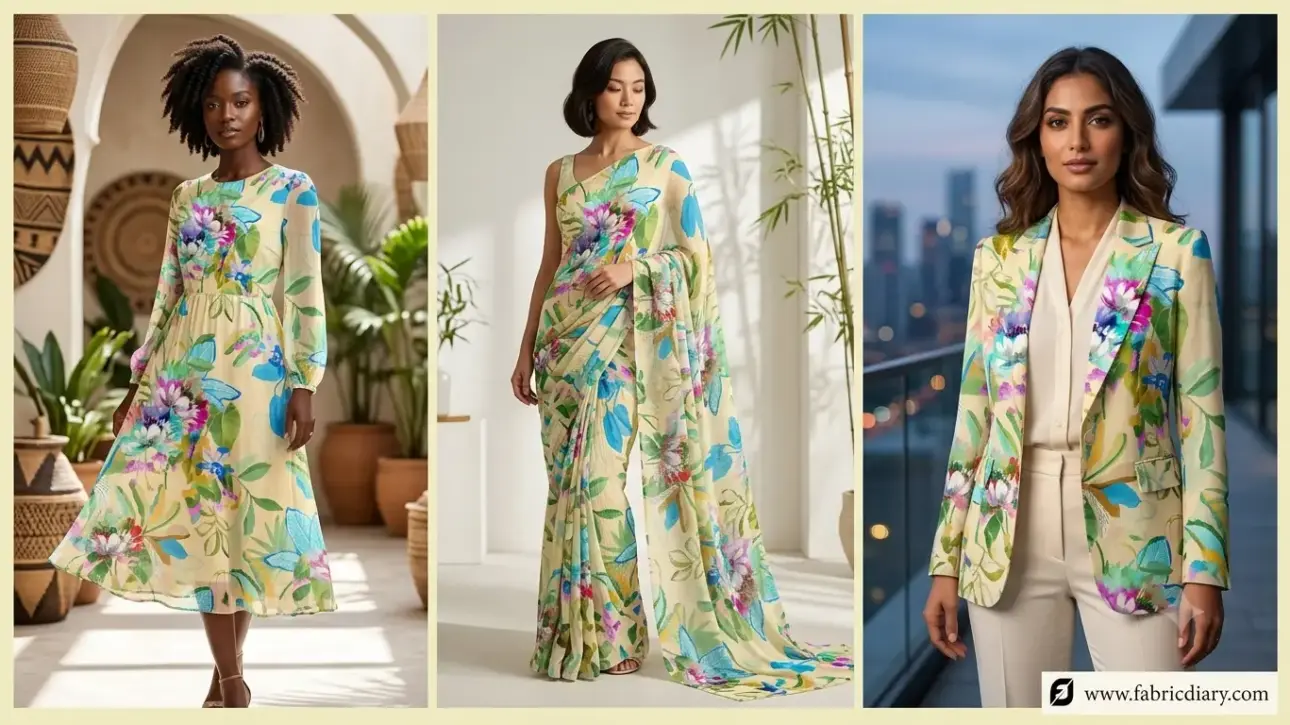
- printed dresses
- blouses
- shirts
- skirts
- co-ordinated sets
- scarves
- dupattas
- fashion overlays
- lightweight seasonal collections
- private-label apparel.
The exact suitability depends on the actual construction.
A more transparent fabric may require lining. A softer construction may be attractive for flowing garments but less appropriate where the designer wants structure. A heavier construction may provide better opacity but change the movement of the garment.
This is why the buyer’s end use must be established before the final base is selected.
The New Fashion Question Is Not “Which Print?” but “Which Print Architecture?
Fashion buyers often begin with artwork.
Professional textile sourcing begins with print architecture.
The same artwork can create completely different commercial results depending on:
- motif scale
- repeat dimensions
- colour density
- direction
- placement
- border treatment
- negative space
- garment pattern
- fabric drape.
An allover floral repeat may work efficiently across multiple garment silhouettes. A large engineered botanical may be better suited to a particular front panel or dress body. A geometric repeat may require precise alignment to prevent an unwanted visual break at seams.
Therefore, a buyer developing custom Muslin printed fabric should decide whether the design is:
Allover repeat
or
Engineered / placement print
before bulk production.
Allover Prints for Commercial Collections
Allover printing remains particularly useful for B2B fashion because the same continuous fabric can be converted into multiple garment styles.
One approved repeat may be used for:
- dresses
- skirts
- tops
- shirts
- scarves
- co-ords.
This gives brands greater flexibility when building a collection around one print story.
It also allows wholesalers and manufacturers to use the same fabric across several SKUs, although garment yield will still depend on the motif scale and pattern layout.
Engineered Prints for Designer-Led Collections
Engineered printing takes a different approach.
Instead of treating the fabric as an endless repeat, the design is developed around the garment.
A border may be positioned along a hem. A central motif may be placed on the front body. A decorative arrangement may be designed around a neckline or sleeve.
This can create a stronger premium-fashion appearance, but it requires greater coordination between textile design and garment pattern development.
For that reason, engineered prints should be approved using the actual garment dimensions wherever possible.
SS and AW: How Buyers Should Think About Print Direction
Seasonal forecasting is useful, but fabric sourcing should not become trapped by short-lived trend language.
For Spring/Summer collections, buyers often explore visual directions that communicate lightness, movement and freshness. Smaller botanicals, airy geometries, soft tonal combinations and open negative space can work effectively when the fabric itself has a fluid hand.
For Autumn/Winter collections, the same construction can be repositioned through deeper colour stories, denser motifs, darker grounds and stronger visual contrast.
The important commercial lesson is that the same fabric base does not need to belong to only one season.
A supplier and buyer can instead change:
- artwork
- colourway
- motif scale
- repeat
- border
- garment application.
That gives a private-label business more flexibility than repeatedly changing the underlying fabric category.
Poly Muslin vs Alternative Printed Bases
Fabric DirectionBuyer Usually EvaluatesCommercial DifferencePoly Muslin Printdrape, print clarity, opacity, cost controlsynthetic/blended muslin-type constructionPure Cotton Muslin Printnatural fibre feel, breathability, print responsedifferent fibre and care behaviourRayon/Viscose Printfluidity, softness, drapecellulosic fibre behaviourPoly Linen-Type Printtexture and linen-inspired appearancemore textured visual identityPoly Pashmina-Type Printfuller tactile characterdifferent seasonal/product positioning
The purpose of this comparison is not to declare one base superior.
A designer building a fluid dress may choose one construction. A wholesaler targeting price-sensitive fashion may choose another. A luxury label developing a particular hand feel may reject both and move toward a different fibre system.
The right decision is always connected to the garment.
What International Buyers Should Ask Before Ordering
A professional buyer should not stop at:
“Send price for printed muslin fabric.”
A stronger RFQ asks for the information that controls the finished garment.
Fibre
Ask for the actual fibre composition.
Allover Prints for Commercial Collections
Request the relevant yarn form and specification, such as filament or staple construction and applicable denier or count.
GSM
Request the actual production GSM or an agreed target range.
Width
Confirm finished and usable width where relevant.
Drape
Evaluate the physical swatch instead of relying on a phrase such as “soft fall.”
Opacity
Test the actual colour and print under appropriate lighting.
Print Repeat
Confirm exact repeat dimensions and direction.
Colour
Approve physical colour references rather than relying only on screen images.
Finish
Ask what finishing treatment has been applied because finishing can alter hand, surface and dimensional behaviour.
Performance
Define the required colourfastness, shrinkage or other performance tests according to the garment’s end use.
This process turns a fashion idea into a manufacturing specification.
Digital Printing Has Changed the Development Conversation
For contemporary fashion businesses, digital printing is particularly valuable during the development stage.
A brand may have:
- five artwork ideas
- three colourways
- two repeat options
- one physical fabric base.
Traditional bulk development of every possibility can become commercially inefficient.
Digital printing allows the buyer to test design directions before committing to a larger production process.
This is especially useful for:
- new brands
- capsule collections
- private labels
- designer collaborations
- seasonal artwork development
- photographic or highly detailed designs.
But digital printing should not automatically be marketed as a universally “zero-water” process.
Actual environmental impact depends on the complete printing system, including pretreatment, ink chemistry, fixation, washing and finishing. Some digital processes can reduce specific process stages, but environmental claims must be tied to the actual production technology rather than the word “digital” alone.
When Bulk Printing Becomes More Logical
Once artwork is approved and production quantities become commercially significant, the buyer should compare digital production with appropriate bulk printing technologies.
The calculation is not simply:
Digital = modern
and
Rotary = old.
The correct question is:
Which process provides the required quality and repeatability at the planned production quantity?
Bulk printing can become commercially attractive when:
- artwork is already approved
- colourways are fixed
- repeat dimensions are locked
- production quantity justifies the setup
- repeatability is important
- unit economics become a priority.
This is particularly relevant for established brands that repeat successful prints.
The smartest sourcing model can therefore be:
Digital development → physical approval → bulk production.
The Importance of the Strike-Off
A digital artwork file is not a fabric approval.
A computer monitor can show colour relationships that change when translated into textile printing.
A strike-off allows the buyer to evaluate the actual artwork on the actual substrate.
The buyer should inspect:
- colour
- motif sharpness
- repeat
- scale
- registration
- print coverage
- hand after printing
- surface appearance
- garment suitability.
If the strike-off is approved, that physical reference becomes a much more useful benchmark for production than a JPEG or PDF alone.
Lab Dips, Colour Approval and Buyer Control
Where colour development involves dyeing or colour matching, lab dips may form part of the approval process. For printed fabric, the strike-off is generally more directly related to artwork evaluation.
The important point is that the buyer should clearly distinguish:
- colour approval
- from
- print approval.
- A colour can be correct while the print is wrong.
- A print can be technically sharp while the colour is wrong.
Both need to be controlled.
For international private-label programmes, an approval record should ideally preserve:
- artwork
- repeat size
- colour references
- approved strike-off
- fabric construction
- GSM
- width
- finish
- inspection requirements.
That record becomes valuable when the same design is reordered months later.
The Role of Fabric Drape in Fashion Design
Drape is one of the least reliable properties to judge from product photography.
A fabric can appear fluid in a hanging photograph but behave differently when cut on:
- straight grain
- cross grain
- bias.
The garment designer should therefore evaluate the actual sample.
Drape influences:
- silhouette
- pleating
- gathering
- sleeve movement
- skirt volume
- hem behaviour
fit
visual rhythm of the print.
The print itself also interacts with drape.
A large floral motif moving across a flowing dress creates a different visual effect from the same motif on a structured shirt.
That is why textile design and garment design should not be treated as separate decisions.
Needle, Thread and Garment Construction
There should not be one universal needle size or sewing specification for every Poly Muslin Print fabric.
The correct sewing setup depends on the actual fabric construction, thickness, surface, machine, thread and garment design.
Before bulk garment production, the manufacturer should test:
- needle compatibility
- stitch formation
- thread tension
- seam puckering
- seam slippage where relevant
- edge handling
- pressing response.
A fabric that performs perfectly during textile inspection can still create sewing problems if the garment-production parameters are not adjusted to the actual construction.
This is another reason why a physical sample is more valuable than a catalogue description.
The Sustainability Question Needs More Precision
Sustainability in textile sourcing has moved beyond simple marketing phrases.
A buyer may ask whether Poly Muslin Print fabric can be produced using a more resource-efficient process. The answer depends on the actual material and technology.
Digital printing can reduce certain setup requirements and may be valuable for sampling because designs can be tested without committing immediately to large conventional print setups.
But “digital” does not automatically mean “zero-water.”
Water consumption can still occur during pretreatment, washing, cleaning or finishing depending on the process.
Likewise, polyester should not automatically be marketed as recycled polyester.
If recycled content is part of the buyer’s requirement, the buyer should request the relevant evidence and certification. GRS is particularly relevant when the commercial claim involves certified recycled materials and chain of custody.
The stronger fashion-business approach is:
make only the sustainability claim that the actual material, process and documentation support.
OEKO-TEX, GRS and REACH: A Buyer’s Perspective
International sourcing teams increasingly separate three different questions:
- What chemicals are present or restricted?
- Is recycled content genuinely certified?
- Does the product meet the destination market’s regulatory requirements?
- OEKO-TEX STANDARD 100 addresses harmful-substance testing within its product-class framework.
- GRS addresses recycled-material claims, chain of custody and additional environmental/social requirements.
- REACH is relevant to chemical regulatory compliance for the European market.
These should not be presented as interchangeable certifications.
For a buyer, the most useful question is:
“Which documentation applies to this exact article?”
That is considerably stronger than asking a supplier to add every possible certification logo to a product page.
Regional Buyer Strategies
North American Buyers
North American private-label and fashion buyers may place strong emphasis on artwork development, repeatability, sample control, usable width and consistent commercial quality.
A practical search may combine:
muslin printed fabric + wholesale + custom + supplier
rather than relying solely on the product name.
For private labels, artwork confidentiality and repeat consistency can also become commercially important.
European Buyers
European sourcing teams may place greater emphasis on fibre disclosure, chemical compliance, documentation and traceability alongside design.
The relevant sourcing conversation can therefore include:
- exact composition,
- production process,
- colourfastness,
- chemical compliance,
- certification where applicable,
- recycled-content documentation where claimed.
The key is documentation rather than generic “eco-friendly” wording.
Middle Eastern Buyers
For many Middle Eastern fashion programmes, visual richness, colour depth, opacity and garment movement can be particularly important depending on the end product.
Print scale also deserves attention.
Large botanical, geometric and decorative repeats can create stronger fashion statements, but the buyer should evaluate the print on the intended garment rather than only on a flat fabric image.
Oceania
For Australia and New Zealand-oriented sourcing, buyers may balance smaller development quantities, international freight efficiency, fabric performance and commercial repeatability.
Sample approval becomes especially valuable when the final production is geographically distant from the textile supplier.
Asia, Latin America and Africa
Price-per-metre can become a more visible sourcing consideration in many high-volume or price-sensitive programmes, but price should still be evaluated against print consistency, usable width, wastage and rejected fabric.
Bold allover patterns, strong colour combinations and commercially efficient repeats can be particularly useful when the fabric is being converted into multiple garment styles.
These are directional sourcing considerations, not universal rules for every buyer in each region.
India as a Fabric Development and Sourcing Base
India’s textile ecosystem is particularly relevant for buyers who want to combine fabric development, printing, embellishment, garment production and export sourcing within one broader manufacturing environment.
For a buyer approaching an Indian supplier, the strongest communication is not a long description.
It is a clear technical brief.
For example:
Fabric: Poly Muslin Print End Use: Women’s dresses Composition: Required / supplier recommendation Target GSM: Buyer specification Width: Required usable width Print Type: Allover repeat Repeat: Defined dimensions Colourways: Number and references Artwork: Buyer supplied Sampling: Physical strike-off required Bulk Quantity: Commercial estimate Testing: Required standards Compliance: Destination-market requirements Packing: Roll specification Destination: Country / port.
This allows the supplier to quote against a real manufacturing requirement.
Cost Is Not the Same as Price
One of the most important lessons for a fashion buyer is that fabric price alone does not determine profitability.
A better calculation considers:
fabric + printing + finishing + packing + freight + duties/taxes + clearance + cutting loss + production wastage + rejected goods.
Print scale can influence cutting efficiency.
Width can influence marker utilisation.
Repeat direction can influence garment placement.
Opacity can determine whether lining is required.
A lower fabric quotation can therefore produce a higher garment cost if it creates additional construction or cutting problems.
The most commercially intelligent buyer evaluates the finished garment economics, not only the quoted metre rate.
MOQ Should Be Discussed as a Production Question
There is no single meaningful MOQ for every custom printed fabric programme.
Digital sampling, strike-offs and commercial bulk production have different economics.
A buyer requesting a few metres for design approval is asking a different question from a brand ordering thousands of metres for a seasonal collection.
MOQ can therefore depend on:
- base fabric availability
- artwork
- printing process
- colourways
- production setup
- quantity
- finishing
- packaging.
The right approach is to ask for a quotation against the actual development and bulk requirement.
Private Label, OEM and ODM Opportunities
Poly Muslin Print fabric can fit three different development models.
Private Label
The buyer supplies artwork or selects from a development range and sells the finished garments under its own brand.
OEM
The manufacturer produces according to buyer-defined specifications.
ODM
The supplier contributes design or product-development capability while the buyer develops the commercial collection under its own brand.
The more design responsibility moves toward the supplier, the more important ownership, approval and repeat-control procedures become.
For custom artwork, buyers should maintain clear documentation around:
- artwork files
- colour references
- repeat dimensions
- approvals
- production revisions.
Quality Control Should Start Before Printing
A common sourcing mistake is inspecting only the finished printed roll.
Quality control should begin with the base fabric.
The inspection sequence can include:
Greige/base fabric → prepared fabric → strike-off → printed bulk → finished roll → packing.
Visual inspection methods such as ASTM D5430 can be incorporated into an agreed fabric-inspection programme. The exact grading/penalty-point system should be specified between buyer and supplier rather than assumed.
Performance testing can be added according to the end use.
For example, ISO 105-X12 can be relevant to rubbing fastness, while ISO 105-C06 addresses colourfastness to domestic and commercial laundering. Where woven-fabric tensile performance needs to be assessed, ISO 13934-1 provides a relevant strip-method test.
The buyer should define the acceptance requirement before production, not after receiving the shipment.
Export Packing and Freight Planning
The final metre of fabric is not the end of the supply chain.
Export packing can influence:
- damage risk
- warehouse handling
- volumetric freight
- roll identification
- receiving efficiency.
Each roll should ideally have clear identification corresponding to the commercial documents.
Depending on the programme, information may include:
- article
- colour
- roll number
- lot
- meterage
- width
- net weight
- gross weight.
- Sample orders may prioritise speed.
Bulk orders may prioritise freight efficiency.
Replenishment orders may require a different balance again.
Therefore, freight should be planned according to the role of the shipment in the buyer’s supply chain.
The Buyer’s Decision Framework
Before selecting Poly Muslin Print fabric, ask seven questions:
- What garment will this fabric become?
The end use determines the required drape, opacity and performance. - What fibre behaviour is required?
Do not choose a fabric by trade name alone. - Is the print allover or engineered?
The answer changes the production and garment-planning process. - Is the design still experimental?
If yes, development flexibility may be more important than bulk-print economics. - Is the artwork locked?
If yes, bulk production economics can be evaluated more seriously. - What documentation is actually required?
Specify testing and certification based on the target market. - What is the total landed garment cost?
Do not judge the fabric only by its quoted metre price.
Why Physical Sampling Still Matters in a Digital Fashion Industry
Fashion sourcing has become increasingly digital, but fabric itself remains physical.
A screen cannot fully communicate:
- hand
- drape
- transparency
- surface friction
- seam behaviour
- pressing response
- movement
- actual print scale.
This is why the most effective B2B workflow combines digital convenience with physical validation.
The artwork can be digital.
The quotation can be digital.
The approval record can be digital.
But the final fabric decision should still be supported by an actual textile sample.
A More Practical Way to Source Muslin Printed Fabric
The most efficient sourcing model is not to begin with a catalogue and ask:
“Which one is cheapest?”
- Instead, begin with the garment.
- Define the desired silhouette.
- Then define the required drape and opacity.
- Then determine the fibre/construction.
- Then select the print architecture.
- Then create the artwork.
- Then produce the strike-off.
- Then approve the physical result.
- Then move into bulk.
This approach reduces the risk of buying a fabric that looks correct online but fails during garment production.
Perspective for International Fashion Buyers
The opportunity around Muslin printed fabric is not simply another keyword in the printed-fabric market.
For fashion businesses, it represents a sourcing question about how a particular textile construction can carry a design from concept to commercial production.
Poly Muslin Print fabric can be useful where buyers want a printed base with a lightweight or flowing visual character and a synthetic or blended construction that can be developed around commercial fashion requirements.
But its success depends on specification.
The fibre must be clear.
The construction must be clear.
The GSM and width must be controlled.
The print repeat must be approved.
The colour must be checked physically.
The printing method must match the substrate and production quantity.
The final roll must be inspected.
The export shipment must be documented.
And any sustainability or certification claim must be supported by the actual product and documentation.
That is the difference between buying a printed fabric and building a reliable textile supply programme.
For international buyers searching for a Muslin printed fabric manufacturer, Poly Muslin Print fabric supplier, custom printed fabric source or bulk textile partner from India, Madhav Fashion can position the category around exactly this process: design understanding, fabric selection, custom development, production control and B2B export sourcing.
In a market where thousands of fabric images can look similar on a screen, the competitive advantage increasingly belongs to suppliers who can explain what happens after the buyer clicks “sample.”
That is where technical clarity becomes commercial value.