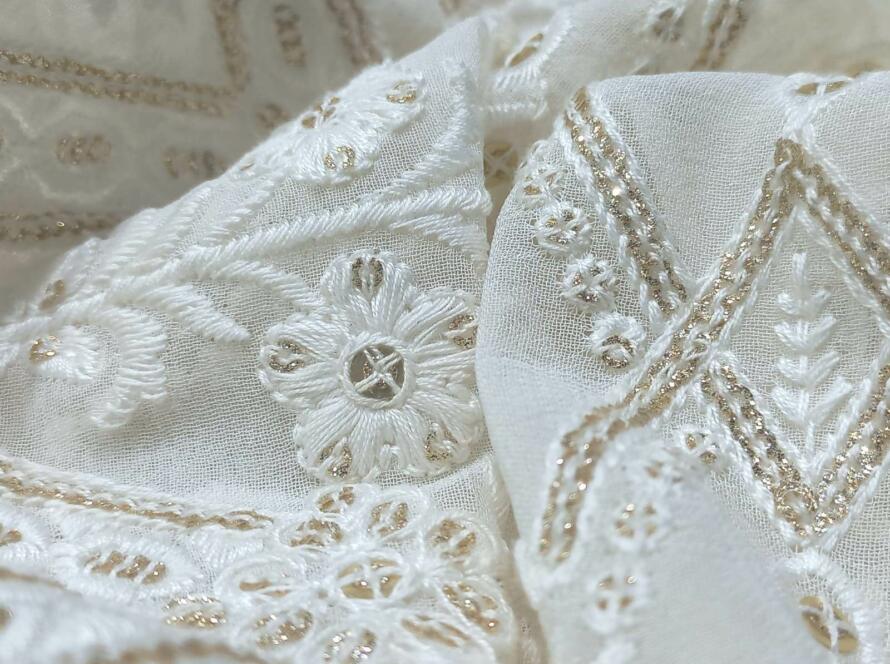



Motif lace is one of the most sought-after elements in couture, bridalwear and festival fashion across Asia. At Madhav Fashion, we specialise in producing design-rich motif lace fabrics crafted using advanced embroidery, cording, and digital enhancement techniques. As one of Asia’s most trusted and innovative motif lace manufacturers, we supply boutique designers, global wholesalers and premium fashion houses through our online export system.
Among the many embroidery legacies of the world, the Heavy Border Embroidery Family — Butta, Butti, Motif, and Patchwork fabrics—stands as one of the most enduring. These fabrics are not simply decorative; they represent a storytelling tradition passed through hands, not books.
Premium Motif Lace Fabric Manufacturer in Asia — Buy Designer Lace Online
They echo the patience of artisans, the rhythm of looms, the precision of needlework, and the cultural narrative woven across continents from India to Africa, the Gulf, Europe, and beyond.
The Heritage Behind Butta, Butti, Motif & Patchwork Work
Heavy embroidery evolved from ancient ceremonial textiles. Royal wardrobes used them as markers of prestige. Folk cultures used them as symbols of celebration. With time, these techniques adapted themselves to modern fashion.
Below is an authentic knowledge-based breakdown—not commercial, but craft-accurate:
Butta — The Poetry of Small Repeated Motifs
“Butta” emerged from classical Indian weaving houses. Small, evenly spaced motifs filled the fabric surface like stars on a night sky. Traditionally made with:
- zari
- cotton thread
- resham
- sequins
- beads
Butta fabrics became staples for sarees, dupattas, light festive clothing, and delicate ceremonial garments.
Their beauty lies in their restraint—never overpowering, always elevating.
Butti — The Bigger, More Artful Cousin
As royalty demanded grandeur, Butta evolved into Butti—larger, more ornate, more detailed.
A typical Butti cluster might include:
- multi-thread embroidery
- mirror placements
- hand-sewn beads
- rich metallic outlines
Butti represents personality—ideal for lehengas, formal gowns, bridal dupattas, and couture silhouettes. Where Butta whispers, Butti speaks.
Motif — The Heart of Storytelling Embroidery
Unlike repeated designs, Motifs are statement elements.
They symbolize:
- flora
- geometric forms
- Mughal-inspired architecture
- peacock themes
- Persian gardens
- paisleys
- cultural icons
Placed strategically on saree pallus, gown bodices, sherwani fronts, and skirt panels, motifs control the visual emotion of the garment.
This is why the global term “Motif Lace Fabric” is now common—it combines the delicacy of lace with the boldness of embroidered motifs.
Patchwork — A Canvas of Many Histories
Patchwork is one of the oldest textile philosophies. It originated when artisans reused leftover embroidered pieces to form new textile surfaces.
Today, it is high fashion.
Patchwork often includes:
- embroidered panels
- appliqué
- lace segments
- cutwork shapes
- hand-stitched borders
The result: a fabric made of memories, each panel with its own story.
Used in jackets, couture gowns, fusion wear, sherwanis, and even luxury home décor.
The Heavy Border: A Tribute to Ceremonial Grandeur
The distinguishing feature of this fabric family is the heavy border—6 to 20 inches of artistry placed at the base of the fabric.
This border is not merely decoration. In heritage textiles, borders marked:
- status
- occasion
- community
- family lineage
- cultural symbolism
Today, heavy border fabrics are prized for bridal wear, lehengas, gowns, sarees, and menswear.
They create the visual weight fashion designers rely on.
Lace vs Embroidery: Two Traditions, One Modern Language
1. Embroidery on Base Fabrics
Fabric types:
- net
- organza
- georgette
- chiffon
- velvet
- silk
- satin
- cotton
This method allows high-density borders, motif placement, and couture-level finishes.
2. Embroidery on Lace
Lace provides an airy, vintage, delicate base.
Embroidery on lace creates:
- see-through elegance
- depth
- overlays for gowns
- ethereal dupattas
- bridal veils
3. Printed Motifs (Modern Interpretation)
For scalable production:
- Butta prints
- Butti prints
- motif panels
- border prints
- patchwork prints
This makes design globally accessible at lower cost—but visually rich.
Why These Fabrics Appeal Globally
Africa – Bold Butti, vibrant patchwork, rich borders. Fashion = celebration.
Middle East – Gold zari, motifs, lace embroidery. Fashion = luxury + modest elegance.
Europe – Minimal motifs, soft borders, couture lace. Fashion = texture + originality.
USA / Canada / Latin America – Printed motifs, sequins, lightweight embroidery. Fashion = trend-speed + comfort.
Asia-Pacific- Pastels, soft motifs, georgette embroidery. Fashion = fusion + subtle elegance.
Craftsmanship Techniques Behind These Fabrics
- sequins embroidery
- cording
- beads & pearls
- zari
- mirror work
- gota
- appliqué
- cutwork
- multi-head machine embroidery
- Schiffli lace embroidery
- hand finishing
Every technique adds a chapter to the fabric’s story.
B2B Perspective: Sampling, Bulk, and Quality
Challenges buyers face:
- inconsistent density
- thread breakage
- color mismatch
- slow shipping
- limited customization
Solutions:
- sampling first (1–3 m)
- standardized QC
- repeatable embroidery files
- dye-lab approvals
- region-specific modifications
- verified export packaging
Order Guidance:
- 1–10 m → sampling / boutique testing
- 10–100 m → small production
- 100–1000+ m → bulk export with discounts
Case Studies
UAE Bridal House – Heavy motif lace used for 2024 bridal capsule → high sell-through due to heritage detailing.
US Couture Label – Patchwork embroidery applied to evening gowns → trending on social media for textural richness.
West Africa Exporter – Bold Butti panels adopted for menswear → strong festival sales.
Why These Fabrics Endure as a Global Textile Language
- They adapt to culture
- They carry history
- They allow creative experimentation
- They are scalable for B2B
- They preserve craftsmanship
- They blend heritage with global fashion trends
The world may modernize its fashion, but artisanal embroidery remains timeless.
The Heavy Border Embroidery Family—Butta, Butti, Motif, and Patchwork—is not a trend. It is a textile heritage that continues to evolve while keeping its soul intact.
Whether used in bridal couture, menswear, children’s ceremonial wear, or global runway collections, these fabrics whisper the same message:
Art survives because hands continue to create.
To explore authentic motif and lace fabrics rooted in history and adapted for global design needs, designers and exporters can now access these traditions through modern platforms—without losing the essence of craftsmanship.