


The conversation around printed georgette has changed as fashion buyers increasingly look beyond a fabric’s appearance and ask a more practical question: how reliably can the same fabric, colour, print and surface be reproduced when a design moves from a sample into commercial production? This is particularly important with Fox Georgette Print Fabric, a trade-oriented category used across fashion manufacturing where the visual character of georgette is combined with a synthetic construction that can be developed for contemporary apparel collections.


For buyers working with private labels, garment factories, wholesalers, exporters, boutiques and fashion brands, the fabric should not be evaluated only from a photograph. Fibre composition, yarn characteristics, fabric construction, GSM, width, transparency, drape, surface finish, print method, colour development, dimensional stability and end-use requirements can all influence the final commercial result.
Fox Georgette Print Fabric: What Global Buyers Need to Know Before Bulk Sourcing
Madhav Fashion approaches this category from that broader sourcing perspective: the objective is not simply to offer a printed fabric, but to help buyers understand how the base fabric and print development work together before they commit to production.
Why Fox Georgette Print Fabric Has Become a Practical Sourcing Category
For a fashion buyer, the attraction of Fox Georgette is often connected to its ability to create a fluid printed appearance without requiring the sourcing economics or construction of a premium natural-fibre georgette. Yet “Fox Georgette” should not be treated as one universally fixed technical specification.
Different mills and suppliers can use the trade description for fabrics with different fibre compositions, yarn characteristics, weights, widths and finishing treatments. That distinction becomes commercially important when a buyer is comparing samples from different suppliers. Two fabrics can both be described as Fox Georgette while behaving differently during cutting, sewing, printing, steaming, washing or garment finishing.
A serious B2B sourcing process therefore begins with the actual technical specification rather than the trade name alone. The buyer should confirm the fibre or blend, construction, GSM, usable width, surface character, opacity, drape, dimensional behaviour and intended printing process before comparing quotations. This is one reason experienced sourcing teams increasingly treat the fabric specification sheet as part of the purchasing decision rather than as paperwork completed after an order has already been negotiated.
The Base Fabric Determines the Commercial Result
Printing cannot compensate for a base fabric that is unsuitable for the intended garment. Fox Georgette is generally selected where the buyer wants a lightweight, flowing fashion-fabric character, but the exact hand feel and performance depend on the construction and finishing used by the supplier.
Yarn characteristics can influence the surface, transparency and visual movement of the fabric, while fabric construction affects how the material behaves when it is printed, cut and stitched. GSM is useful for comparing production references, but it should not be treated as a universal “correct” number because the appropriate weight depends on the buyer’s garment, market and design requirement.
Width is equally important because an apparently competitive price can produce a different fabric yield once usable width and cutting layout are considered. Buyers developing dresses, skirts, scarves, flowing tops, occasionwear or other draped garments should therefore assess the actual fabric in motion rather than relying entirely on a flat swatch.
For Madhav Fashion, the more useful sourcing conversation is consequently not “What is the GSM of Fox Georgette?” but “Which construction, weight, width and finish are appropriate for this specific garment program?”
Printing Technology Matters More Than the Artwork File
A buyer may provide an excellent floral, geometric, abstract or conversational print file and still receive a disappointing production result if the artwork is not engineered for the fabric. Fox Georgette’s lightweight and visually fluid character means that print scale, repeat size, colour separation, registration and surface interaction need to be considered before bulk production.
Digital printing can be particularly useful during sampling, colour exploration and lower-volume development because artwork can be changed without creating the same type of fixed bulk-print setup associated with traditional production methods. For larger commercial programs, rotary or screen-based printing may become more appropriate depending on the artwork, quantity, colour requirements, production economics and mill capabilities.
The important point for the buyer is that digital printing and bulk mill printing are not simply two interchangeable buttons. They represent different production approaches, and the appropriate choice should be made after considering the quantity, repeat, artwork complexity, colour requirements and production schedule.
From Design File to Production Roll
A professionally managed printed-fabric program normally moves through several stages before commercial rolls are released. The process can begin with the buyer’s existing artwork, a reference image, a repeat requirement or a request for custom development.
The artwork is then assessed against the chosen fabric construction to determine whether the design should be treated as an all-over repeat, border, engineered placement or another format. Colour development follows, particularly where the buyer has defined brand colours or needs the production shade to remain consistent with an approved reference. Sampling or a strike-off can then be used to evaluate the relationship between artwork and actual fabric.
At this stage, buyers should look beyond whether the colours “look right” on a screen. They should examine print clarity, motif scale, registration, surface appearance, hand feel, transparency and the behaviour of the fabric after the relevant finishing process. Once the development is approved, production parameters should be locked as clearly as possible so that the bulk order is manufactured against an agreed reference rather than being interpreted again during every production stage.
All-Over Prints Are Usually a Strong Commercial Starting Point
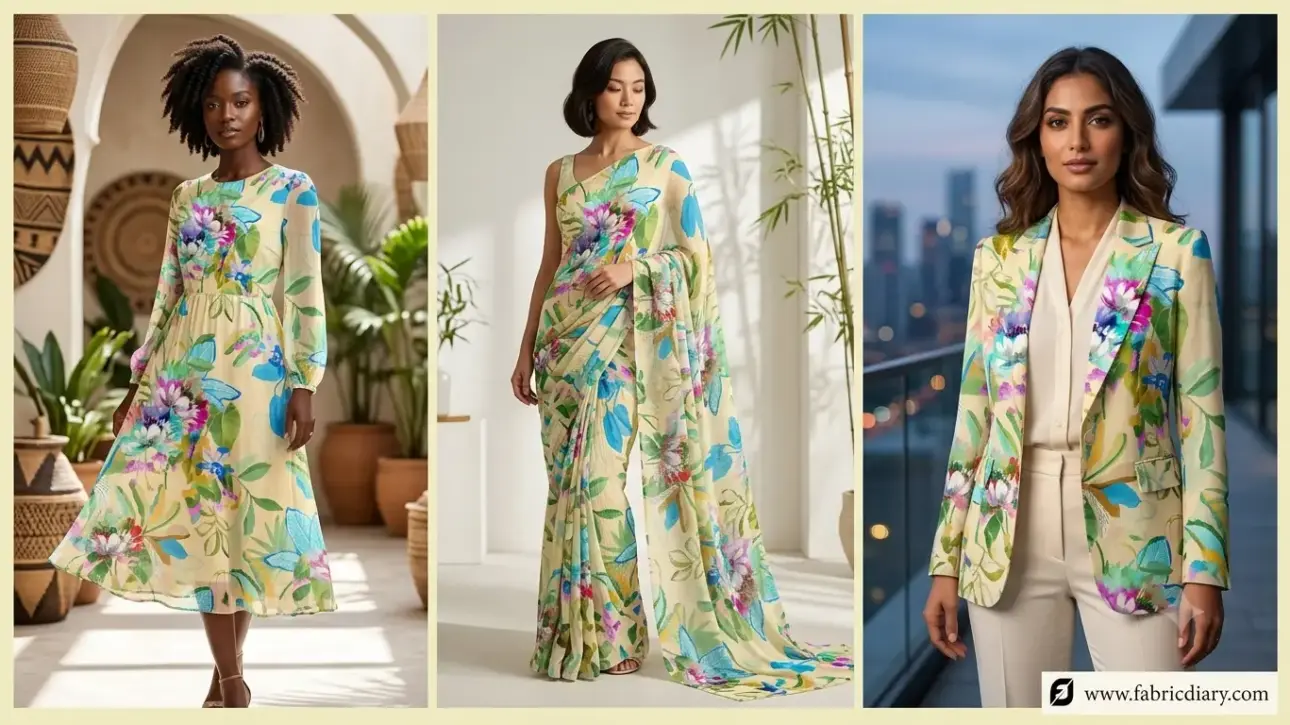
For a general Fox Georgette Print Fabric collection, all-over repeat designs provide broad garment flexibility because the fabric can be cut in different directions and adapted to different silhouettes without depending on a single predetermined placement. Floral repeats, abstract patterns, geometric motifs, small conversational designs and continuous decorative surfaces can therefore work effectively when the buyer wants one fabric reference to serve multiple garment styles.
However, an all-over print is not automatically the best choice for every product. Premium fashion collections may require borders, engineered panels, placement motifs or specific artwork positioning around necklines, sleeves or garment fronts. Such development should be discussed as a custom print requirement rather than assumed to be included in a standard all-over collection. This distinction matters commercially because engineered artwork can affect development, sampling and cutting requirements differently from a conventional repeating print.
What International Buyers Should Check Before Ordering
The most useful Fox Georgette sourcing brief is specific enough for the manufacturer to reproduce the buyer’s requirement without unnecessary interpretation. At minimum, the buyer should identify the intended composition or reference fabric, required width, approximate GSM or weight range where relevant, print artwork, repeat dimensions, colour references, expected quantity, garment application, sampling requirement and destination market.
If the buyer has compliance requirements, those should be stated before production rather than after the goods are manufactured. The same applies to packaging, roll presentation, labelling and shipping documentation. Buyers who simply send a photograph and ask for a price may receive a quotation, but buyers who provide a structured technical brief are much more likely to receive a commercially comparable development. This is especially important when multiple suppliers are being evaluated because a common specification allows price, quality and production capability to be compared on a more meaningful basis.
Quality Control Should Follow the Buyer’s Actual Risk
Visual inspection is one part of textile quality control, but it should not be confused with a blanket certification of fabric quality. ASTM D5430 is a standard test method for visually inspecting and grading fabrics, and its application can be agreed between buyer and seller for commercial acceptance testing. The specific inspection option and grading approach should therefore be defined rather than casually described as an universal quality score.
For Fox Georgette Print Fabric, a practical inspection program can consider fabric width, surface defects, shade variation, print clarity, registration, repeat consistency, stains, holes, streaks, roll condition and other defects relevant to the agreed specification.
Dimensional stability and colour fastness should be evaluated according to the buyer’s end use and the appropriate test method rather than by using vague expressions such as “high quality” or “excellent fastness.” The strongest B2B sourcing relationship is one in which the buyer and supplier agree what will actually be checked before production begins.
Compliance Claims Need to Be Specific
Global fashion buyers increasingly request documentation relating to chemical safety, recycled content and restricted substances, but these requirements need to be connected to the actual product and certification scope. OEKO-TEX STANDARD 100, for example, concerns testing textiles for harmful substances and uses criteria that vary according to product class and intended use.
REACH-related requirements may also become relevant depending on the market and substances involved. Where recycled polyester or another recycled input is specified, buyers may require a recognised chain-of-custody framework such as the Global Recycled Standard, subject to the applicable certification scope.
These are not phrases that should simply be added to a product description to make a fabric appear more premium. The buyer should request the relevant documentation and confirm that it applies to the actual material, production chain and commercial requirement.
Price Should Be Compared Against Yield, Not Only Metres
A Fox Georgette quotation can look inexpensive on a per-metre basis and still produce a higher garment cost if usable width, weight, cutting efficiency, shrinkage or wastage differs from another supplier’s fabric. This is why professional sourcing teams compare the complete material proposition rather than focusing exclusively on the headline metre price.
If two fabrics have different usable widths, for example, the garment marker may consume different quantities even when the nominal price looks similar. Printing method, development charges, sampling, packaging and freight can also influence the landed cost.
For international buyers, the commercial calculation should therefore consider the fabric specification, usable yield, order quantity, production requirements, packaging and transportation together. This approach is particularly relevant for private labels and manufacturers working to a defined garment cost because a small difference in fabric utilisation can become meaningful across a larger production program.
Which Buyers Are Most Likely to Source It?
Fox Georgette Print Fabric can fit several B2B sourcing models, but each buyer approaches the material differently. A boutique or emerging fashion label may prioritise low-risk sampling, custom artwork and the ability to develop several colourways without committing immediately to very large production. A private-label brand may focus more heavily on repeatability, colour consistency, specification control and delivery planning because the same reference could become part of a seasonal collection.
A garment manufacturer or export house may be more concerned with cutting yield, usable width, bulk consistency and compatibility with an established production line. Wholesalers may prioritise commercially versatile prints that can serve multiple downstream buyers.
Designers, meanwhile, may care most about drape, surface appearance, motif scale and how the print behaves across the finished silhouette. Understanding these differences helps a manufacturer structure the sourcing discussion around the buyer’s actual commercial objective instead of offering the same generic specification to everyone.
Regional Markets Do Not Read a Fabric the Same Way
International sourcing behaviour varies by market because buyers are solving different product and commercial problems. North American and European fashion businesses often place strong emphasis on documented specifications, consistency, traceability and controlled development, particularly when fabrics are being used for branded or private-label collections.
Middle Eastern buyers may place greater emphasis on richer colour stories, flowing silhouettes, occasionwear and fabrics that work with additional embellishment or layering, although requirements naturally vary by customer. South Asian buyers are generally familiar with construction terminology and may evaluate Fox Georgette through the lens of ethnicwear, contemporary occasionwear and export garment production.
Buyers across African markets can place strong commercial importance on visually expressive prints, colour impact and price-per-metre economics, while Southeast and East Asian sourcing programs may place greater attention on lightweight constructions, fluidity and manufacturing consistency.
Australia and New Zealand boutique and resort-oriented businesses may evaluate printed georgette through seasonal, lightweight and design-led applications, while Latin American buyers may respond strongly to vibrant print development for fashion, occasion and resort categories. These are directional sourcing patterns, not rigid rules, and the actual specification should always come from the individual buyer.
When Fox Georgette Is Not the Right Choice
A responsible fabric supplier should also be able to explain when a buyer may need another construction. Fox Georgette may not be the ideal solution when a project requires a substantially heavier body, a very structured silhouette, a specific natural-fibre performance profile, unusually high opacity without layering, or another specialised technical property that the selected construction cannot reliably provide.
In those cases, the buyer may be better served by evaluating another georgette construction, a different polyester base, a blended fabric, a satin-family construction, a crepe construction or another fabric category entirely.
The correct sourcing decision is not always the fabric with the most attractive sample; it is the material that performs consistently against the finished garment’s design, production and market requirements. This is where experienced textile development becomes more valuable than simply matching a photograph.
How Madhav Fashion Fits Into the Sourcing Conversation
Madhav Fashion’s role in printed fabric sourcing is best understood through development rather than through a simple catalogue transaction. Buyers often begin with a reference image, an existing garment, an artwork file, a colour direction or a target market, and the manufacturing discussion then has to translate that creative requirement into a reproducible textile specification.
For Fox Georgette Print Fabric, that can involve evaluating the base construction, deciding the most suitable print process, developing colour, establishing repeat dimensions, reviewing a sample or strike-off, confirming the production reference and then moving into bulk manufacturing.
This approach is particularly relevant for international B2B buyers who need a supplier capable of discussing both design intent and manufacturing realities. The goal is to make the final fabric predictable enough for commercial garment production while retaining the visual character that made the original design attractive.
The Better Way to Buy Printed Georgette
The strongest Fox Georgette sourcing decisions usually begin before the purchase order. A buyer should know what the fabric needs to do, where it will be used, how it will be printed, what level of colour and surface consistency is expected, which compliance documents are required and how the finished goods will be inspected.
Once these questions are established, sampling becomes more meaningful because the buyer is no longer judging an isolated swatch; the swatch becomes evidence that the proposed construction and print direction can meet the production brief. From there, bulk production can be controlled against an agreed reference, with inspection and packing requirements established before dispatch.
This process reduces the risk of treating textile sourcing as a simple price comparison and instead turns it into what it actually is: a technical supply-chain decision connecting yarn, construction, printing, finishing, garment manufacturing and international distribution.
For buyers researching Fox Georgette Print Fabric wholesale, custom printed georgette, digital print development or bulk textile sourcing, Madhav Fashion can serve as a development-oriented manufacturing partner for projects where the fabric specification and artwork need to be translated into a production-ready textile.
The most productive enquiry is one that includes the artwork or reference, desired construction, approximate quantity, colour requirements, intended garment, destination market and any testing or compliance expectations. The more clearly those requirements are established at the beginning, the more accurately a supplier can evaluate the right fabric construction, printing route and commercial production path.